CM Bhajan Lal Sharma Pushes Rajasthan Power Self-Sufficiency
Synopsis
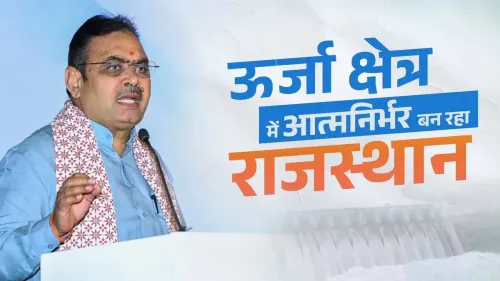
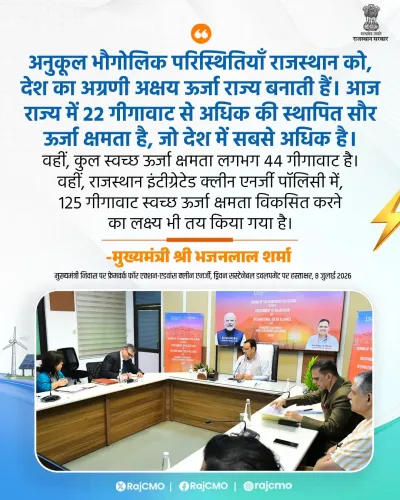
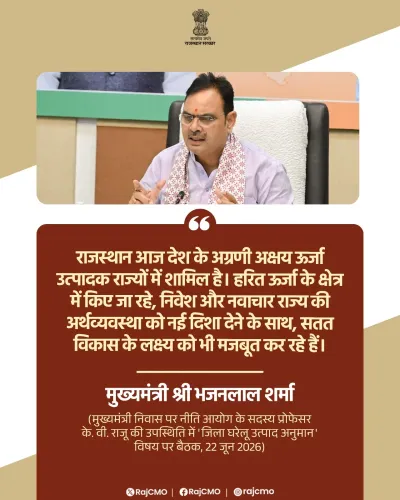
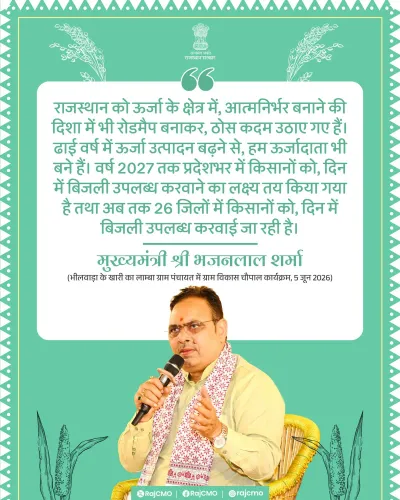
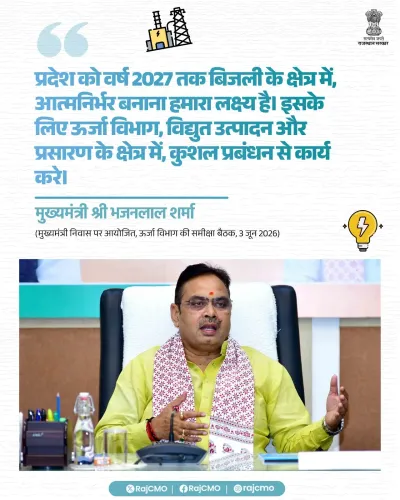
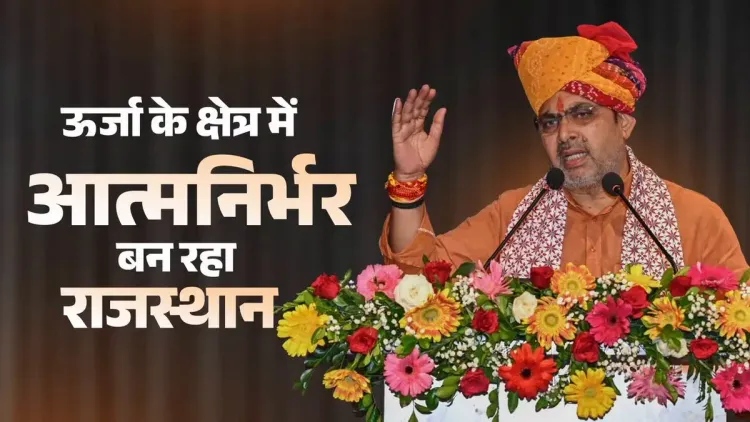
Rajasthan Chief Minister Bhajan Lal Sharma declared on X that self-reliance in electricity is giving new momentum to the state's development, reaffirming his government's commitment to meeting energy needs across all sectors and building on Rajasthan's renewable energy expansion.
Key Takeaways
Chief Minister Bhajan Lal Sharma posted on 17 October 2026 that electricity self-reliance is accelerating Rajasthan's development.
Sharma's government, in office since December 2023 , has made energy sufficiency a central pillar of its development agenda.
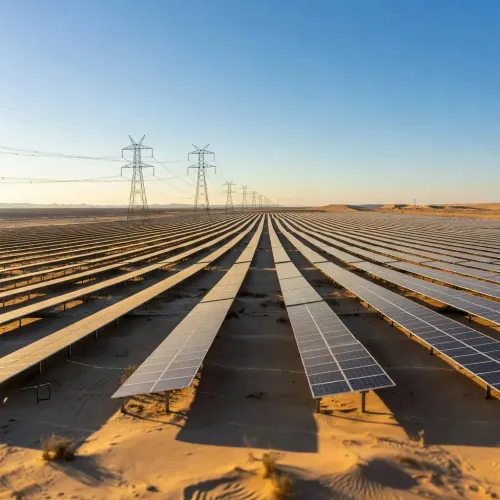
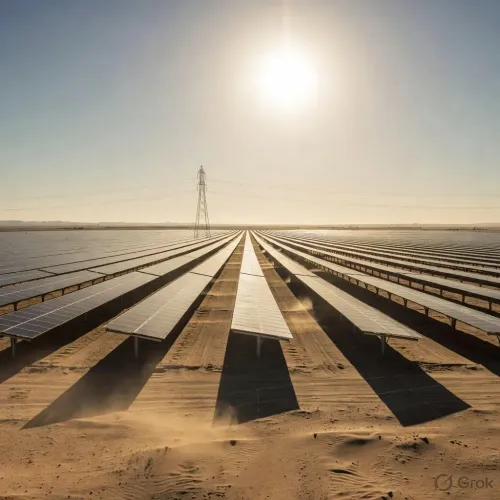
Rajasthan has been expanding solar and wind generation capacity since the early 2010s , with landmarks like the Bhadla Solar Park in Jodhpur district .
Key beneficiary sectors include agriculture, industry, and domestic power consumers across the state.
The government signalled continued focus on new generation projects and transmission infrastructure in line with the state's power self-sufficiency goal.
Energy independence is no longer a distant goal for Rajasthan — it is, according to Chief Minister Bhajan Lal Sharma, already reshaping the state's development trajectory. On Saturday, 17 October 2026, Sharma took to X to declare that self-reliance in electricity is giving fresh momentum to Rajasthan's growth, and that his government stands committed to meeting the energy needs of every sector.
In his post, Sharma wrote: 'Bijli ke kshetra mein atmanirbharta Rajasthan ke vikas ko nayi gati de rahi hai' — 'Self-reliance in the electricity sector is giving new momentum to Rajasthan's development.' He added that his government is 'committed to fulfilling the energy needs of every sector and accelerating the state's progress.'
Rajasthan's Renewable Push: From Bhadla to Broader Ambition
Rajasthan's bid for power self-sufficiency did not begin overnight. The state has pursued expansion of solar and wind generation capacity since the early 2010s, anchored by large solar parks including the Bhadla Solar Park in Jodhpur district — one of the largest in the world. That foundation of renewable infrastructure has given successive governments the platform to talk credibly about energy independence.
The Sharma government, which took office in December 2023, has positioned this renewable momentum as central to its broader development agenda — covering industries, the agricultural sector, and domestic power consumers across the state's vast geography.
Why Every Sector Has a Stake in Rajasthan's Grid
Rajasthan's energy story is not just about megawatts on paper. Agriculture, which depends heavily on reliable pump-set power, and industry, which requires uninterrupted supply to remain competitive, are the two sectors where electricity shortfalls hit hardest and fastest. A state that can generate enough to meet its own demand — without depending on costly interstate purchases — frees up fiscal space and reduces vulnerability to grid stress elsewhere in the country.
The broader pattern is clear: Rajasthan has been systematically adding renewable capacity alongside conventional sources to close the gap between peak demand and available supply. Sharma's statement signals that this trajectory is being maintained, and that transmission infrastructure and new generation projects remain on the government's active agenda.
Whether the next milestone is a new solar corridor, an upgraded transmission line, or a revised state energy policy, Rajasthan's grid is being watched as a test case for how India's largest state by area turns sun and wind into lasting economic leverage.
Point of View
Framing energy self-reliance as a BJP governance dividend in a state that has historically struggled with power deficits and farmer discontent over erratic electricity supply. By invoking 'atmanirbharta' — Prime Minister Modi's signature self-reliance vocabulary — at the state level, the CM aligns Rajasthan's energy narrative with the Centre's broader economic identity, a politically useful linkage ahead of any budget or policy cycle. The emphasis on 'every sector' is also a signal to industry and agriculture simultaneously, two constituencies the BJP cannot afford to lose in a state where rural electricity politics can swing elections. Whether the rhetoric translates into measurable capacity additions and tariff stability will be the real test.
NationPress
18 Oct 2026
Frequently Asked Questions
What did Rajasthan CM Bhajan Lal Sharma say about electricity in October 2026?
Sharma stated that self-reliance in the electricity sector is giving new momentum to Rajasthan's development, and that his government is committed to meeting the energy needs of every sector in the state.
What is Rajasthan's renewable energy strategy?
Rajasthan has been expanding solar and wind generation capacity since the early 2010s, with major projects like the Bhadla Solar Park in Jodhpur district, aiming to reduce dependence on external power sources and achieve energy self-sufficiency.
When did Bhajan Lal Sharma become Chief Minister of Rajasthan?
Bhajan Lal Sharma assumed office as Chief Minister of Rajasthan in December 2023 after the BJP's victory in the state assembly elections.
Which sectors benefit from Rajasthan's push for electricity self-reliance?
The key beneficiaries include the agricultural sector, which depends on pump-set power, industries requiring uninterrupted supply, and domestic consumers across the state's vast geography.
What is the Bhadla Solar Park and why is it significant for Rajasthan?
The Bhadla Solar Park in Jodhpur district is one of the largest solar parks in the world and a cornerstone of Rajasthan's renewable energy ambitions, significantly boosting the state's installed solar power capacity.