CM Bhajanlal Calls Cleanliness a Social Duty, Not Just Admin Task
Synopsis
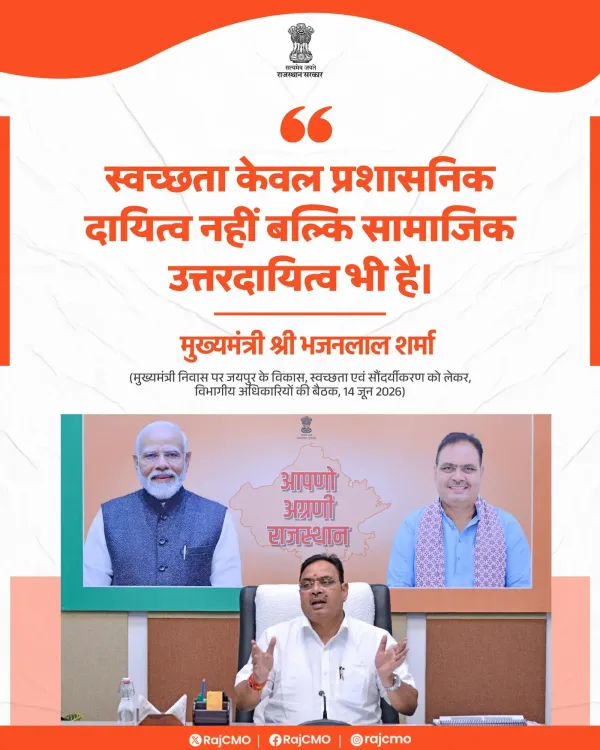
Rajasthan Chief Minister Bhajanlal Sharma's office posted on June 15, 2026, that cleanliness is a social duty of every citizen — not just an administrative function — aligning with the Swachh Bharat Mission's community-ownership approach under the state's 'Our Leading Rajasthan' campaign.
Key Takeaways
The Chief Minister's Office of Rajasthan posted on June 15, 2026 , attributing the message to CM Bhajanlal Sharma .
The message declares that cleanliness is both an administrative and a social responsibility — shifting ownership to citizens.
The post is tagged under #आपणो_अग्रणी_राजस्थान ('Our Leading Rajasthan'), the state government's governance branding campaign.
The framing aligns with the national Swachh Bharat Mission (launched 2014 ), which emphasises behaviour change alongside infrastructure.
Urban local bodies and rural panchayats in Rajasthan are the primary bodies expected to operationalise this message on the ground.
Upcoming Swachh Survekshan rankings will be a key indicator of whether the messaging translates into improved state performance.
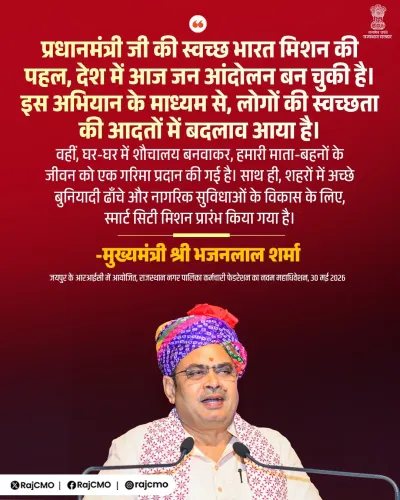
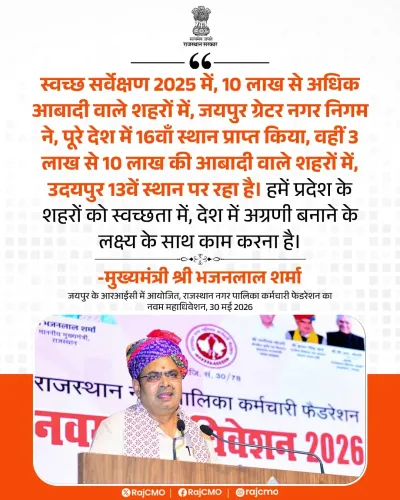
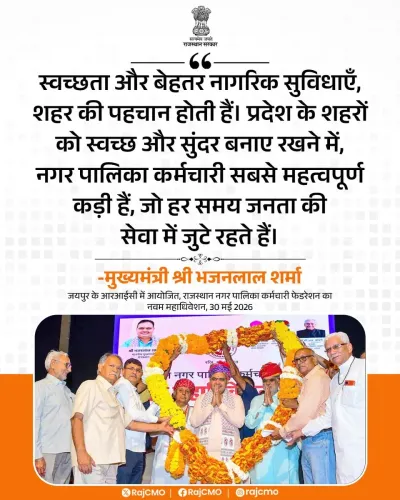
The Chief Minister's Office of Rajasthan on Monday, June 15, 2026, shared a message from Chief Minister Bhajanlal Sharma asserting that cleanliness is not merely an administrative responsibility but a social one — framing sanitation as a collective public obligation under the hashtag #आपणो_अग्रणी_राजस्थान ('Our Leading Rajasthan').
Context
The post, tagged to @BhajanlalBjp, carries a pointed message in Hindi: 'स्वच्छता केवल प्रशासनिक दायित्व नहीं बल्कि सामाजिक उत्तरदायित्व भी है' — 'Cleanliness is not only an administrative duty but also a social responsibility.' The framing deliberately shifts the burden of sanitation from government machinery alone to every citizen. The hashtag links the message to the Rajasthan government's broader branding around the state as a frontrunner in governance and development.
Chief Minister Bhajanlal Sharma has led Rajasthan since December 2023, when the Bharatiya Janata Party returned to power in the state. His administration has consistently aligned with central government priorities, including those under the Swachh Bharat Mission.
Policy Backdrop
The Swachh Bharat Mission, launched nationally in 2014, was designed to eliminate open defecation and modernise waste management across urban and rural India. Beyond infrastructure, the programme has always carried a behaviour-change mandate — precisely the dimension CM Sharma's message underscores. Annual cleanliness rankings under Swachh Survekshan have pushed states and urban local bodies to compete on sanitation outcomes, giving political salience to public messaging of this kind.
Rajasthan's successive governments have emphasised community mobilisation alongside official sanitation drives, reflecting a broader national pattern where sustained cleanliness is seen as requiring public participation rather than enforcement alone. The current administration's messaging continues in that tradition while tying it to the state's own identity campaign.
Stakeholders and Impact
Urban local bodies and rural panchayats across Rajasthan are the primary institutional actors responsible for translating such messaging into on-ground action. For them, a signal from the Chief Minister's Office reinforces the expectation that cleanliness drives must engage residents — not simply deploy sanitation workers or issue fines. Citizen-level awareness campaigns, ward-level competitions, and school outreach programmes typically follow such high-level public statements.
The message also carries implicit accountability: by defining cleanliness as a social responsibility, the administration can mobilise community pressure alongside official enforcement, a combination that has shown results in states that have performed well in Swachh Survekshan rankings.
What's Next
The next round of Swachh Survekshan rankings and any state-level Swachhata Hi Seva activities scheduled later in 2026 will be a key test of how this messaging translates into measurable outcomes for Rajasthan. If the state improves its standing in national cleanliness surveys, the administration is likely to amplify this community-ownership narrative further. The hashtag #आपणो_अग्रणी_राजस्थान signals that the government intends to position Rajasthan as a model state — making sanitation performance a matter of state pride as much as policy compliance.
Point of View
Where high survey scores carry electoral and reputational value. The 'Our Leading Rajasthan' hashtag suggests the administration is building a coherent state-identity narrative around governance delivery, of which sanitation is one visible pillar. Whether the messaging produces measurable rank improvements will determine how much political capital the government can extract from it.
NationPress
14 Sept 2026
Frequently Asked Questions
What did Rajasthan CM Bhajanlal Sharma say about cleanliness?
CM Bhajanlal Sharma stated that cleanliness is not only an administrative duty but also a social responsibility of every citizen, urging public participation in sanitation efforts alongside government action.
What is the Swachh Bharat Mission and how does it relate to Rajasthan?
The Swachh Bharat Mission is a national sanitation programme launched in 2014 to eliminate open defecation and improve waste management. Rajasthan has aligned its state-level cleanliness drives with this mission, focusing on both infrastructure and community behaviour change.
What is #आपणो_अग्रणी_राजस्थान?
'Aapno Agrани Rajasthan' translates to 'Our Leading Rajasthan' and is a campaign hashtag used by the Rajasthan government to brand its governance and development initiatives, positioning the state as a frontrunner among Indian states.
What is Swachh Survekshan and why does it matter for Rajasthan?
Swachh Survekshan is an annual national survey that ranks cities and states on cleanliness and sanitation outcomes. A strong ranking boosts a state government's credibility on governance delivery and is closely watched by urban local bodies.
Who is Bhajanlal Sharma?
Bhajanlal Sharma is the Chief Minister of Rajasthan, leading the state since December 2023 after the Bharatiya Janata Party won the state assembly elections. He is a senior BJP leader and the first person with this name to hold the Rajasthan CM's office.