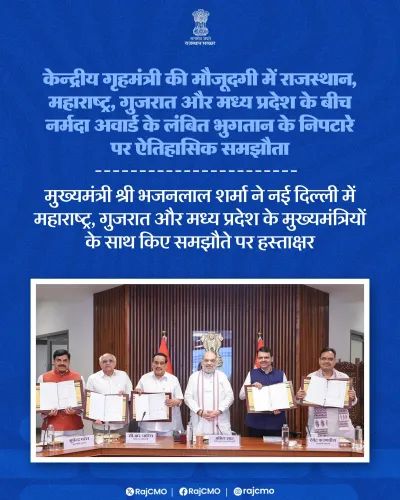
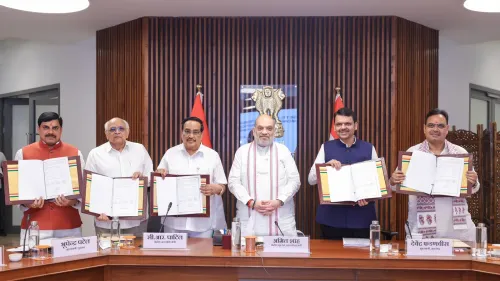
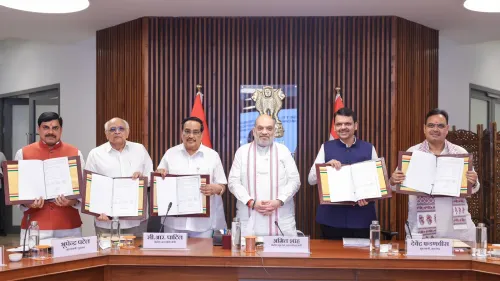
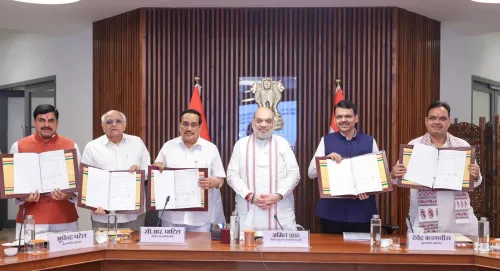
CM Bhajanlal joins 4-state Narmada review chaired by Jal Shakti Minister Patil
Synopsis
The 15th Narmada Control Authority review meeting, chaired by Union Jal Shakti Minister C. R. Patil, brought together Chief Ministers of Rajasthan, Madhya Pradesh, Maharashtra and Gujarat via video conference on 27 October 2026, with CM Bhajanlal Sharma thanking all parties for cooperative engagement.
Key Takeaways
The 15th Narmada Control Authority review meeting was held on 27 October 2026 , chaired by Union Jal Shakti Minister C.
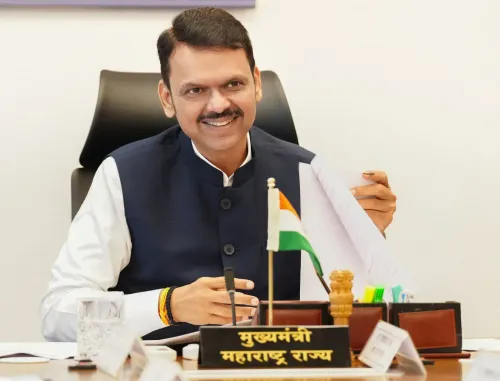
Chief Ministers Bhajanlal Sharma (Rajasthan), Devendra Fadnavis (Maharashtra), Dr.
Mohan Yadav (Madhya Pradesh) and Bhupendra Patel (Gujarat) attended via video conference.
The Narmada Control Authority was established in 1980 to implement the 1979 Narmada Water Disputes Tribunal award allocating river water among four states.
Rajasthan, though not on the Narmada's main course, holds a defined water allocation critical to its arid western districts.
CM Bhajanlal Sharma expressed gratitude for the 'positive cooperation' of the central government and the three other basin states.
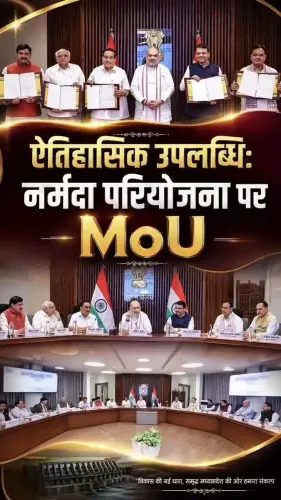
Four chief ministers, one union minister, and decades of inter-state water law converged on Tuesday, 27 October 2026, when the 15th review meeting of the Narmada Control Authority brought together the political leadership of Rajasthan, Madhya Pradesh, Maharashtra and Gujarat — underscoring just how much of western India's agricultural future still runs through a single river's carefully arbitrated flows.
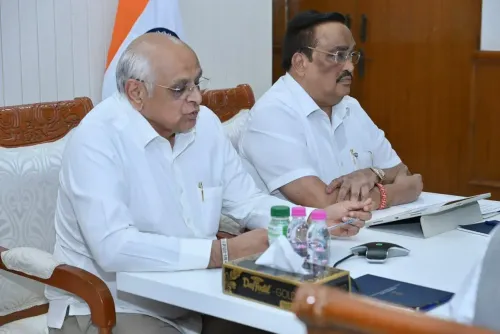
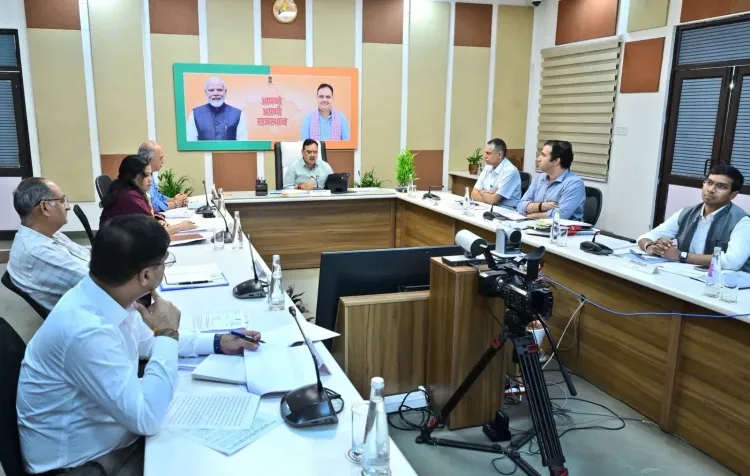
The session was chaired by Union Jal Shakti Minister C. R. Patil and was attended via video conference by Rajasthan Chief Minister Bhajanlal Sharma, Maharashtra Chief Minister Devendra Fadnavis, Madhya Pradesh Chief Minister Dr. Mohan Yadav, and Gujarat Chief Minister Bhupendra Patel, alongside senior officials from all four states. The Chief Minister's Office of Rajasthan confirmed the meeting and noted that CM Bhajanlal Sharma expressed gratitude to the Union minister and his counterparts in Gujarat, Madhya Pradesh and Maharashtra for their 'positive cooperation.'
Why the Narmada Authority still matters in 2026
The Narmada Control Authority (NCA) is not a new body — it was constituted in 1980 to implement the final award of the Narmada Water Disputes Tribunal, which in 1979 allocated defined shares of the river's waters among the four basin states. Madhya Pradesh holds the largest share, with Gujarat, Maharashtra and Rajasthan receiving their respective portions under a binding federal arrangement. The NCA's periodic reviews exist precisely to manage the operational complexities that arise each year: reservoir levels, seasonal release schedules, project monitoring, and environmental safeguards across the entire basin.
Rajasthan occupies a distinctive position in this framework — it is the only basin state that does not lie on the Narmada's main course. Its allocation, delivered through the Narmada Main Canal infrastructure, is a lifeline for arid districts in the state's western reaches, making these review meetings far more than bureaucratic calendar events for Rajasthan's farmers.
Four chief ministers at the table — what it signals
The simultaneous presence of all four basin-state chief ministers at a single NCA review session is a marker of political seriousness. Inter-state river coordination in India is frequently managed at the bureaucratic or ministerial level; when heads of government participate directly, it signals either pressure points requiring political resolution or a deliberate effort to demonstrate unity on water management — or both.
CM Bhajanlal Sharma's explicit expression of thanks to the central minister and the three other state governments points to a cooperative rather than adversarial tenor at the 15th meeting — a contrast to the friction that has historically characterised some inter-state water negotiations in India. Whether this goodwill translates into specific decisions on water releases or project clearances will be the metric to watch in the coming weeks.
Point of View
Whose Narmada allocation underpins irrigation in drought-prone districts, CM Bhajanlal Sharma's cooperative posture signals a strategy of consensus-building within the BJP's multi-state governing bloc. The cordial tenor of the meeting stands in contrast to historical friction over Narmada flows, but the true test will be whether this political goodwill accelerates decisions on seasonal water releases and pending project clearances. India's inter-state river governance architecture, built on tribunal awards and statutory bodies, depends on exactly this kind of periodic high-level reaffirmation to function smoothly.
NationPress
27 Oct 2026
Frequently Asked Questions
What is the Narmada Control Authority and why does it hold review meetings?
The Narmada Control Authority (NCA) is a statutory body set up in 1980 to implement the 1979 Narmada Water Disputes Tribunal award, which allocated the river's waters among Madhya Pradesh, Gujarat, Maharashtra and Rajasthan. It holds periodic review meetings to monitor water allocation, dam operations and environmental compliance across the basin.
What was the 15th Narmada Control Authority meeting about?
The 15th NCA review meeting, held on 27 October 2026, brought together Union Jal Shakti Minister C. R. Patil and all four basin-state chief ministers via video conference to review Narmada basin operations and coordination. Specific agenda outcomes have not been publicly disclosed.
Why does Rajasthan have a share of Narmada water if the river does not flow through it?
The 1979 Narmada Water Disputes Tribunal award assigned Rajasthan a defined share of Narmada waters, delivered through canal infrastructure. This allocation supports irrigation in the state's arid western districts even though the Narmada's main course does not pass through Rajasthan.
Who chaired the 15th Narmada Control Authority review in 2026?
Union Minister of Jal Shakti C. R. Patil chaired the 15th NCA review meeting on 27 October 2026, with the chief ministers of Rajasthan, Madhya Pradesh, Maharashtra and Gujarat attending via video conference.
What did Rajasthan CM Bhajanlal Sharma say at the Narmada review meeting?
CM Bhajanlal Sharma expressed gratitude to Union Jal Shakti Minister C. R. Patil and the chief ministers of Gujarat, Madhya Pradesh and Maharashtra for their positive cooperation at the 15th NCA review meeting.