CM Bhajanlal Launches ₹2,824 Cr Projects, Drought Relief in Barmer
Synopsis
Chief Minister Bhajanlal Sharma inaugurated and laid foundation stones for over 1,000 development works worth more than ₹2,824 crore across eight Jodhpur division districts in Barmer, while announcing emergency water supply extension till December 31, fast-track collector authority for relief works, and fodder depots for drought-hit livestock keepers.
Key Takeaways
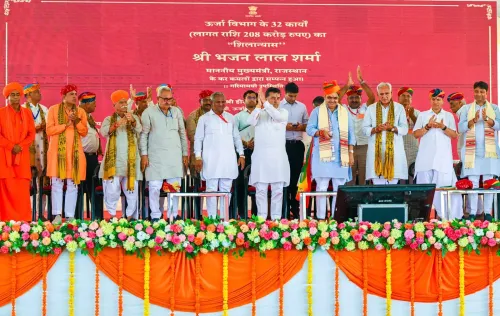
Over 1,000 development projects worth more than ₹2,824 crore inaugurated and foundation-stoned at Bachhdau, Barmer on September 30 .
Projects cover eight districts: Barmer, Balotra, Jaisalmer, Jalore, Jodhpur, Pali, Phalodi, and Sirohi in the Jodhpur division.
Emergency tanker-based drinking water supply extended through December 31 in low-rainfall areas.
District Collectors empowered to approve emergency relief works worth up to ₹1 crore without higher-level clearance.
Fodder depots to be opened in Barmer, Balotra, Jaisalmer and other affected areas to support livestock keepers facing fodder shortage.
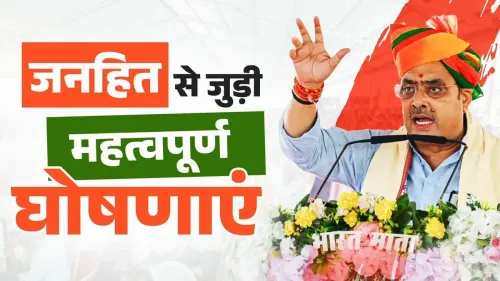
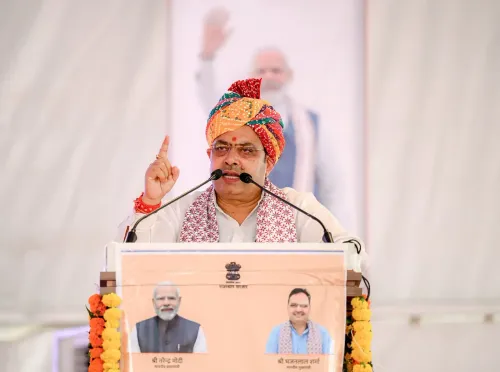
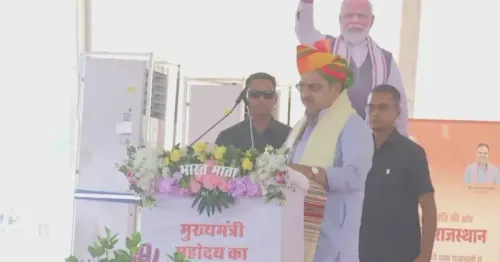
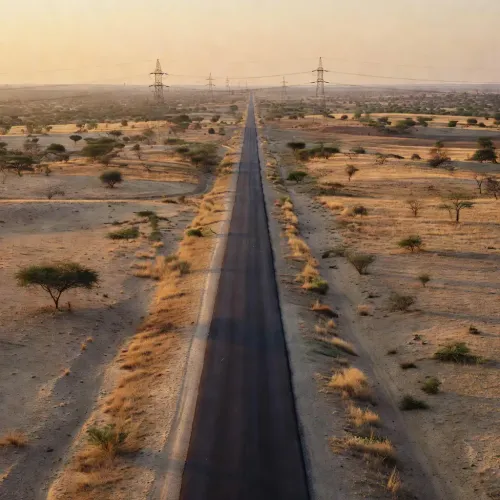
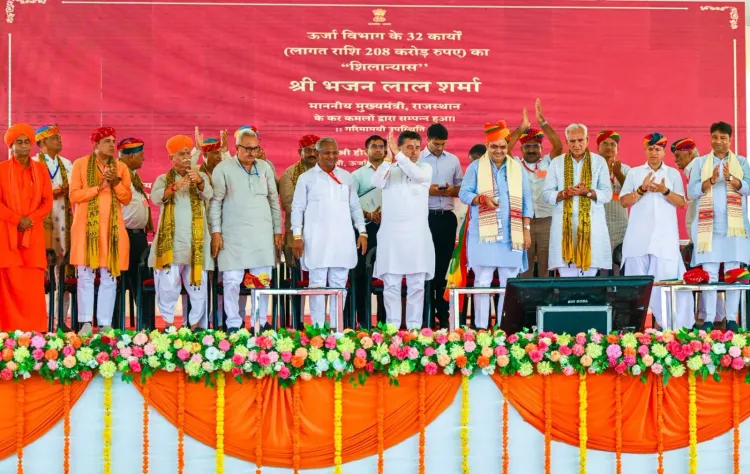
In the heart of the Thar desert, where scanty monsoon rains have left farmers counting losses and livestock keepers scrambling for fodder, Chief Minister Bhajanlal Sharma arrived at Bachhdau in Barmer on Wednesday, September 30 — and arrived with numbers that matter. He inaugurated and laid the foundation stones for over 1,000 development works worth more than ₹2,824 crore across eight districts of the Jodhpur division, while simultaneously announcing a raft of emergency relief measures for communities battered by deficient rainfall.
Eight Districts, One Sweeping Infrastructure Push
The event at Bachhdau covered projects spanning Barmer, Balotra, Jaisalmer, Jalore, Jodhpur, Pali, Phalodi, and Sirohi — an arc of arid and semi-arid districts that form the western spine of Rajasthan. The scale is deliberate: Jodhpur division has long been the state's most infrastructure-starved administrative zone, where road connectivity, water supply, and rural utilities lag behind eastern Rajasthan by a visible margin. Launching over a thousand works in a single ceremony signals a concentrated political and administrative push into this belt.
Emergency Water Supply Extended to December 31
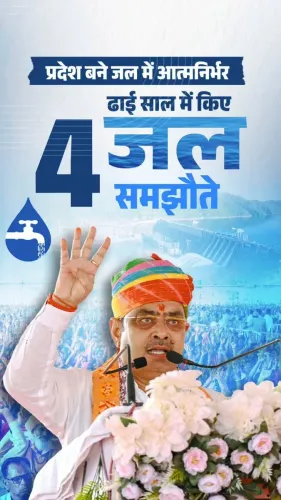
The most immediate relief came on drinking water. CM Sharma announced that the emergency drinking water arrangements — including tanker-based water transport — that were activated during the summer heat will continue uninterrupted until December 31. In a region where groundwater is brackish and surface water nearly absent, tanker supply is not a luxury; for many villages, it is the only potable option. Extending the arrangement through the winter months signals that the administration is not treating this as a seasonal problem.
District Collectors Get ₹1 Crore Fast-Track Authority
To cut through bureaucratic delay in low-rainfall areas, the Chief Minister empowered District Collectors to approve emergency works worth up to ₹1 crore without waiting for higher-level clearance. This administrative decentralisation is a practical tool — it allows on-ground officials to sanction urgent repairs, water-harvesting structures, or access roads without the weeks-long file movement that typically slows relief delivery in rural Rajasthan. Speed, in a drought year, is policy.
Fodder Depots for Barmer, Balotra, Jaisalmer and Beyond
For livestock keepers — a community that is the economic backbone of the Thar belt — CM Sharma announced the opening of fodder depots in Barmer, Balotra, Jaisalmer, and other affected areas. Cattle mortality in drought years cascades into household income loss that takes seasons to recover from. Fodder depots, when operationalised efficiently, act as a price-stabilising and supply-securing buffer. Rajasthan has deployed this mechanism before; the test, as always, will be in the execution and the continuity of supply through the dry winter months.
Rajasthan's western districts sit on a recurring fault line — structurally underserved and climatically vulnerable. The Bhajanlal government's Bachhdau event weaves together long-term infrastructure investment and short-term drought response into a single political moment, under the hashtag #आपणो_अग्रणी_राजस्थान ('Our Leading Rajasthan'). Whether the fodder depots are stocked, the collector-approved works break ground on time, and the tankers keep rolling through December will determine whether Wednesday's announcements become a turning point — or a template.
Point of View
And the BJP government under Bhajanlal Sharma is clearly calibrating its presence there accordingly. The decentralisation of approval authority to District Collectors is the most structurally interesting element: it acknowledges that top-down relief pipelines are too slow for climate-driven emergencies, a lesson Rajasthan has learned — and sometimes forgotten — across multiple drought cycles. Whether this administrative flexibility outlasts the immediate political moment will be the real measure of the policy's ambition.
NationPress
30 Sept 2026
Frequently Asked Questions
What development projects did CM Bhajanlal Sharma launch in Barmer?
CM Bhajanlal Sharma inaugurated and laid the foundation stones for over 1,000 development works worth more than ₹2,824 crore at Bachhdau in Barmer, covering eight districts of the Jodhpur division including Barmer, Balotra, Jaisalmer, Jalore, Jodhpur, Pali, Phalodi, and Sirohi.
What drought relief did the Rajasthan government announce for Barmer?
The government announced extension of emergency tanker-based drinking water supply until December 31, empowerment of District Collectors to approve works up to ₹1 crore, and opening of fodder depots in Barmer, Balotra, Jaisalmer and other affected areas.
Why is Barmer facing a water and fodder crisis?
Barmer and neighbouring western Rajasthan districts received deficient rainfall this season, leading to drinking water shortages and fodder scarcity for livestock — a recurring challenge in the Thar desert belt.
What authority have District Collectors been given for drought relief in Rajasthan?
District Collectors in low-rainfall areas have been empowered to approve emergency works worth up to ₹1 crore without requiring higher-level clearance, enabling faster ground-level relief delivery.
Which districts fall under the Jodhpur division where projects were launched?
The Jodhpur division districts covered by the Bachhdau event are Barmer, Balotra, Jaisalmer, Jalore, Jodhpur, Pali, Phalodi, and Sirohi — all in western Rajasthan.