Giriraj Singh lauds DC Handloom Dr. M. Beena's three-year tenure
Synopsis
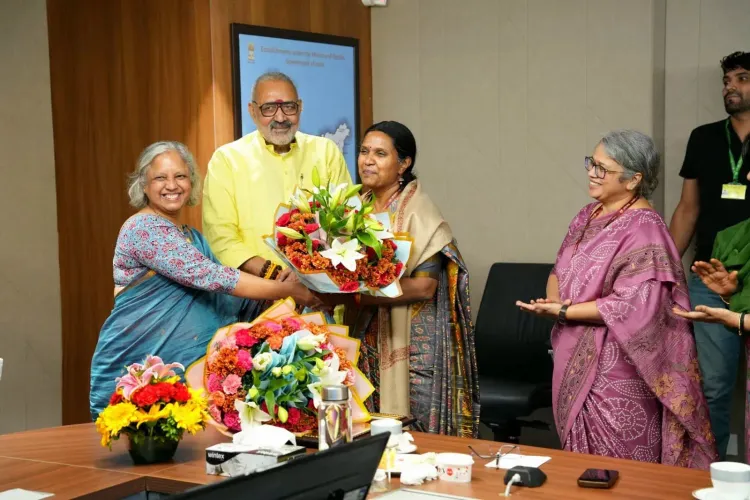
Union Textiles Minister Giriraj Singh publicly acknowledged Dr. M. Beena, IAS, on completing her three-year tenure as Development Commissioner (Handloom), crediting her with giving the sector new direction and advancing weaver welfare through key initiatives.
Key Takeaways
Beena, IAS has completed a three-year tenure as Development Commissioner (Handloom) under the Ministry of Textiles.
Union Textiles Minister Giriraj Singh publicly praised her contribution to handloom sector development and weaver welfare.
The DC Handloom office is the apex administrative body for handloom policy implementation and welfare scheme delivery in India.
Singh noted that her efforts gave the handloom sector 'a new direction' and advanced its 'rich heritage' through multiple initiatives.
The transition raises attention to who will be appointed as the next DC Handloom and whether ongoing schemes will maintain momentum.
Three years at the helm of one of India's most tradition-laden offices — and Union Textiles Minister Giriraj Singh wants the record to stand. On Wednesday, 30 September 2026, the minister took to X to formally acknowledge the outgoing Development Commissioner (Handloom), Dr. M. Beena, IAS, as she concluded her tenure and moved on to fresh responsibilities.
In his post, Minister Singh wrote: 'पिछले तीन वर्षों में DC Handloom के पद पर डॉ. एम. बीना जी, IAS ने हथकरघा क्षेत्र के विकास और बुनकरों के हित में उल्लेखनीय कार्य किए।' — 'Over the past three years as DC Handloom, Dr. M. Beena, IAS, did remarkable work for the development of the handloom sector and the welfare of weavers.' He added that her efforts gave the sector 'a new direction' and that her commitment to preserving its 'rich heritage' through 'many important initiatives' would always be remembered. He closed with warm wishes for her upcoming responsibilities.
The office Dr. Beena leaves behind
The Development Commissioner (Handloom) sits at the apex of the Ministry of Textiles' administrative machinery for the sector — responsible for policy implementation, weaver welfare schemes, market access programmes, and the promotion of India's handloom heritage. The role is pivotal: India's handloom industry is one of the largest in the world, employing millions of artisans, and its health is directly tied to decisions made from this desk. A three-year tenure in the post is a full policy cycle — enough time to shape, launch, and begin measuring the impact of major initiatives.
What the transition signals for handloom policy
Bureaucratic transitions at this level are routine, but they are rarely inconsequential. Every change in the DC Handloom's chair prompts a quiet reassessment of ongoing schemes, pending reviews, and the pace of welfare disbursements to weavers on the ground. The Ministry of Textiles has, across successive governments, maintained a consistent policy emphasis on preserving handloom traditions — through direct-benefit transfers, cluster development, and heritage promotion. The question now is who steps into the role next, and whether the momentum built during Dr. Beena's three-year run carries forward without a gap.
For India's weaving communities — from the silk weavers of Varanasi to the cotton clusters of Andhra Pradesh — continuity at the top of the DC Handloom office is not an administrative footnote. It is a signal about whether the state's attention to their livelihoods holds.
Point of View
Where continuity of administrative focus directly affects millions of artisan livelihoods, such acknowledgements also serve as a soft pressure on the incoming incumbent to maintain the pace. The BJP government has consistently positioned handloom as a cultural-heritage asset alongside an economic one, and Singh's framing — emphasising 'rich heritage' and 'new direction' together — fits squarely within that political narrative.
NationPress
30 Sept 2026
Frequently Asked Questions
Who is Dr. M. Beena IAS?
Dr. M. Beena is an IAS officer who served as Development Commissioner (Handloom) under India's Ministry of Textiles for three years, overseeing sector development and weaver welfare programmes.
What does the Development Commissioner Handloom do?
The Development Commissioner (Handloom) heads the Ministry of Textiles' administrative office responsible for implementing handloom policy, running weaver welfare schemes, enabling market access, and promoting India's handloom heritage.
Why did Giriraj Singh post about Dr. M. Beena?
Union Textiles Minister Giriraj Singh posted a tribute on X to acknowledge Dr. M. Beena's completion of her three-year tenure as DC Handloom and to wish her well in her next assignment.
What happens after the DC Handloom changes?
When the DC Handloom post changes hands, the Ministry of Textiles typically reviews ongoing welfare schemes and initiatives; the appointment of a successor is expected to be announced by the government.
How important is the DC Handloom post for Indian weavers?
The DC Handloom is the senior-most official directly responsible for weaver welfare schemes and handloom policy, making the role critical for millions of artisans across India's handloom clusters.