CM Bhajanlal Directs Monitored Clearance of Legacy Waste in Rajasthan Towns
Synopsis
Chief Minister Bhajanlal Sharma's office has directed that legacy waste dumps in Rajasthan's cities and towns be cleared through active monitoring, freeing residents from accumulated garbage while enabling the rollout of waste-processing plants under the Swachh Bharat Mission-Urban 2.0 framework.
Key Takeaways
The Chief Minister's Office of Rajasthan issued a directive on 20 June 2026 for monitored disposal of legacy waste dumps across state cities and towns.
Chief Minister Bhajanlal Sharma has been in office since December 2023 and has been pushing urban local bodies on sanitation governance.
The directive aligns with Swachh Bharat Mission-Urban 2.0 , which set a 2025-26 deadline for legacy waste remediation and processing plant establishment.
Clearance of legacy dumps is a prerequisite for commissioning waste-processing plants and unlocking central performance-linked funding under SBM-U 2.0.
Urban residents ( aamjan ) and municipal corporations in cities such as Jaipur , Jodhpur , and Kota are the primary stakeholders.
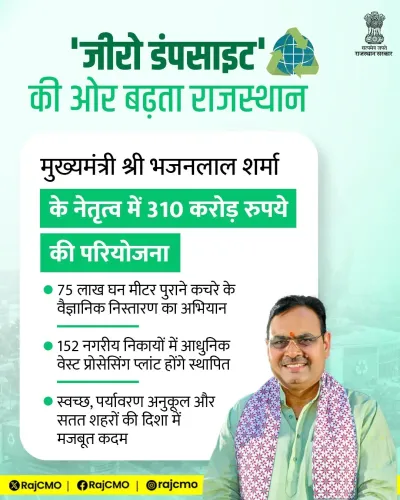
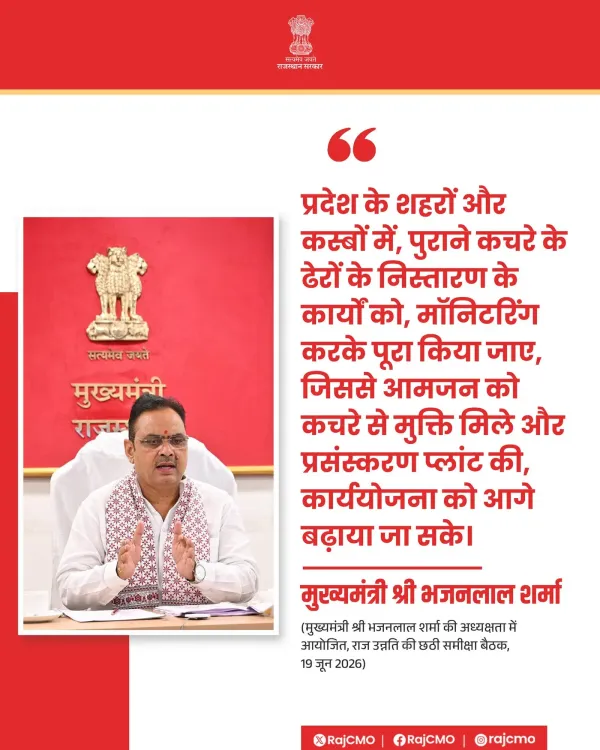
The Chief Minister's Office of Rajasthan, on behalf of Chief Minister Bhajanlal Sharma, on Saturday, 20 June 2026, issued a directive calling for monitored disposal of legacy waste dumps across cities and towns in the state, with the twin goals of freeing residents from the burden of accumulated garbage and accelerating the rollout of waste-processing plants.
The post, shared under the hashtag #आपणो_अग्रणी_राजस्थान ('Our Leading Rajasthan'), states: 'In the cities and towns of the state, the disposal of old garbage heaps should be completed through monitoring, so that the common people are freed from waste and the action plan for processing plants can be moved forward.'
Context
Rajasthan's urban landscape, like many Indian states, carries the burden of decades-old legacy waste dumps — large, unscientific landfills that have accumulated in and around municipal limits. These sites pose public health risks, contaminate groundwater, and occupy valuable urban land. Chief Minister Bhajanlal Sharma, who took office in December 2023 following the state assembly elections, has been pushing urban local bodies to tackle this backlog as part of a broader urban governance agenda.Policy Backdrop
The directive fits squarely within the framework of Swachh Bharat Mission-Urban 2.0 (SBM-U 2.0), approved by the central government in 2021, which set explicit targets for the remediation of legacy waste sites and the establishment of waste-processing infrastructure across Indian cities, with a deadline of 2025-26. The original Swachh Bharat Mission (Urban), launched in October 2014, had focused on achieving open-defecation-free status and initiating scientific waste management. SBM-U 2.0 deepened the mandate by tying central performance-linked funding to measurable progress on legacy dump clearance and plant commissioning. Rajasthan's urban local bodies — including municipal corporations in Jaipur, Jodhpur, and Kota — are among the implementing agencies responsible for meeting these benchmarks.Stakeholders and Impact
Urban residents and municipal corporations are the primary stakeholders in this push. For common citizens (aamjan), the clearance of legacy dumps translates directly into cleaner neighbourhoods, reduced vector-borne disease risk, and improved air quality from the elimination of open burning at dump sites. For municipal corporations, completing remediation is a prerequisite for unlocking central government funding tranches under SBM-U 2.0's performance-linked incentive structure. The directive's emphasis on monitoring signals an intent to hold urban local bodies accountable through measurable milestones rather than leaving implementation to discretion. Multiple states across India have issued comparable instructions to their urban bodies as central funding reviews approach.What's Next
The immediate watch-point is whether Rajasthan's urban local bodies translate this directive into time-bound action plans with verifiable progress reports. Commissioning of waste-processing plants — a key SBM-U 2.0 requirement — depends on legacy sites being cleared first, making the sequencing of these two tasks critical. Central government funding releases tied to SBM-U 2.0 performance reviews will serve as an external accountability mechanism. If Rajasthan demonstrates measurable progress, it could strengthen the state's position in future central grant allocations for urban infrastructure, setting a template for other BJP-governed states navigating similar legacy waste challenges.Point of View
The CMO is implicitly acknowledging that ground-level implementation has lagged behind stated targets. The move fits a broader pattern among BJP-governed states of using social media directives to create visible pressure on bureaucratic machinery. The real test will be whether Rajasthan's municipal corporations can convert this political push into measurable site-level progress before the next central funding review cycle.
NationPress
19 Sept 2026
Frequently Asked Questions
What did Rajasthan CM Bhajanlal Sharma order regarding waste management?
CM Bhajanlal Sharma's office directed that old, accumulated garbage dumps in Rajasthan's cities and towns be cleared through active monitoring, and that action plans for waste-processing plants be advanced so residents can be freed from the burden of legacy waste.
What is Swachh Bharat Mission-Urban 2.0 and how does it relate to this directive?
Swachh Bharat Mission-Urban 2.0 is a central government scheme approved in 2021 that requires states to remediate legacy waste dumps and commission waste-processing plants by 2025-26, with central funding linked to performance. Rajasthan's directive is aimed at meeting these targets.
Which cities in Rajasthan are affected by the legacy waste clearance order?
The directive covers all cities and towns across Rajasthan, with major urban local bodies including those in Jaipur, Jodhpur, and Kota among the key implementing agencies.
Why is monitoring of legacy waste disposal important for Rajasthan?
Without active monitoring, legacy dump clearance tends to stall due to logistical and funding challenges. Completing remediation is also a prerequisite for unlocking central government performance-linked grants under SBM-U 2.0.
What is the hashtag #AapnoAgraniRajasthan used for?
The hashtag #आपणो_अग्रणी_राजस्थान , meaning 'Our Leading Rajasthan', is used by the Rajasthan CMO to brand governance initiatives and policy communications under Chief Minister Bhajanlal Sharma's administration.