CM Bhajanlal Sharma Targets Zero Dumpsites Across Rajasthan
Synopsis
Rajasthan's CMO announced a Rs 310-crore project under CM Bhajanlal Sharma to scientifically clear 75 lakh cubic metres of legacy waste and build modern processing plants across 152 urban local bodies, advancing the state's Zero Dumpsite goal under Swachh Bharat Mission-Urban 2.0.
Key Takeaways
The Rajasthan government is executing a project worth over Rs 310 crore targeting legacy waste across 152 urban local bodies .
Approximately 75 lakh cubic metres of legacy waste is to be scientifically remediated under the initiative.
Modern waste processing plants are being established alongside legacy dumpsite clearance.
The project is aligned with Swachh Bharat Mission-Urban 2.0 , the central scheme targeting zero dumpsites by 2025-26.
Chief Minister Bhajanlal Sharma , who took office in December 2023, has positioned urban sanitation as a priority.
Work is stated to be already under way, with no specific completion dates announced for individual plants.
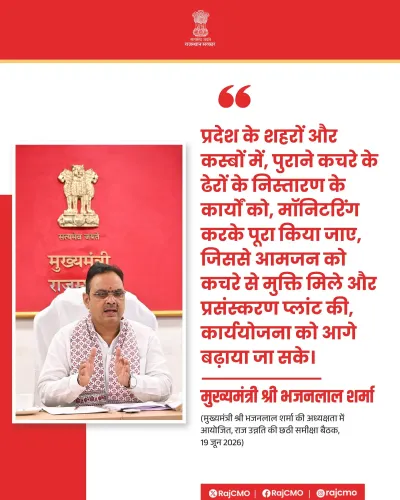
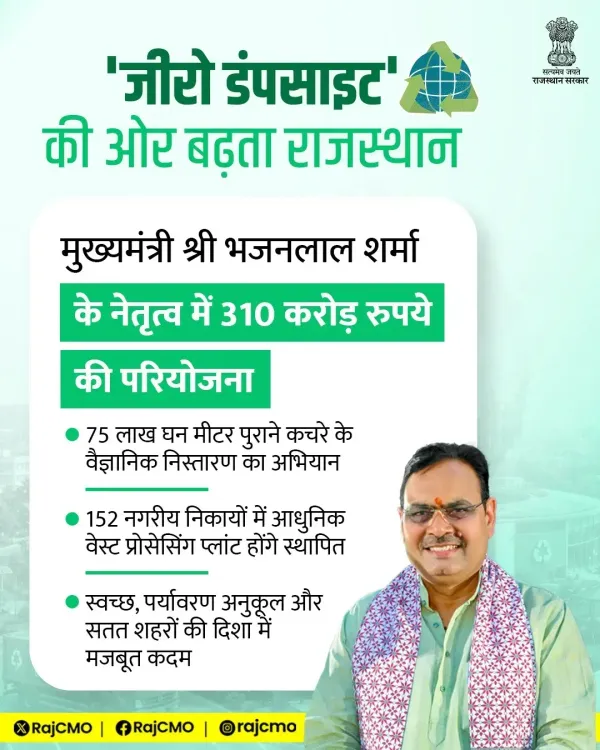
The Chief Minister's Office of Rajasthan announced on Sunday, 13 July 2026 that the state government, under Chief Minister Bhajanlal Sharma, is executing a project worth over Rs 310 crore to scientifically remediate legacy waste and establish modern waste processing plants across 152 urban local bodies in the state.
The post states: '152 ngariya nikayo mein lagbhag 75 lakh ghann metre legacy waste ke vaigyanik nistaran evam aadhunik waste processing plant sthapit karne ke liye, 310 crore rupaye se adhik ki pariyojana par karya jari hai' — meaning work is under way on a project exceeding Rs 310 crore to scientifically dispose of approximately 75 lakh cubic metres of legacy waste across 152 municipal bodies and to set up modern waste processing plants.
Context
The announcement is part of the state's declared 'Zero Dumpsite' goal, aimed at eliminating open legacy dumpsites from urban areas across Rajasthan. Legacy waste refers to decades-old accumulations at existing dumpsites that have not been processed or scientifically capped, posing environmental and public-health hazards to surrounding communities. The scale of the undertaking — 75 lakh cubic metres of waste across 152 urban local bodies — reflects the depth of the challenge that municipal bodies in the state have inherited.Policy Backdrop
The project is positioned as a direct contribution to Swachh Bharat Mission-Urban 2.0 (SBM-U 2.0), the central government's second phase of its national urban sanitation programme, approved in 2021. SBM-U 2.0 set a national target of eliminating legacy dumpsites and achieving 100 per cent scientific processing of fresh municipal solid waste by 2025-26. The original Swachh Bharat Mission was launched in 2014 with a focus on improving urban sanitation and reducing open defecation, with waste management added as a core pillar in subsequent years. Rajasthan's Rs 310-crore initiative aligns state expenditure with centrally defined outcomes, a model seen across multiple Indian states that have mobilised funds under SBM-U 2.0 to build bioremediation facilities, waste-to-energy plants, and engineered sanitary landfills.Stakeholders and Impact
Urban residents across Rajasthan's 152 municipalities stand to benefit most directly. Open dumpsites generate leachate that contaminates groundwater, emit greenhouse gases, and create persistent public-health risks for communities living nearby. Modern waste processing plants are intended to convert incoming municipal solid waste into compost, refuse-derived fuel, or inert material, reducing the volume sent to landfills. Urban local bodies (ULBs) — the 152 municipal councils and nagar panchayats — are the implementing agencies responsible for day-to-day execution, including land identification, contractor management, and waste segregation at source. The CMO's statement frames the initiative as advancing 'clean, environment-friendly and sustainable urban development', linking it to both sanitation and broader climate-resilience goals.What's Next
The CMO's post indicates that work is already under way rather than merely planned, suggesting contracts or tenders are at an active stage. Completion timelines for individual plants across the 152 ULBs have not been specified in the announcement. State and central government periodic progress reports under SBM-U 2.0 will be key indicators of how quickly the 75 lakh cubic metres of legacy waste is processed and how many sites achieve certified 'zero dumpsite' status. If Rajasthan meets its targets, the state could serve as a benchmark for other large states still in early stages of legacy waste remediation under the same national mission.Point of View
But one where execution has lagged across most states. By framing the initiative under the 'Zero Dumpsite' banner and tying it to 152 ULBs simultaneously, the Bhajanlal Sharma government is signalling scale and political will ahead of what are likely to be nationally watched cleanliness rankings. The move also fits a broader pattern in which BJP-governed states have sought to demonstrate alignment with centrally sponsored sanitation targets as a governance credential. Whether the ambition translates into verified dumpsite closures will depend on ULB capacity, waste segregation at source, and sustained budget release — all historically weak links in India's urban waste chain.
NationPress
11 Oct 2026
Frequently Asked Questions
What is Rajasthan's Zero Dumpsite project?
Rajasthan's Zero Dumpsite project is a state government initiative under Chief Minister Bhajanlal Sharma to scientifically remediate approximately 75 lakh cubic metres of legacy waste and establish modern waste processing plants across 152 urban local bodies, at a project cost of over Rs 310 crore.
What is Swachh Bharat Mission-Urban 2.0?
Swachh Bharat Mission-Urban 2.0 is the second phase of India's national urban sanitation programme, approved by the central government in 2021, with targets including 100 per cent scientific solid waste processing and elimination of all legacy dumpsites by 2025-26.
How many urban bodies are covered under Rajasthan's waste project?
A total of 152 urban local bodies across Rajasthan are covered under the project, which involves both legacy waste remediation and the setting up of new waste processing plants.
How much is Rajasthan spending on legacy waste management?
The Rajasthan government has announced a project worth over Rs 310 crore for legacy waste remediation and modern waste processing plant installation across its 152 municipal bodies.
What is legacy waste and why does it matter?
Legacy waste refers to decades-old accumulated solid waste at existing dumpsites that has not been scientifically processed or capped. It poses risks of groundwater contamination, greenhouse gas emissions, and public-health hazards for nearby communities.