CM Bhajanlal Directs Rajasthan Camps to Become Relief Drives
Synopsis
The Chief Minister's Office of Rajasthan on 15 June 2026 posted CM Bhajanlal Sharma's directive to turn rural and urban service camps into a mass campaign for relief, service, and solutions — framing grassroots outreach as a defining mission of his administration under the 'Aapno Agrani Rajasthan' banner.
Key Takeaways
The Chief Minister's Office of Rajasthan posted the directive on 15 June 2026 via its official X account.
CM Bhajanlal Sharma called for rural and urban shivirs to be converted into a 'maha-abhiyan' of service and solutions for common citizens.
The campaign targets both rural and urban populations across Rajasthan, broadening the traditional scope of camp-based outreach.
The directive aligns with the BJP government's 'seva' and 'samadhan' governance framework since taking office in December 2023 .
Existing platforms such as Jan Soochna and e-Mitra are expected to provide digital support for camp-based enrolment and verification.
District-level rollout, participation rates, and grievance resolution data will be key indicators of the campaign's effectiveness.
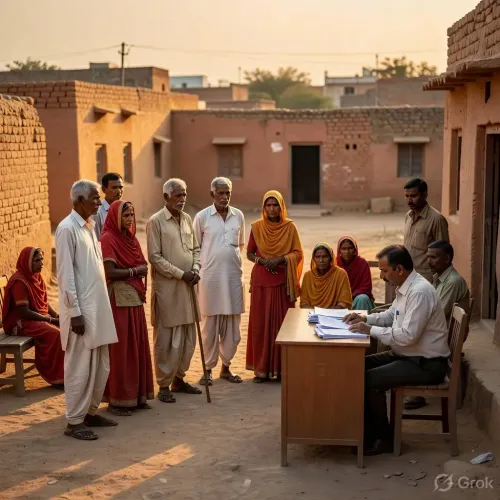
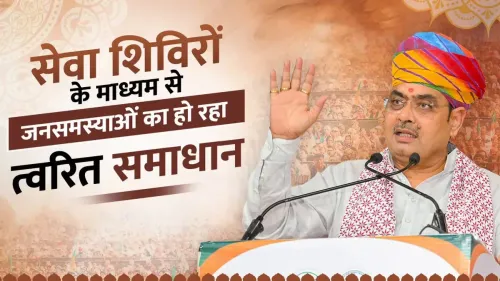
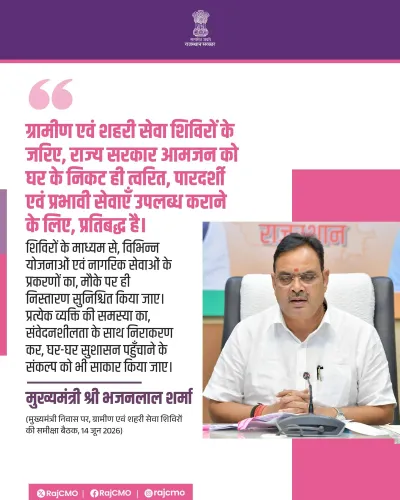
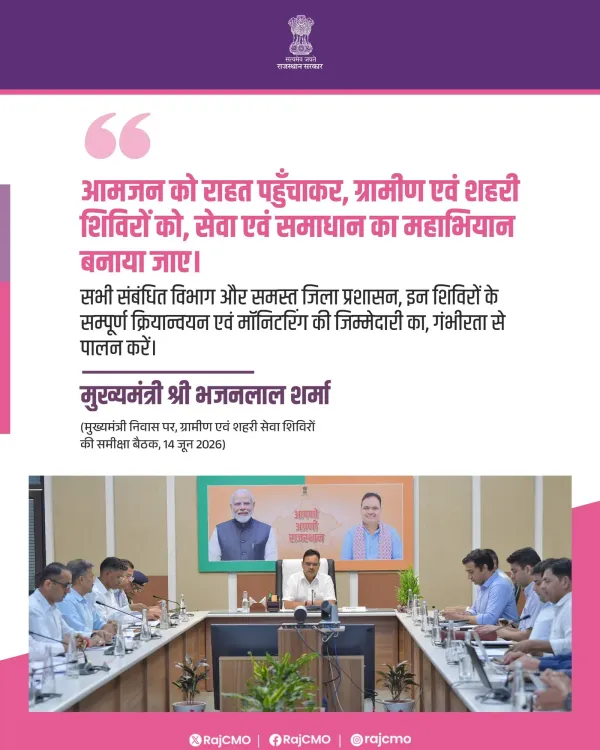
The Chief Minister's Office of Rajasthan, posting from its official X account on Monday, 15 June 2026, relayed a directive from Chief Minister Bhajanlal Sharma calling for rural and urban service camps to be transformed into a 'maha-abhiyan' — a grand campaign — for delivering relief, services, and solutions directly to common citizens.
The post, carrying the hashtag #आपणो_अग्रणी_राजस्थान ('Our Pioneering Rajasthan'), quoted CM Sharma's instruction: 'आमजन को राहत पहुँचाकर, ग्रामीण एवं शहरी शिविरों को सेवा एवं समाधान का महाभियान बनाया जाए' — 'By reaching relief to the common people, rural and urban camps should be made into a grand campaign of service and solutions.'
Context
The directive underscores the Bhajanlal Sharma government's continued push to make grassroots service delivery a defining feature of its administration, which took office in December 2023 after the BJP's victory in the Rajasthan assembly elections. The instruction specifically names both rural and urban populations, signalling that the campaign is intended to have state-wide reach across Rajasthan's diverse geography — from desert districts in the west to tribal belts in the south. The framing of shivirs (camps) as a 'maha-abhiyan' elevates what has traditionally been a periodic administrative exercise into a sustained, mission-mode initiative. The language of 'seva' (service) and 'samadhan' (solution) mirrors the BJP's broader governance vocabulary, which the party has used consistently across its state administrations.Policy Backdrop
Rajasthan has a long institutional history with camp-based service delivery. The Rajasthan Public Service Guarantee Act, 2011, established time-bound delivery of government services and created structured grievance redressal mechanisms that successive governments have built upon. The camp format — bringing officials directly to citizens rather than requiring citizens to travel to offices — has been used across party lines to distribute certificates, resolve land records disputes, enrol beneficiaries in welfare schemes, and address local complaints. Since December 2023, the BJP government has launched multiple outreach initiatives focused on scheme delivery and grievance resolution at the block and panchayat level. Platforms such as Jan Soochna and the e-Mitra network form the digital backbone that such physical camps can complement, allowing on-the-spot enrolment and verification.Stakeholders and Impact
The primary beneficiaries of the directed campaign are Rajasthan's common citizens — particularly rural residents who face barriers of distance and documentation in accessing government schemes. Urban populations, often overlooked in camp-based outreach, are explicitly included in this directive, suggesting an intent to address service gaps in towns and cities as well. For district and block-level officials, the instruction from the Chief Minister's Office translates into an administrative mandate to organise, staff, and report on these camps. Civil society organisations and elected local-body representatives are likely to play a facilitation role in mobilising citizens and surfacing localised grievances.What's Next
Attention will now shift to the district-level rollout of these camps — specifically, which departments participate, how grievance resolution statistics are tracked, and whether outcomes are integrated into existing digital portals. The hashtag #आपणो_अग्रणी_राजस्थान suggests the campaign is being positioned as part of a broader state-branding effort under CM Sharma's administration. The scale and regularity of the camps will determine whether this directive translates into measurable relief for citizens or remains an aspirational communication.Point of View
As urban grievance redressal has historically been the weaker link in Rajasthan's camp ecosystem. The 'Aapno Agrani Rajasthan' framing ties individual directives to a state-identity narrative, a pattern common among BJP chief ministers seeking to brand their tenure with a distinctive regional slogan. Whether the maha-abhiyan produces measurable outcomes will depend on bureaucratic follow-through — the gap between CMO directives and district-level execution has historically been Rajasthan's governance Achilles heel.
NationPress
15 Sept 2026
Frequently Asked Questions
What did CM Bhajanlal Sharma say about Rajasthan service camps?
CM Bhajanlal Sharma directed that rural and urban service camps in Rajasthan be transformed into a grand 'maha-abhiyan' — a mass campaign — for delivering relief, services, and solutions directly to common citizens, as posted by the Chief Minister's Office on 15 June 2026.
What is the 'Aapno Agrani Rajasthan' campaign?
'Aapno Agrani Rajasthan' (Our Pioneering Rajasthan) is a branding initiative of the Bhajanlal Sharma-led BJP government in Rajasthan, used as a hashtag and slogan to frame the administration's governance and outreach efforts since December 2023.
What are shivirs in Rajasthan government context?
Shivirs are government-organised camps held at the local level — in villages, panchayats, or urban wards — where officials deliver services, distribute scheme benefits, resolve grievances, and issue documents directly to citizens without requiring them to visit government offices.
What is the Rajasthan Public Service Guarantee Act?
The Rajasthan Public Service Guarantee Act, 2011, established a legal framework for time-bound delivery of government services to citizens and created structured mechanisms for grievance redressal, forming the institutional backbone for initiatives like the current camp campaign.
How does Jan Soochna relate to Rajasthan's service camps?
Jan Soochna is a Rajasthan government transparency portal that provides citizens access to information on government schemes and entitlements. During service camps, it can be used alongside the e-Mitra network to enable on-the-spot digital enrolment and verification of beneficiaries.