CM Bhajanlal Pushes Govt Jobs and Private Hiring for Rajasthan Youth
Synopsis
The Chief Minister's Office of Rajasthan on 18 July 2026 announced that CM Bhajanlal Sharma's government is creating lakhs of private-sector employment opportunities alongside expanded government recruitment, aiming to secure the futures of the state's youth under the 'Our Leading Rajasthan' initiative.
Key Takeaways
The Chief Minister's Office of Rajasthan posted on 18 July 2026 reaffirming a dual-track employment drive for youth.
CM Bhajanlal Sharma has anchored his government's agenda on both public-sector recruitment and private-sector job creation since taking office in December 2023 .
The government claims lakhs of private-sector employment opportunities are being generated, though specific verified figures are yet to be released through official data channels.
The initiative is branded under the hashtag #आपणो_अग्रणी_राजस्थान ('Our Leading Rajasthan'), framing Rajasthan as a development front-runner.
The approach mirrors a broader BJP -governed-state model combining government hiring drives with industrial-policy incentives for private employers.
Budget documents and economic surveys will be key to verifying the scale of actual job creation on the ground.
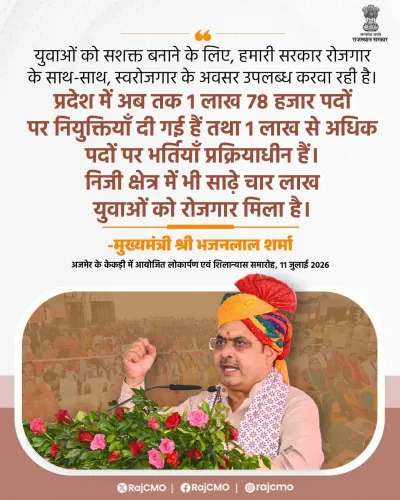
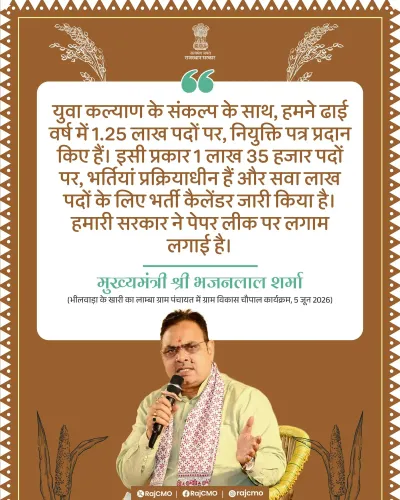
The Chief Minister's Office of Rajasthan on Saturday, 18 July 2026, reaffirmed the state government's commitment to securing the futures of young people by expanding both government recruitment and private-sector employment opportunities running into lakhs across the state.
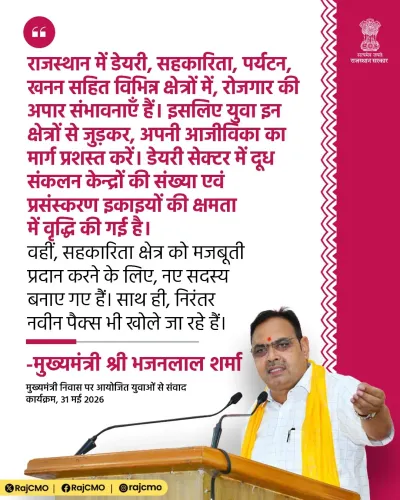
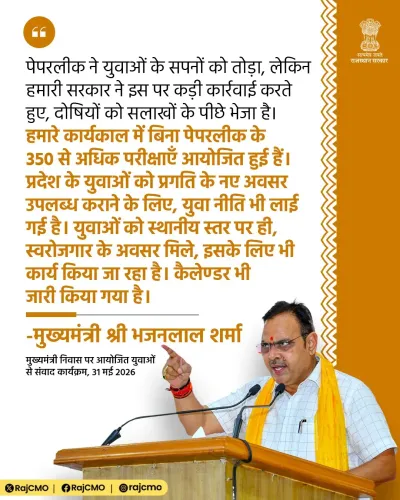
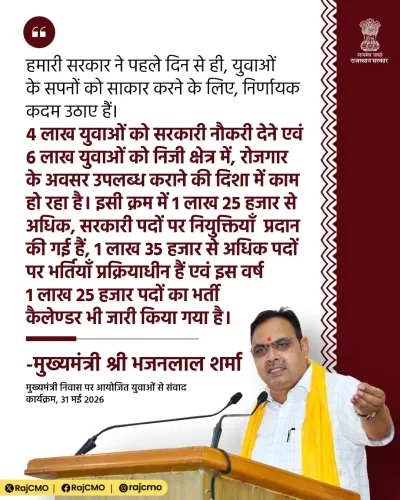
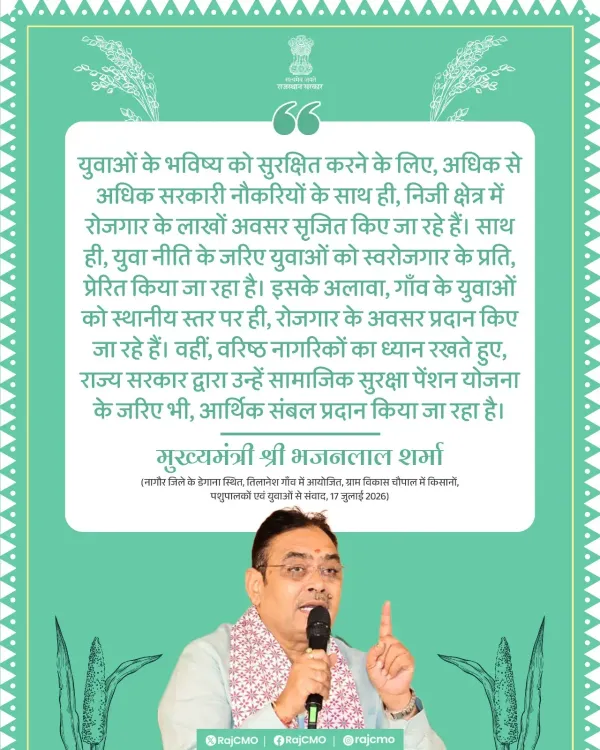
The post, attributed to Chief Minister Bhajanlal Sharma and shared under the hashtag #आपणो_अग्रणी_राजस्थान ('Our Leading Rajasthan'), stated: 'To secure the future of youth, lakhs of employment opportunities are being created in the private sector, along with more and more government jobs.'
Context
Since assuming office in December 2023, Chief Minister Bhajanlal Sharma and his administration have consistently placed youth employment at the centre of the government's agenda. The Rajasthan government has framed job creation as a dual-track effort — accelerating public-sector recruitment drives while simultaneously drawing private investment to generate large-scale employment outside the government apparatus.
The hashtag #आपणो_अग्रणी_राजस्थान ('Our Leading Rajasthan') has been used by the CMO to brand the state's development narrative, signalling an intent to position Rajasthan as a front-runner among Indian states in governance and economic opportunity.
Policy Backdrop
The BJP-led government in Rajasthan came to power on a platform that prominently featured promises of expanded government hiring and an improved investment climate. Following the December 2023 election victory, the administration announced its intention to pursue both public-sector vacancies and private-sector job creation in parallel — a model aligned with the broader national emphasis on ease of doing business and manufacturing-led growth.
Across BJP-governed states, this dual approach — combining recruitment in departments such as police, education, and health with industrial-policy incentives for private employers — has become a defining feature of state-level economic governance. Rajasthan, a large western state with significant rural youth unemployment, represents a critical testing ground for this model.
Stakeholders and Impact
Rajasthan's youth population forms the primary constituency for this policy push. Young job-seekers in the state watch government recruitment calendars closely, while private employers — particularly in sectors such as manufacturing, logistics, and services — are the intended partners in the private-sector employment drive.
The government's messaging is also directed at prospective investors, signalling that Rajasthan is an active partner in workforce absorption. Any tangible increase in formal employment would carry significant social and economic weight in a state where agriculture remains a dominant livelihood but offers limited income security for young entrants to the workforce.
What's Next
Observers will look to upcoming Rajasthan budget documents, economic surveys, and official recruitment notifications for verifiable figures on how many government posts have been filled and what volume of private investment has translated into actual jobs. The credibility of the 'lakhs of opportunities' framing will ultimately rest on data released through these official channels.
As Rajasthan positions itself under the #आपणो_अग्रणी_राजस्थान banner, the government's ability to demonstrate measurable employment outcomes — rather than policy intent alone — will shape public and political assessments of CM Bhajanlal Sharma's tenure ahead of future electoral cycles.
Point of View
Which is a standard feature of ruling-party communications between budget cycles. The dual-track framing — government jobs plus private investment — allows the administration to claim credit on two fronts simultaneously, hedging against the slow pace of public-sector recruitment with the broader, harder-to-measure promise of private-sector growth. For CM Bhajanlal Sharma, maintaining this narrative is essential heading into the mid-term of his tenure, when voters begin to assess delivery against promises. The real test will come when Rajasthan releases verifiable employment data that either substantiates or complicates the 'lakhs of opportunities' claim.
NationPress
18 Jul 2026
Frequently Asked Questions
What is the Rajasthan government doing to create jobs for youth in 2026?
The Rajasthan government under CM Bhajanlal Sharma is pursuing a dual approach: accelerating government-sector recruitment across departments while also working to generate lakhs of employment opportunities in the private sector through investment and industrial-policy measures.
Who is Bhajanlal Sharma?
Bhajanlal Sharma is a BJP politician who has served as the Chief Minister of Rajasthan since December 2023, following the party's victory in the state assembly elections.
What does 'Aapno Agrani Rajasthan' mean?
'Aapno Agrani Rajasthan' is a Hindi-Rajasthani phrase meaning 'Our Leading Rajasthan.' It is used by the Chief Minister's Office as a branding hashtag to promote the state's development and governance initiatives.
How many private sector jobs is Rajasthan creating?
The Chief Minister's Office has stated that lakhs of private-sector employment opportunities are being created, but specific verified figures have not yet been released through official budget documents or economic surveys.
When did the BJP come to power in Rajasthan?
The BJP came to power in Rajasthan in December 2023 after winning the state assembly elections, with Bhajanlal Sharma sworn in as Chief Minister.