Jal Shakti Minister Paatil: Centre Leaves No Stone Unturned for Punjab
Synopsis
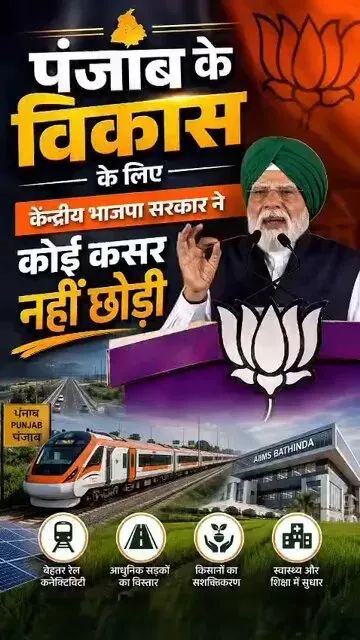
Union Jal Shakti Minister C. R. Paatil on 18 July 2026 quoted PM Modi to assert that the central NDA government is actively executing connectivity and infrastructure projects in Punjab, regardless of the state's non-BJP government, leaving no effort spared for the state's development.
Key Takeaways
Paatil , Union Jal Shakti Minister, on 18 July 2026 shared a statement from PM Narendra Modi on central infrastructure work in Punjab .
The post explicitly acknowledges Punjab does not have a BJP government, yet asserts the Centre is leaving no stone unturned for its development.
The central government's efforts fall under national frameworks including the PM Gati Shakti National Master Plan (launched 2021 ) and Bharatmala Pariyojana (initiated 2015 ).
Under India's constitutional division, the Union government holds primary responsibility for national highways, railways and major waterway projects, enabling execution independent of state political alignment.
The BJP is signalling its central-government delivery record in Punjab , a state it does not control, likely ahead of future electoral cycles.
Union Jal Shakti Minister C. R. Paatil on Saturday, 18 July 2026, shared remarks attributed to Prime Minister Narendra Modi emphasising that the central NDA government is pursuing multiple connectivity and infrastructure projects in Punjab — despite the state being governed by an opposition party — and that no effort is being spared to ensure Punjab's development.
Context
Paatil quoted PM Modi directly, posting: 'आज भारत सरकार कनेक्टिविटी के, इंफ्रास्ट्रक्चर के अनेक ऐसे प्रोजेक्ट पर पंजाब में काम कर रही है' ('Today the Government of India is working on many such connectivity and infrastructure projects in Punjab'). The statement explicitly acknowledges that Punjab does not have a BJP government, yet asserts that the central BJP-led NDA government is leaving no stone unturned — 'कोई कसर बाकी नहीं छोड़ रही' — for the state's development.
The post carries political significance because it frames central infrastructure investment as a pan-India commitment that transcends state-level electoral outcomes, a position that the ruling alliance has consistently projected across opposition-governed states.
Policy Backdrop
The central government's infrastructure push in Punjab sits within two major national frameworks. The PM Gati Shakti National Master Plan, launched in 2021, coordinates road, rail, waterway and logistics projects across all states through an integrated digital platform, ensuring that project pipelines are not disrupted by changes in state-level political alignment.
Separately, the Bharatmala Pariyojana, initiated in 2015, covers development of national highway corridors with stretches passing through Punjab, connecting the state to broader national trade and logistics networks. Under India's constitutional framework, the Union government retains primary responsibility for national highways, railways and major waterway infrastructure, meaning project execution does not require a co-governing arrangement with the state.
Stakeholders and Impact
The primary beneficiaries of improved connectivity infrastructure in Punjab are the state's residents, farmers dependent on efficient supply chains, and industrial and logistics operators. Better road and rail links reduce transportation costs and open markets for Punjab's agricultural produce and manufactured goods.
Infrastructure developers and contractors executing central-scheme projects in the state are also direct stakeholders. The broader pattern — where successive NDA governments have maintained funding flows for highways, railways and irrigation works in non-BJP states — signals a federal approach where Union-funded projects proceed on technical and budgetary timelines rather than political considerations.
What's Next
Observers will watch for the release of project-wise progress reports and fund utilisation statements for Punjab under central schemes, which are expected to feature in disclosures around the next Union Budget. The political messaging embedded in Paatil's post also signals that the BJP intends to highlight its central-government delivery record in Punjab ahead of future electoral cycles in the state.
Point of View
The BJP frames its central-government infrastructure investment as a service to all Indians, not just states it governs — a message designed to blunt the opposition's anti-incumbency narrative in Punjab. The acknowledgement that Punjab has no BJP government is not a concession but a rhetorical device, positioning the Centre as above partisan gatekeeping. This fits a broader NDA pattern of using infrastructure delivery as a political asset in states where the party is out of power, building a pre-election record of visible development. Analysts will note that the effectiveness of this messaging depends on whether specific, completed projects can be cited to voters — something the current post, quoting a general assertion, does not yet establish.
NationPress
18 Jul 2026
Frequently Asked Questions
What infrastructure projects is the central government doing in Punjab?
The central government is executing connectivity and infrastructure projects in Punjab under national frameworks such as the PM Gati Shakti National Master Plan and Bharatmala Pariyojana, though specific project names were not listed in the 18 July 2026 post by C. R. Paatil.
Does Punjab have a BJP government?
No. As explicitly acknowledged in C. R. Paatil's post quoting PM Modi, Punjab does not have a BJP government, but the Centre's NDA government states it is still working for the state's development.
What did C. R. Paatil say about Punjab development?
Paatil shared PM Modi's remarks stating that the Government of India is working on many connectivity and infrastructure projects in Punjab and is leaving no effort spared for the state's development, regardless of the state's political alignment.
What is PM Gati Shakti and does it cover Punjab?
PM Gati Shakti is a national master plan launched in 2021 to coordinate multimodal connectivity and logistics infrastructure across all Indian states, including Punjab, through an integrated digital platform.
Why is the BJP highlighting infrastructure work in Punjab?
By highlighting central-government infrastructure investment in opposition-governed Punjab, the BJP aims to demonstrate its commitment to national development and build a delivery record in a state it does not control, which carries political value ahead of future elections.