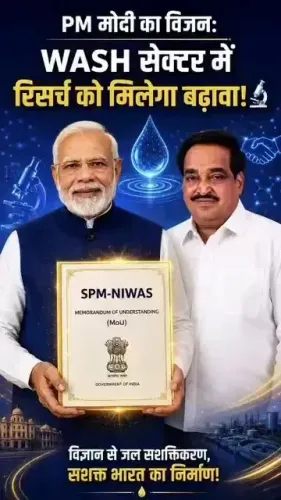
Jal Shakti Minister Paatil highlights ministry R&D push

Synopsis
Union Jal Shakti Minister C. R. Paatil on 1 June 2026 highlighted the ministry's broad R&D programme spanning groundwater management, flood forecasting and river rejuvenation, calling it a 'blueprint' for India's water-secure future under PM Modi's leadership.
Key Takeaways
Union Jal Shakti Minister C.
Paatil publicly highlighted the ministry's R&D mandate on 1 June 2026 .
The ministry's research spans water conservation, groundwater management, flood forecasting, river rejuvenation, water quality and modern water infrastructure.
The Ministry of Jal Shakti was formed in May 2019 by merging two earlier ministries and anchors schemes including Jal Jeevan Mission , Namami Gange and Atal Bhujal Yojana .
The National Hydrology Project (approved 2016 ) underpins flood forecasting and water data modernisation central to the ministry's evidence-based approach.
Minister Paatil framed the research output as a 'blueprint' for a developed, self-reliant India — linking it to the Viksit Bharat 2047 agenda.
Upcoming signals to watch: new R&D allocations in the Union Budget and a possible revision of the National Water Policy .
Union Jal Shakti Minister C. R. Paatil on Monday, 1 June 2026 underscored the Ministry of Jal Shakti's ongoing research and development drive, saying the ministry is working continuously to make India a water-secure nation under the visionary leadership of Prime Minister Narendra Modi.
Context
In a post on X, Minister Paatil outlined the breadth of R&D activity underway at the ministry, covering water resource conservation, groundwater management, flood forecasting, river rejuvenation, water quality, and modern water infrastructure. He wrote: 'यह केवल research नहीं… बल्कि विकसित एवं आत्मनिर्भर भारत के जल भविष्य की मजबूत blueprint है' — 'This is not merely research… but a strong blueprint for the water future of a developed and self-reliant India.'
The minister described the ministry's output as hundreds of research studies, thousands of technical reports and research papers, framing them as the foundation for making India's water sector data-driven, science-backed and future-ready.
Policy Backdrop
The Ministry of Jal Shakti was created in May 2019 by merging the erstwhile Ministry of Water Resources with the Ministry of Drinking Water and Sanitation, consolidating water governance under a single administrative roof. Since its formation, the ministry has anchored several large-scale programmes — including the Jal Jeevan Mission, the Namami Gange river rejuvenation programme, and the Atal Bhujal Yojana groundwater management scheme — each of which relies on data systems and technical research for implementation and monitoring.
The National Hydrology Project, approved in 2016, specifically modernised water data acquisition, flood forecasting and decision-support systems across the country. Together, these programmes have institutionalised an evidence-based approach to water governance that the minister's post now publicly reinforces.
The Namami Gange programme was approved by the Cabinet in 2014 with an initial outlay of Rs 20,000 crore, incorporating research on pollution abatement, river ecology and basin management alongside infrastructure works.
Stakeholders and Impact
The primary beneficiaries of a science-backed water policy are India's rural households, farmers dependent on irrigation, and state water and irrigation departments that translate central research into on-ground planning. The Jal Jeevan Mission, which targeted universal rural tap-water connections, relies on quality-monitoring data and hydrogeological surveys — precisely the kind of outputs the ministry's R&D apparatus generates.
State-level groundwater departments in water-stressed regions benefit from aquifer-mapping studies and recharge models produced under the Atal Bhujal Yojana, while flood-prone communities along major river basins depend on the forecasting models developed under the National Hydrology Project. The minister's framing of this research as a 'blueprint' signals an intent to keep R&D central to policy execution rather than treating it as a peripheral academic exercise.
What's Next
Observers will watch for the next annual outcome report of the National Hydrology Project and any fresh R&D budget allocations in the forthcoming Union Budget, which could indicate how much institutional weight the government assigns to this research agenda. A possible revision of the National Water Policy or new state-level data-sharing frameworks would be a concrete downstream step.
Minister Paatil's public articulation of the ministry's research mandate also arrives in the context of the broader Viksit Bharat 2047 agenda, which treats water security as foundational infrastructure for both economic growth and climate resilience — suggesting that R&D investment in the water sector is unlikely to recede in the near term.
Point of View
The minister ties routine departmental R&D to a high-visibility national vision, lending it political salience beyond technical circles. This also signals to state governments and international climate-finance bodies that India's water sector is building the data infrastructure needed for large-scale, evidence-based interventions. The timing, coming years after the ministry's consolidation in 2019, suggests an effort to demonstrate institutional maturity and readiness for the next phase of water-sector reform.
NationPress
16 Oct 2026
Frequently Asked Questions
What is the Ministry of Jal Shakti and what does it do?
The Ministry of Jal Shakti is India's central ministry for water governance, formed in May 2019 by merging the Ministry of Water Resources and the Ministry of Drinking Water and Sanitation. It oversees schemes such as Jal Jeevan Mission, Namami Gange and Atal Bhujal Yojana, and conducts R&D in flood forecasting, groundwater management and water quality.
What did C. R. Paatil say about water research in India?
Minister C. R. Paatil said the Ministry of Jal Shakti is conducting wide-ranging research and development — covering water conservation, groundwater management, flood forecasting, river rejuvenation and water infrastructure — calling the collective output a 'blueprint' for making India water-secure and self-reliant.
What is the Viksit Bharat 2047 water security agenda?
Viksit Bharat 2047 is the government's broader vision for a developed India by the centenary of independence, in which water security is treated as foundational infrastructure. The Ministry of Jal Shakti's R&D programmes are being aligned with this agenda to make the water sector data-driven and climate-resilient.
What is the National Hydrology Project?
The National Hydrology Project is a centrally approved initiative from 2016 aimed at modernising water data acquisition, flood forecasting and decision-support systems across India. It forms a key technical backbone for the Ministry of Jal Shakti's evidence-based water management approach.
What is Atal Bhujal Yojana?
Atal Bhujal Yojana is a groundwater management scheme launched in 2018 that focuses on community-led planning and data-based aquifer monitoring in water-stressed states, directly benefiting farmers and rural communities dependent on groundwater.