Jal Shakti Minister Paatil Backs Research Push in WASH Sector
Synopsis
Union Jal Shakti Minister C. R. Paatil on 25 May 2026 invoked PM Modi's vision to advance scientific research in the WASH sector, linking science-driven water empowerment to a prosperous India — signalling a new research thrust within the ministry's flagship water and sanitation programmes.
Key Takeaways
Union Jal Shakti Minister C.
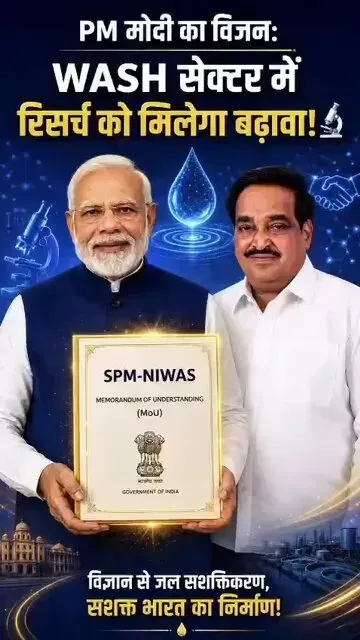
Paatil posted on 25 May 2026 endorsing PM Modi's vision for boosting research in the WASH sector .
The post frames science-driven water empowerment as central to building a prosperous India.
The Jal Shakti Ministry oversees Jal Jeevan Mission (launched 2019) and Swachh Bharat Mission Phase 2 (approved 2020), both integral to India's WASH framework.
The ministry has progressively increased allocations for technology, data systems and applied water research across successive budgets.
Next Union Budget allocations and possible amendments to the Water (Prevention and Control of Pollution) Act are key developments to watch.
Rural households, state water departments and public health researchers are the primary stakeholders of any expanded WASH research agenda.
Union Jal Shakti Minister C. R. Paatil on Monday, 25 May 2026 invoked Prime Minister Narendra Modi's vision for advancing scientific research in the WASH (Water, Sanitation and Hygiene) sector, framing it as a pathway to water empowerment and a prosperous India.
Context
Posting on X, Minister Paatil wrote: 'PM Modi sir ka vision: WASH sector mein research ko milega badhawa!' — translated as 'PM Modi's vision: research in the WASH sector will get a boost!' He paired the announcement with the tagline 'Science-driven water empowerment, building a prosperous India,' signalling a policy emphasis on applied research within the country's water and sanitation framework.
The post accompanied a video, suggesting the minister may have been speaking at or sharing footage from a related event or institutional engagement, though the specific occasion has not been independently detailed in the post itself.
Policy Backdrop
The Jal Shakti Ministry was created by merging the drinking water and sanitation portfolios, giving India an integrated institutional home for SDG-6 (clean water and sanitation) targets. The ministry oversees flagship programmes including the Jal Jeevan Mission, launched in 2019 to provide functional household tap connections to all rural homes, and the Swachh Bharat Mission Phase 2, approved in 2020 to sustain open-defecation-free status and manage greywater at the village level.
The Jal Shakti Abhiyan, running since 2019, has focused on water conservation and aquifer recharge across water-stressed districts. Successive Union Budgets have progressively raised allocations for technology, data systems and applied research in water quality, reuse and climate-resilient infrastructure — a pattern that mirrors the government's science-first approach in sectors such as renewable energy and digital public infrastructure.
Paatil, a senior BJP leader and former Gujarat BJP state president, has championed the ministry's outreach and implementation agenda since taking charge of the Jal Shakti portfolio.
Stakeholders and Impact
Rural households — the primary beneficiaries of Jal Jeevan Mission — stand to gain most directly if research investments translate into better water quality testing, source sustainability and climate-resilient supply systems. State water departments and public health researchers are also key stakeholders, as any dedicated WASH research infrastructure would depend on state-level implementation capacity and academic collaboration.
A stronger research ecosystem in the WASH sector could improve India's ability to meet its commitments under SDG-6 by generating locally relevant data on contamination, water reuse and sanitation outcomes — areas where evidence gaps have historically slowed policy response.
What's Next
Observers will watch the next Union Budget or supplementary grant statements for specific allocations toward dedicated WASH research centres or new institutional mechanisms. A parliamentary discussion on updating the Water (Prevention and Control of Pollution) Act is also a legislative avenue through which science-backed water governance could be formalised. Minister Paatil's post signals that research will be a visible political priority for the ministry in the coming months, even as the precise contours of any new scheme remain to be announced.
Point of View
' the communication follows a well-established BJP pattern of presenting sector-level policy shifts as expressions of top-down political leadership, lending the initiative institutional weight before any formal announcement. The WASH research push, if backed by budget allocations, could meaningfully strengthen India's SDG-6 standing, where data deficits and implementation gaps remain persistent challenges. It also positions the ministry to absorb and direct academic and institutional energy ahead of what is expected to be a high-stakes water-policy legislative cycle.
NationPress
10 Oct 2026
Frequently Asked Questions
What is the WASH sector in India?
WASH stands for Water, Sanitation and Hygiene — a policy framework that covers drinking water supply, sanitation infrastructure and hygiene promotion. In India, the Jal Shakti Ministry coordinates WASH outcomes through schemes like Jal Jeevan Mission and Swachh Bharat Mission.
What did C. R. Paatil say about WASH research?
On 25 May 2026, Minister C. R. Paatil posted on X stating that PM Modi's vision will boost research in the WASH sector, framing science-driven water empowerment as a route to a prosperous India.
What is the Jal Jeevan Mission?
Jal Jeevan Mission is a central government scheme launched in 2019 with the goal of providing functional household tap connections for safe drinking water to all rural households in India, with a later focus on water quality and source sustainability.
How does scientific research help India's water sector?
Applied research in the WASH sector can improve water quality testing, identify contamination sources, develop climate-resilient infrastructure and generate data that helps state governments and policymakers close implementation gaps in drinking water and sanitation programmes.
What should we watch for after Paatil's WASH research announcement?
Key developments to monitor include dedicated WASH research allocations in the next Union Budget or supplementary grants, the possible establishment of new research centres under the Jal Shakti Ministry, and any parliamentary movement on updating the Water (Prevention and Control of Pollution) Act.