CM Bhupendra Patel doubles farmer payout for power line land use
Synopsis
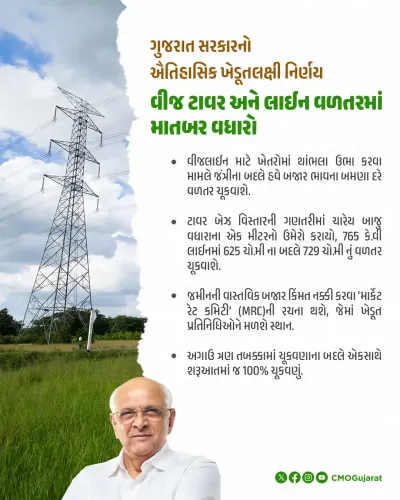
Gujarat CM Bhupendra Patel has announced that farmers will be paid at twice the prevailing market rate — in a single lump sum — for land used to install electricity poles and towers, replacing the old Jantri-rate, three-instalment system. A new Market Rate Committee will determine land values transparently with farmer representation.
Key Takeaways
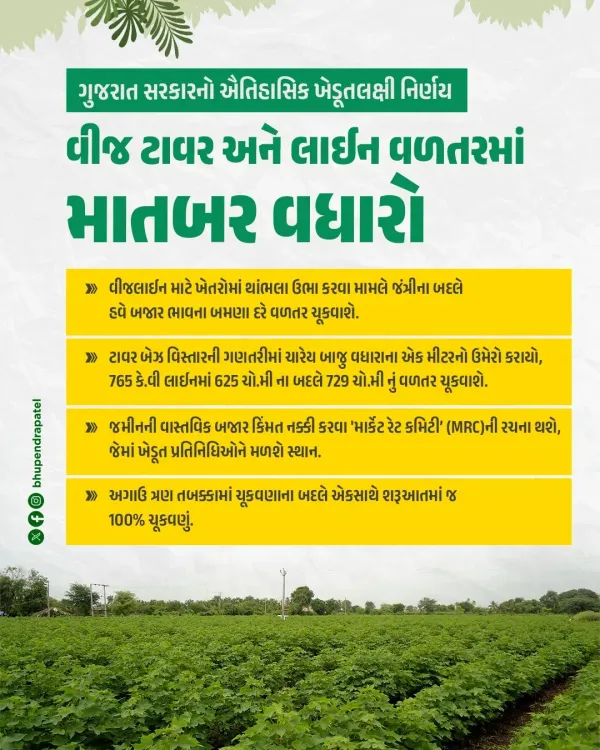
Gujarat will now pay farmers double the market rate for agricultural land used to erect electricity poles and transmission towers.
Compensation will be made in a single 100% upfront payment , replacing the previous three-instalment model.
The earlier benchmark was the Jantri (circle) rate , which typically undervalues land relative to actual transaction prices.
A new Market Rate Committee (MRC) will be formed to determine land values neutrally, including affected farmer representatives and authorised market valuers.
CM Bhupendra Patel said the decision followed direct consultations with farmers, whose chief demand was higher and fairer compensation.
The move could raise land-use costs for power transmission utilities but is expected to reduce farmer disputes over infrastructure projects.
Gujarat Chief Minister Bhupendra Patel announced on Friday, 3 July 2026 that the state government will now compensate farmers at twice the prevailing market rate for land used to erect electricity poles and transmission towers — replacing the earlier practice of paying at Jantri (circle) rates. The decision, shared by the Chief Minister on X, also shifts compensation from a three-instalment model to a single 100% upfront payment.
Context
In his post, CM Patel explained the rationale in Gujarati: 'ખેડૂતોની જમીનની વાસ્તવિક બજાર કિંમત તટસ્થ અને પારદર્શક રીતે નક્કી થઈ શકે' — ('so that the actual market value of farmers' land can be determined in a neutral and transparent manner'). He noted that farmers had long felt the compensation offered for poles erected on their fields was inadequate, and that the government held consultations with them before arriving at this decision.
The Chief Minister described farmers as 'અન્નદાતા' ('providers of food') and called them the 'foundation pillar of a developed Gujarat', pledging that the government 'was, is, and will always stand beside them.'
Policy Backdrop
Until now, compensation for power transmission infrastructure passing through private agricultural land in Gujarat was calculated using Jantri rates — government-notified circle rates that typically lag behind actual transaction prices — and disbursed in three separate instalments. Critics and farmer groups had argued this left landholders under-compensated relative to what the same land would fetch on the open market.
Gujarat has simultaneously pursued aggressive expansion of its electricity transmission network, including renewable energy evacuation lines, making land-use disputes with farmers a recurring friction point. The shift to market-linked compensation mirrors adjustments seen in other Indian states when rolling out high-voltage or grid-scale renewable infrastructure.
Market Rate Committee
To operationalise the new rate, the state government will constitute a Market Rate Committee (MRC). The body will include representatives of affected farmers and their authorised market valuers, alongside government officials, to ensure the land valuation process is independent and transparent.
The MRC's formation and its first operational guidelines will be closely watched, as the committee's methodology will directly determine how much individual farmers receive and could set a precedent for future infrastructure projects across the state.
Stakeholders and Impact
The primary beneficiaries are farmers whose land falls along existing or planned electricity transmission corridors in Gujarat. Power transmission utilities — both state and central — will face higher land-use costs, which could feed into project estimates for new lines.
For farmers, the shift to a single upfront payment eliminates the cash-flow uncertainty that came with staggered disbursements, a change that smaller landholders in particular are expected to welcome. The inclusion of farmer-nominated valuers on the MRC is also a structural departure from purely government-controlled assessments.
What's Next
The immediate milestones will be the formal gazette notification constituting the Market Rate Committee and the publication of its operating guidelines. Pending transmission projects in the state may see revised cost estimates once the new compensation framework is applied. The policy could also influence how other BJP-governed states approach similar land-use compensation revisions as India expands its national grid.
Point of View
The state reduces its exposure to land-acquisition litigation, which has stalled infrastructure projects elsewhere in India. The creation of a farmer-inclusive Market Rate Committee adds procedural legitimacy, though its true independence will depend on how its members are selected and whether its valuations are binding. If the MRC functions as intended, it could become a template for other states seeking to balance infrastructure rollout with agrarian welfare commitments.
NationPress
3 Jul 2026
Frequently Asked Questions
What is the new farmer compensation rule for electricity poles in Gujarat?
Gujarat will now pay farmers at twice the prevailing market rate for land used to erect electricity poles and transmission towers, replacing the earlier Jantri (circle) rate. The full amount will be paid in a single instalment rather than in three phases.
What is the Market Rate Committee (MRC) in Gujarat?
The Market Rate Committee (MRC) is a new state body announced by CM Bhupendra Patel to determine the actual market value of farmland used for power transmission infrastructure. It will include affected farmer representatives and their authorised market valuers to ensure transparent, neutral valuations.
What was the Jantri rate used for farmer compensation in Gujarat?
Jantri rates are government-notified circle rates used to value land for official purposes. They are typically lower than actual market transaction prices, which is why farmers argued they were under-compensated when electricity poles were erected on their land.
Who announced the double market rate compensation for Gujarat farmers?
Gujarat Chief Minister Bhupendra Patel announced this decision on 3 July 2026 via a post on X, stating that the government had consulted farmers before placing their economic interests at the centre of the new policy.
Will Gujarat farmers get the full compensation at once or in instalments?
Under the new policy, farmers will receive 100% of the compensation in a single upfront payment . The previous system disbursed the amount in three separate instalments.