CM Bhupendra Patel Hails CG Semi OSAT Launch in Gujarat

Synopsis
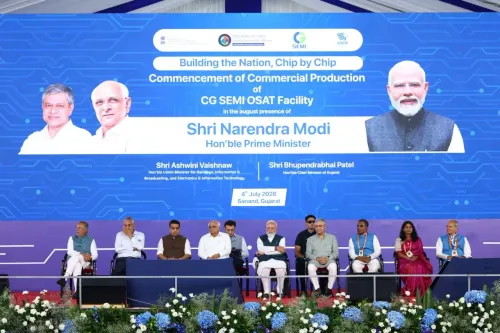
Gujarat Chief Minister Bhupendra Patel on 4 July 2026 welcomed the start of commercial production at CG Semi's OSAT facility in Sanand, which will package and test chips for automotive, 5G and AI sectors, beginning at 20 crore chips annually and targeting 500 crore chips per year for global markets.
Key Takeaways
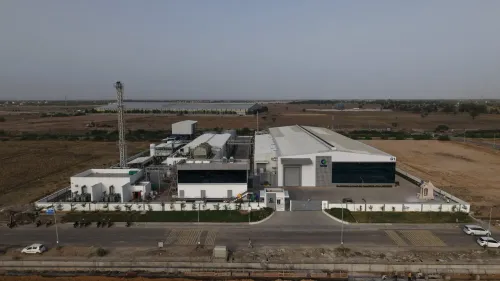
CG Semi has commenced commercial production at its OSAT facility in Sanand, Gujarat , packaging and testing semiconductor chips.
Initial production capacity is set at 20 crore chips per year , with a long-term target of 500 crore chips annually .
Chips will serve sectors including automotive , 5G , AI , industrial electronics, telecommunications and consumer electronics.
Export markets include Japan , the United States , Europe and other countries, integrating India into global semiconductor supply chains.
The launch aligns with the India Semiconductor Mission , backed by a Rs 76,000 crore central government outlay approved in 2021 .
CM Bhupendra Patel reaffirmed Gujarat's commitment to supporting semiconductor investors and advanced manufacturing under the Aatmanirbhar Bharat framework.
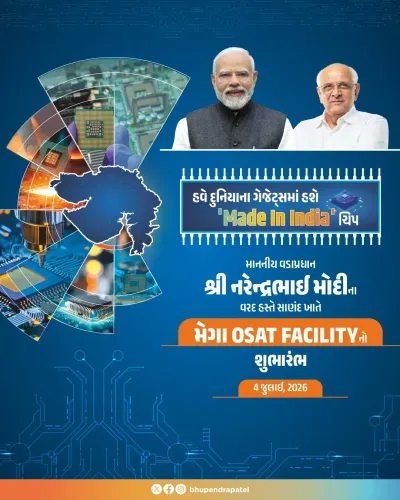
Gujarat Chief Minister Bhupendra Patel on Saturday, 4 July 2026, welcomed the commencement of commercial production at CG Semi, an advanced Outsourced Semiconductor Assembly and Test (OSAT) facility in Sanand, Gujarat, calling it 'the beginning of a new chapter' in India's semiconductor journey.
Context
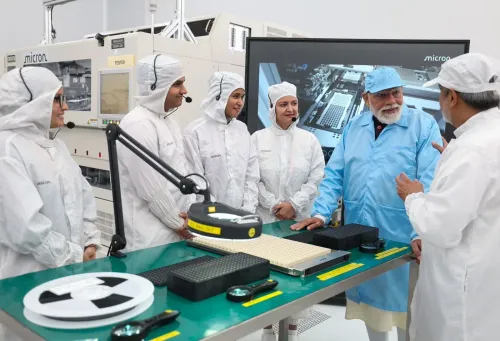
The CG Semi facility in Sanand has begun packaging and testing semiconductor chips for sectors including automotive, industrial electronics, telecommunications, 5G, consumer electronics and artificial intelligence. The plant starts with a production capacity of 20 crore chips annually and is targeting a scale-up to 500 crore chips per year.
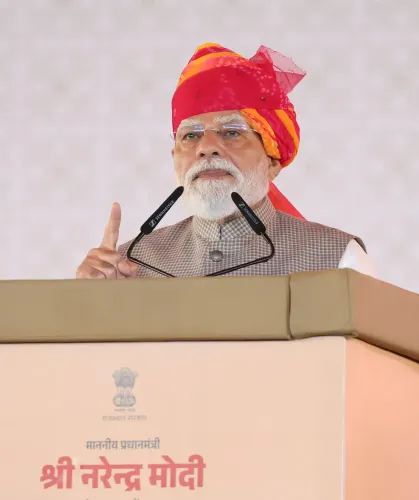
CM Patel stated that chips produced at the facility will serve markets across Japan, the United States, Europe and several other countries, positioning Gujarat as a node in global semiconductor supply chains. He also tagged Prime Minister Narendra Modi in the post, underlining the national significance of the milestone.
Policy Backdrop
The launch aligns with the India Semiconductor Mission, approved in 2021 with an outlay of Rs 76,000 crore to build domestic capabilities in chip design, fabrication and assembly and testing. OSAT units such as CG Semi represent an early and strategically important entry point into the semiconductor value chain before full-scale fabrication facilities come online.
Gujarat's industrial policy, updated from 2020 onwards, prioritised semiconductor and electronics clusters with land and power incentives. Sanand and Dholera have emerged as anchor locations for electronics and semiconductor investments under central Production-Linked Incentive (PLI) schemes between 2022 and 2024. The CG Semi commissioning is among the first tangible production milestones to emerge from this pipeline.
India's push into semiconductors is driven by the need to reduce import dependence and capture segments of global supply chains disrupted by post-pandemic shortages and ongoing US-China technology tensions. Gujarat is positioned as a western manufacturing hub alongside projects in Tamil Nadu and Assam.
Stakeholders and Impact
CM Patel congratulated the 'entire team of @CGSEMI_Official' and reaffirmed that 'the Gujarat Government remains fully committed to supporting innovation, advanced manufacturing and every investor who chooses Gujarat as a partner in growth.' The statement signals continued state-level facilitation for incoming semiconductor and electronics investors.
The facility's multi-sector chip output — spanning automotive, 5G and AI applications — means its customers span both domestic original equipment manufacturers and export-oriented supply chains. A ramp-up to 500 crore chips per year would make the plant one of the larger OSAT operations in the country, with direct implications for employment and ancillary industry in the Sanand region.
For India's broader semiconductor ecosystem, each operational OSAT unit builds testing and packaging expertise domestically, reducing the outflow of value-added processing to Southeast Asia and East Asia, where the bulk of global chip packaging currently takes place.
What's Next
Attention will now turn to the pace of CG Semi's capacity ramp-up from the initial 20 crore chips to its stated 500 crore chip target, as well as to further OSAT or assembly project approvals under the India Semiconductor Mission expected between 2025 and 2027. The use of the hashtag #PMinSanand in CM Patel's post suggests a possible upcoming visit by Prime Minister Modi to the facility, which could accompany additional announcements.
As India works to become, in CM Patel's words, 'an indispensable partner in the global semiconductor value chain,' the operational success of early movers like CG Semi will serve as a proof of concept for attracting the larger fabrication investments that the India Semiconductor Mission ultimately seeks.
Point of View
Moving the conversation from policy announcements to actual chip output. For CM Bhupendra Patel, the launch reinforces Gujarat's positioning as the frontrunner state in India's semiconductor geography, a status the government has cultivated through successive investment summits and targeted industrial policy. The tagging of PM Modi and the hashtag #PMinSanand point to a deliberate effort to frame this as a national achievement tied to the Prime Minister's technology self-reliance agenda ahead of what may be a high-profile facility visit. The 500 crore chip target, if achieved, would mark a meaningful shift in India's role from chip importer to a mid-stream participant in global semiconductor value chains.
NationPress
4 Jul 2026
Frequently Asked Questions
What is CG Semi and where is it located?
CG Semi is an Outsourced Semiconductor Assembly and Test ( OSAT ) company that has commenced commercial production at its facility in Sanand , an industrial hub in Gujarat , India.
What chips will CG Semi produce and for which sectors?
CG Semi will package and test semiconductor chips for sectors including automotive , industrial electronics, telecommunications , 5G , consumer electronics and artificial intelligence .
What is CG Semi's production capacity?
The facility begins with a capacity of 20 crore chips per year and aims to scale up to 500 crore chips annually , exporting to markets in Japan , the United States , Europe and other countries.
What is India's Semiconductor Mission and how does CG Semi fit in?
The India Semiconductor Mission , approved in 2021 with a Rs 76,000 crore outlay, supports domestic chip design, fabrication and assembly. CG Semi 's OSAT facility represents one of the first commercial production milestones under this national programme.
Why is Gujarat important for India's semiconductor industry?
Gujarat has been prioritised as a western semiconductor hub through state industrial policy updates since 2020 , with Sanand and Dholera attracting electronics and chip investments under central PLI schemes, supported by land and power incentives.