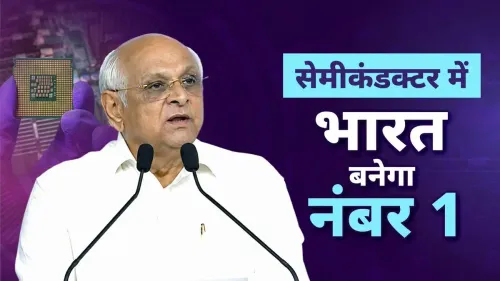
CM Bhupendra Patel Hails Sanand as India's Semiconductor Cluster Hub

Synopsis
Gujarat CM Bhupendra Patel on 4 July 2026 echoed PM Modi's assertion that semiconductor clusters — including one at Sanand — are being built across India, calling it the next step in a decade-long electronics revolution backed by the ₹76,000-crore India Semiconductor Mission.
Key Takeaways
Gujarat CM Bhupendra Patel shared PM Narendra Modi 's remarks on India's semiconductor cluster push on 4 July 2026 .
Sanand in Ahmedabad district is highlighted as a key node in India's emerging semiconductor cluster network.
The India Semiconductor Mission , launched in 2021, carries an outlay of ₹76,000 crore to build domestic chip manufacturing capacity.
Semiconductor clusters are described as the 'next step' after a decade of growth in mobile phone and electronics assembly manufacturing in India.
The multi-state cluster model is designed to build supply-chain resilience and reduce India's dependence on imported chips.
Gujarat has consistently attracted electronics and semiconductor MoUs through the Vibrant Gujarat Summit platform.
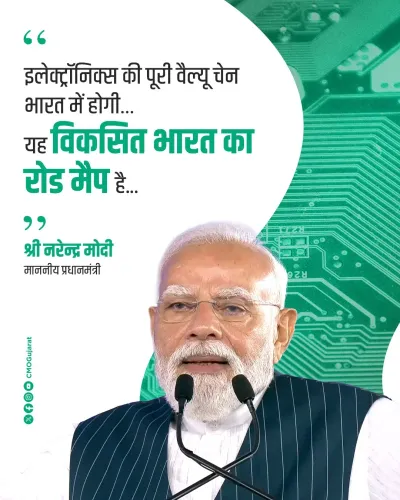
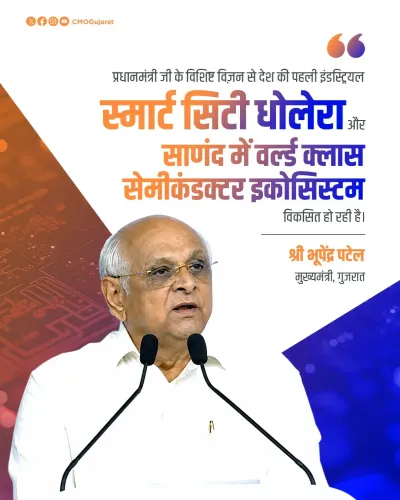
Gujarat Chief Minister Bhupendra Patel on Saturday, 4 July 2026, amplified Prime Minister Narendra Modi's remarks on India's semiconductor ambitions, highlighting that chip clusters are taking shape across multiple states including Sanand in Gujarat — describing the development as the 'next step' in the electronics revolution India has witnessed over the past decade.
Quoting the Prime Minister directly, CM Patel wrote: 'Sanand sahit desh ke anek raajyon mein semiconductor ke cluster ban rahe hain' ('Semiconductor clusters are being built in Sanand and many other states across the country — this is the next step in the electronics revolution that has come to India over the last decade'). The post, tagged #SemiconHubBharat and #PMinSanand, signals a coordinated push to position Gujarat at the centre of India's chip manufacturing narrative.
Context
Sanand, located in Ahmedabad district, has evolved over two decades from an auto-manufacturing corridor into one of India's most active electronics and industrial hubs. The area has attracted large-scale investments in mobile phone manufacturing and component supply chains, making it a natural candidate for the next phase of the electronics value chain: semiconductor fabrication and assembly.
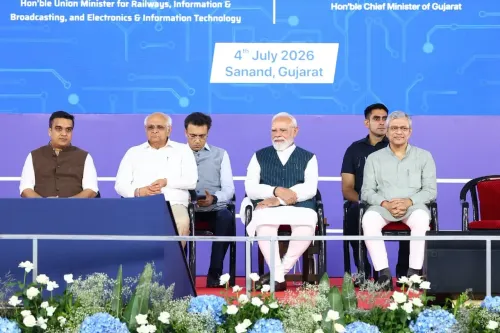
PM Modi's visit to Sanand — referenced by the hashtag #PMinSanand — underscores the political and strategic weight the Centre is attaching to the state's semiconductor trajectory. Gujarat Chief Minister Patel's amplification of the Prime Minister's words reflects the state government's active role in championing these investments.
Policy Backdrop
The Union Cabinet in 2021 approved the Semicon India programme under the India Semiconductor Mission (ISM), backed by an outlay of ₹76,000 crore, to attract semiconductor fabrication, assembly, testing, marking and packaging (ATMP) facilities to India. The mission was designed to reduce India's near-total dependence on imported chips — a vulnerability laid bare by global supply-chain disruptions during the pandemic and sharpened by escalating US-China technology tensions.
Since 2014, India has pursued an integrated electronics manufacturing strategy through Production Linked Incentive (PLI) schemes, rationalised import duties and state-level incentives. The progression — from mobile phone assembly to component manufacturing and now to chip clusters — represents a deliberate climb up the electronics value chain. Gujarat has been a consistent participant in this arc, signing multiple memoranda of understanding for semiconductor and electronics projects at successive Vibrant Gujarat Summits.
Stakeholders and Impact
For Gujarat's industrial workforce and the broader electronics manufacturing ecosystem, semiconductor clusters promise high-skill employment and deeper integration into global supply chains. Electronics manufacturers currently importing chips stand to benefit from localised supply, reduced lead times and greater cost predictability as domestic capacity scales up.
Nationally, a distributed cluster model — spanning multiple states — is intended to build resilience into India's chip supply chain rather than concentrating risk in a single geography. Sanand's established logistics infrastructure, proximity to Mundra port and existing electronics ecosystem give it a structural advantage in this multi-state framework.
What's Next
Attention will now turn to groundbreaking ceremonies and capacity milestones for the semiconductor projects announced in Gujarat and other states. Any fresh state-level incentive packages or additional central approvals under the India Semiconductor Mission will be closely watched as indicators of how quickly the cluster model translates from policy commitment to operational reality.
As India seeks to embed itself in global semiconductor supply chains alongside established players in Taiwan, South Korea and the United States, the pace of progress at Sanand and peer clusters will serve as a key benchmark for the country's broader technology self-reliance ambitions under the Atmanirbhar Bharat framework.
Point of View
Anchoring Gujarat's brand to India's most strategically significant industrial bet of the decade. By foregrounding Sanand alongside a multi-state narrative, the state government signals that Gujarat intends to be the flagship, not merely a participant, in the semiconductor race. This fits a longer arc in which Gujarat has used central PLI momentum to attract anchor investments and then leverage them for further industrial deepening. The timing — tied to a Prime Ministerial visit — ensures maximum visibility for both the state's ambitions and the Centre's Atmanirbhar Bharat technology agenda.
NationPress
4 Jul 2026
Frequently Asked Questions
What is the semiconductor cluster being built in Sanand, Gujarat?
Sanand in Ahmedabad district is being developed as a semiconductor manufacturing cluster under India's broader Semicon India programme, which aims to build chip fabrication, assembly and testing capacity across multiple states.
What is the India Semiconductor Mission and how much is its budget?
The India Semiconductor Mission is a central government scheme approved in 2021 with an outlay of ₹76,000 crore to attract semiconductor fabrication and assembly investments and reduce India's reliance on imported chips.
Why did PM Modi visit Sanand in July 2026?
PM Modi visited Sanand in connection with India's semiconductor cluster development, with the hashtag #PMinSanand used by Gujarat CM Bhupendra Patel to mark the occasion, though specific details of the visit's agenda were shared through official channels.
How does Sanand fit into India's electronics manufacturing strategy?
Sanand has grown from an auto hub into a major electronics manufacturing corridor. Semiconductor clusters there represent a move up the value chain from mobile phone assembly to chip production, aligning with India's Atmanirbhar Bharat technology goals.
Which states are getting semiconductor clusters in India?
According to PM Modi's remarks quoted by CM Patel, semiconductor clusters are being built in Sanand and several other states across India, though the exact list of operational or under-construction sites is subject to official central government announcements.