CM Dhami: 7 Aroma Valleys to boost Uttarakhand farmer income
Synopsis
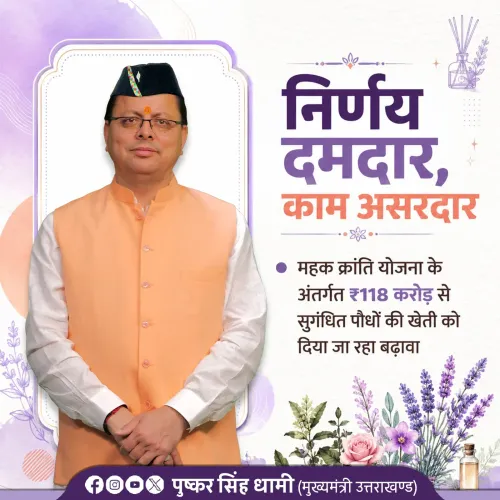
Chief Minister Pushkar Singh Dhami announced on October 30, 2026 that Uttarakhand is developing 7 Aroma Valleys under the Mahak Kranti scheme to raise farmer incomes through aromatic plant cultivation and create local self-employment in hill districts.
Key Takeaways
7 Aroma Valleys are being developed across Uttarakhand under the Mahak Kranti (Fragrance Revolution) initiative.
The scheme focuses on aromatic and medicinal plant cultivation suited to Uttarakhand's Himalayan terrain.
The stated goals are raising farmer income and creating new self-employment opportunities in rural areas.
The initiative addresses a structural problem: conventional cereal farming in hill districts cannot generate sufficient cash income, driving out-migration.
Key unresolved details include the district-level locations of the valleys and market-linkage or processing infrastructure plans.
Uttarakhand's hill farmers are getting a new economic lifeline — one that smells like lavender, lemongrass, and opportunity. On Friday, October 30, 2026, the Chief Minister's Office of Uttarakhand quoted Chief Minister Pushkar Singh Dhami announcing that seven Aroma Valleys are being developed across the state under the Mahak Kranti (Fragrance Revolution) initiative, aimed squarely at raising farmer incomes through aromatic plant cultivation.
Mahak Kranti: What the Fragrance Revolution promises
The Chief Minister's statement, shared via the official CMO handle, said: 'प्रदेश में किसानों की आय बढ़ाने के उद्देश्य से महक क्रांति के अंतर्गत 7 एरोमा वैली विकसित की जा रही हैं' — 'With the aim of increasing farmers' income in the state, 7 Aroma Valleys are being developed under Mahak Kranti.' The statement added that cultivating aromatic plants is being actively promoted to create 'new opportunities for self-employment and income' for farmers.
Mahak Kranti is the Uttarakhand government's dedicated scheme for aromatic and medicinal plant promotion. It targets the unique advantage of the state's Himalayan terrain, where marginal, high-altitude land unsuitable for conventional grain crops can yield high-value aromatic species — think rosemary, damask rose, geranium, and eucalyptus varieties that command strong prices from fragrance and pharmaceutical industries.
A strategic answer to hill-district out-migration
The arithmetic is straightforward: Uttarakhand's hill districts have long watched young people leave for the plains because subsistence cereal farming simply cannot generate enough cash income. Aromatic crops flip that equation — low input volumes, higher per-kilogram returns, and crucially, processing and distillation work that can be done locally, anchoring livelihoods in the village itself.
This fits a pattern playing out across Himalayan India, where state governments have increasingly pushed crop diversification away from wheat and maize toward medicinal and aromatic plants. But the 'Aroma Valley' cluster model goes a step further, concentrating infrastructure, supply chains, and expertise into dedicated geographic zones rather than scattering pilots thinly across districts.
What needs to follow the announcement
The real test lies in the specifics that the statement does not yet name: which districts will host the seven valleys, what processing and market-linkage infrastructure will accompany them, and on what timeline. Aromatic farming succeeds or stalls at the post-harvest stage — farmers need distillation units and reliable buyers, not just seeds. Those details will determine whether Mahak Kranti becomes a genuine income multiplier or remains a well-intentioned headline.
CM Dhami, in office since 2021, has repeatedly cited agricultural modernisation and rural self-employment as twin pillars of his government's agenda. The Aroma Valley programme is the sharpest structural expression of that commitment yet — and the state's hill farmers are watching to see if the fragrance of policy translates into the fragrance of earnings.
Point of View
Which the current statement does not address. Broader Himalayan state experience shows that aromatic farming schemes succeed where post-harvest processing is state-backed and stumble where farmers are left to find buyers alone. If the government publishes district-level rollout plans and infrastructure investment figures, Mahak Kranti could become a replicable model; without them, it risks joining a long list of aspirational hill-economy announcements.
NationPress
30 Oct 2026
Frequently Asked Questions
What is Mahak Kranti in Uttarakhand?
Mahak Kranti, meaning 'Fragrance Revolution', is a Uttarakhand government scheme to promote the cultivation of aromatic and medicinal plants among farmers, with the aim of raising incomes and creating self-employment in hill districts.
How many Aroma Valleys are being developed in Uttarakhand?
Chief Minister Pushkar Singh Dhami announced that 7 Aroma Valleys are being developed across the state under the Mahak Kranti initiative.
Why is Uttarakhand promoting aromatic plant farming?
Uttarakhand's Himalayan terrain is well-suited to aromatic and medicinal crops, which offer higher per-hectare returns than traditional cereals. The government hopes the shift will raise farmer incomes and reduce rural out-migration.
Which farmers benefit from Mahak Kranti?
The scheme targets farmers in Uttarakhand, particularly those in hill districts where conventional cereal farming is economically marginal and where aromatic crops can generate better cash income.
What aromatic plants are grown under Uttarakhand's Aroma Valley scheme?
Uttarakhand's aromatic farming ecosystem includes species such as rosemary, damask rose, geranium, lemongrass, and eucalyptus varieties, all of which are in demand from fragrance and pharmaceutical industries.