CM Dhami: Over 8 Lakh Uttarakhand Farmers Benefit from PM-KISAN
Synopsis
Uttarakhand Chief Minister Pushkar Singh Dhami announced on June 26, 2026, that over 8 lakh farmers in the state are benefiting from PM-KISAN, attributing the scheme's reach to PM Modi's leadership and the BJP's 'double engine' governance model.
Key Takeaways
CM Pushkar Singh Dhami stated that more than 8 lakh farmers in Uttarakhand are benefiting from the PM-KISAN scheme.
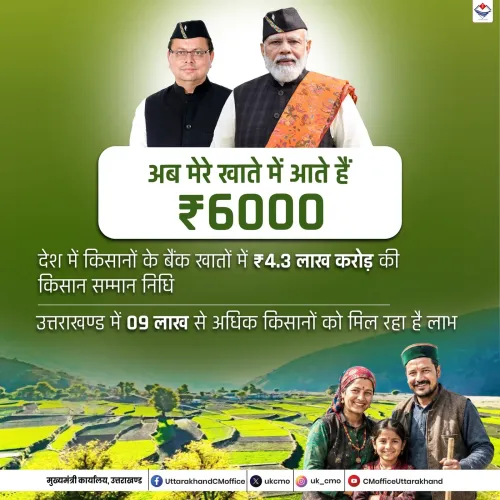
The PM-KISAN scheme provides Rs 6,000 per year in direct income support to eligible landholding farmer families across India.
The scheme was launched in February 2019 by the Modi government as a central sector welfare initiative.
CM Dhami invoked the 'double engine government' model, citing aligned BJP rule at the Centre and in Uttarakhand as a driver of effective scheme delivery.
The post reinforces the BJP 's broader political strategy of linking state-level welfare outcomes to national flagship programmes.
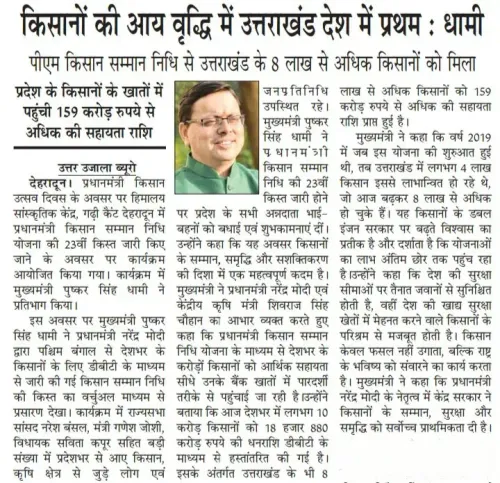
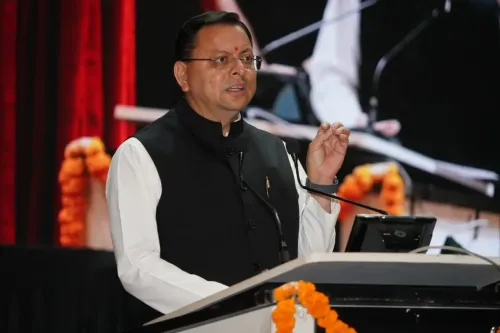
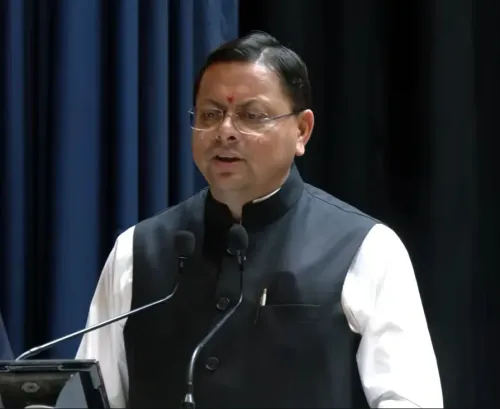
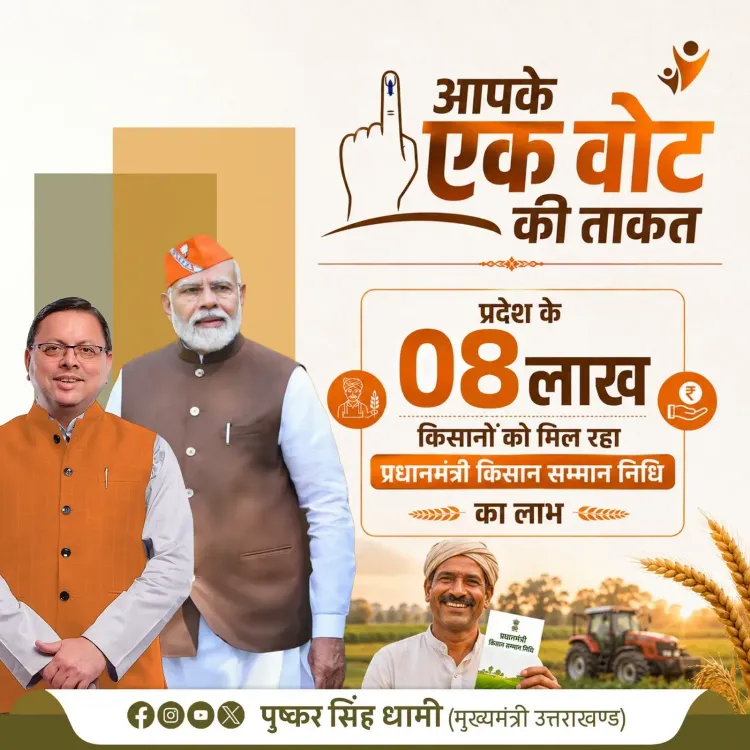
Uttarakhand Chief Minister Pushkar Singh Dhami on Friday, June 26, 2026, highlighted that more than 8 lakh farmers in the state are benefiting from the Pradhan Mantri Kisan Samman Nidhi (PM-KISAN) scheme, crediting Prime Minister Narendra Modi's leadership for the scheme's reach across the country.
Context
In his post on X, CM Dhami wrote — 'देवभूमि उत्तराखंड के 08 लाख से अधिक किसान भी इस योजना से लाभान्वित हो रहे हैं' — meaning 'More than 8 lakh farmers of Devbhoomi Uttarakhand are also benefiting from this scheme.' He further stated that the 'double engine government' continues to work with resolve for the prosperity, dignity, and happiness of farmers.
The post underscores the BJP's consistent political messaging around the alignment between the central government and state governments it leads, framing coordinated welfare delivery as a structural advantage for citizens.
Policy Backdrop
The PM-KISAN scheme was launched in February 2019 by the Modi government to provide direct income support of Rs 6,000 per year to eligible landholding farmer families, disbursed in three equal instalments of Rs 2,000 each directly into bank accounts. The scheme operates as a central sector initiative, with states responsible for verifying and enrolling eligible beneficiaries.
Uttarakhand, also known as Devbhoomi (Land of Gods), has a predominantly rural and agrarian population concentrated in its hill districts, where small and marginal farmers form the bulk of the agricultural community. Access to direct benefit transfers has been a key metric of welfare delivery in such geographies.
Stakeholders and Impact
The primary beneficiaries are small and marginal farmers across Uttarakhand's districts, who receive the annual income support to supplement agricultural earnings. For hill farmers with limited landholdings and seasonal crop cycles, the guaranteed transfer provides a measure of income stability.
The 'double engine' framing — referring to the BJP holding power at both the Centre and in Uttarakhand — is a recurring political argument that aligned governance reduces friction in scheme implementation, from beneficiary identification to fund disbursement. This model has been consistently invoked by BJP leaders across states since 2014 to connect state-level outcomes with national flagship programmes.
What's Next
Attention will now turn to Uttarakhand's state budget allocations for agriculture and any supplementary farmer support measures the state government may announce in the Uttarakhand Legislative Assembly. The state's ability to expand beneficiary coverage and complement central transfers with its own schemes will be a key indicator of the 'double engine' model's on-ground effectiveness.
As the PM-KISAN programme continues its periodic instalment disbursements, state governments like Uttarakhand's are expected to keep updating beneficiary rolls and resolving pending verifications to ensure no eligible farmer is left out of the direct benefit transfer system.
Point of View
Which signals an intent to ground the messaging in verifiable delivery data rather than aspirational claims. Sustained focus on direct benefit transfers in hill states like Uttarakhand reflects a broader party bet that welfare reach, not just rhetoric, drives rural political loyalty.
NationPress
25 Sept 2026
Frequently Asked Questions
What is the PM-KISAN scheme and who is eligible?
PM-KISAN, or Pradhan Mantri Kisan Samman Nidhi, provides Rs 6,000 per year in three instalments of Rs 2,000 directly to the bank accounts of eligible landholding farmer families across India. It was launched in February 2019.
How many farmers in Uttarakhand benefit from PM-KISAN?
According to Chief Minister Pushkar Singh Dhami's post on June 26, 2026, more than 8 lakh farmers in Uttarakhand are benefiting from the PM-KISAN scheme.
What does 'double engine government' mean in BJP's political language?
'Double engine government' is a BJP phrase referring to the party being in power both at the Centre and in a particular state, which the party argues leads to faster and more effective implementation of central welfare schemes.
When was PM-KISAN launched and by whom?
PM-KISAN was launched in February 2019 by the Narendra Modi-led central government to deliver direct income support to farmer families across India.
What is Uttarakhand's agricultural profile?
Uttarakhand, also known as Devbhoomi, has a predominantly rural population with a large share of small and marginal farmers, particularly in its hill districts, making direct benefit transfer schemes like PM-KISAN especially significant for the state.