CM Dhami adds Bhagavad Gita shlokas to Uttarakhand school syllabus
Synopsis
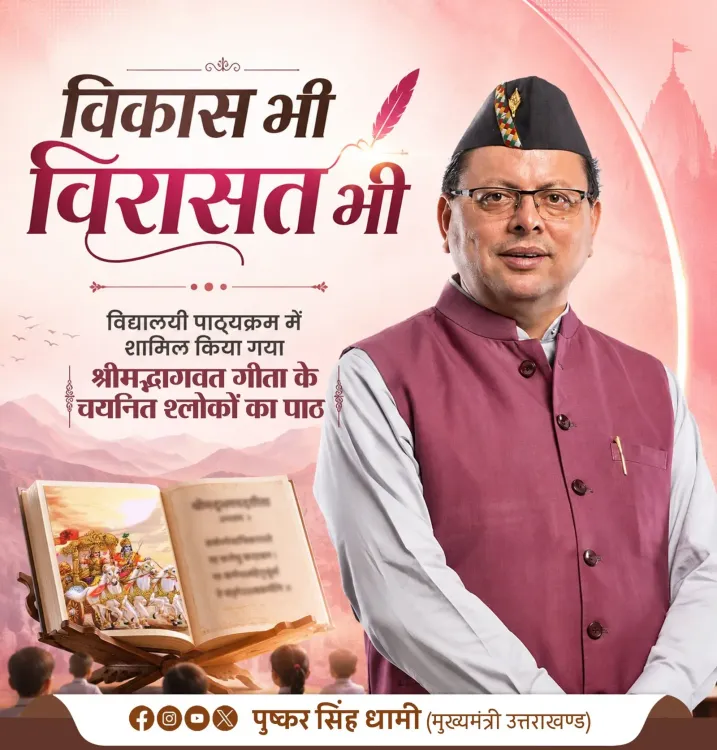
Uttarakhand Chief Minister Pushkar Singh Dhami announced on 17 July 2026 that selected Bhagavad Gita shlokas have been added to state school syllabi, citing the goal of nurturing a new generation grounded in Indian knowledge traditions and ethical values, in line with NEP 2020.
Key Takeaways
Uttarakhand CM Pushkar Singh Dhami announced the inclusion of selected Shrimad Bhagavad Gita shlokas in the state's school curriculum on 17 July 2026 .
The government described building a value-rooted new generation as among its 'highest priorities.' The move aligns with the National Education Policy 2020 , which directs states to integrate Indian Knowledge Systems into school learning.
Primary stakeholders are state-school students and teachers across Uttarakhand .
Specific details — grade levels covered, number of shlokas, and examination status — have not yet been disclosed.
The initiative may serve as a model for comparable Gita modules in other BJP -governed states.
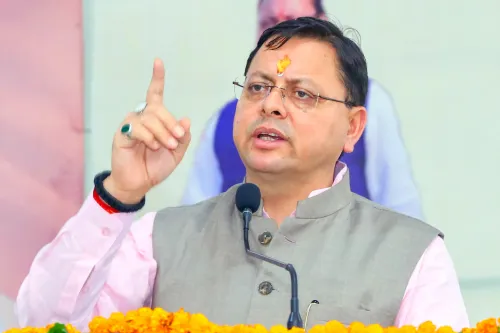
Uttarakhand Chief Minister Pushkar Singh Dhami announced on Friday, 17 July 2026 that selected shlokas from the Shrimad Bhagavad Gita have been incorporated into the state's school curriculum, framing the move as a top government priority to build a new generation rooted in Indian knowledge traditions, values, and ethics.
Context
Posting in Hindi on X, CM Dhami stated: 'भारतीय ज्ञान परंपरा, संस्कार और नैतिक मूल्यों से समृद्ध नई पीढ़ी का निर्माण हमारी सरकार की सर्वोच्च प्राथमिकताओं में है' ('Building a new generation enriched with Indian knowledge traditions, values, and ethical principles is among the highest priorities of our government'). He added that in keeping with this resolve, selected shlokas from the Shrimad Bhagavad Gita have been included in the state's school syllabus.
The announcement signals a formal curricular shift in Uttarakhand, one of the BJP-governed states that has consistently emphasised cultural and value-based education since Dhami assumed office in 2021.
Policy Backdrop
The move draws direct support from the National Education Policy 2020, which directed states to integrate Indian Knowledge Systems (IKS) and value education drawn from classical texts into school learning frameworks. Uttarakhand's decision to include Gita shlokas in its syllabus is among the more concrete implementations of that directive at the state level.
Comparable initiatives have emerged in other BJP-ruled states, reflecting a broader pattern of standardising student exposure to classical Indian scriptures as part of moral and cultural education. The NEP 2020 framework provides the policy cover that distinguishes such steps from purely ideological moves, grounding them in a nationally endorsed education reform agenda.
Stakeholders and Impact
The primary stakeholders are Uttarakhand's school students and teachers across state-run institutions. Students will encounter selected Gita shlokas as part of their regular coursework, while teachers will need orientation or training to deliver the content effectively within the existing curriculum structure.
The scope of the inclusion — which grade levels are covered, how many shlokas are selected, and whether the content is examinable — has not been specified in the announcement. These details will determine the practical weight the new module carries in daily classroom instruction.
What's Next
Attention will now turn to the rollout timeline for textbook revisions and teacher training programmes that must accompany any substantive syllabus change. Uttarakhand's education department will be expected to publish revised curriculum documents detailing the specific shlokas chosen and the pedagogical approach to be adopted.
If the initiative is implemented smoothly, it could serve as a template for similar Gita modules in other BJP-governed states, extending the reach of classical-text integration under the NEP 2020 umbrella well beyond Uttarakhand.
Point of View
It serves a dual purpose: advancing a cultural-nationalist policy agenda while operating within a nationally legitimised reform framework, making the move harder to contest on purely procedural grounds. The absence of granular implementation details — grade levels, shloka selection, assessment — leaves room for both optimism about value education and concern about execution gaps. Whether the initiative translates into meaningful pedagogical change or remains a symbolic announcement will depend on the speed and quality of teacher training and textbook revision that follows.
NationPress
17 Jul 2026
Frequently Asked Questions
Which shlokas of the Bhagavad Gita will be taught in Uttarakhand schools?
The specific shlokas have not been publicly disclosed yet. CM Dhami's announcement referred to 'selected shlokas' from the Shrimad Bhagavad Gita, but the full list is expected to be detailed in revised curriculum documents from the state education department.
From which class will Bhagavad Gita be taught in Uttarakhand schools?
The grade levels have not been specified in the announcement. Further details on which classes will study the Gita shlokas are awaited from the Uttarakhand government.
Is teaching the Bhagavad Gita in schools allowed under NEP 2020?
Yes. The National Education Policy 2020 explicitly encourages states to integrate Indian Knowledge Systems and value education drawn from classical texts into school curricula, providing a policy basis for such initiatives.
Which other states teach the Bhagavad Gita in schools?
Several BJP-governed states have introduced modules on classical Indian texts as part of value-based education efforts. Uttarakhand's move follows a broader pattern of such initiatives across BJP-ruled states, though specific syllabus structures vary.
Why did CM Dhami include the Bhagavad Gita in the Uttarakhand school syllabus?
CM Dhami stated the aim is to build a new generation enriched with Indian knowledge traditions, values, and ethical principles, which he described as among the highest priorities of the Uttarakhand government.