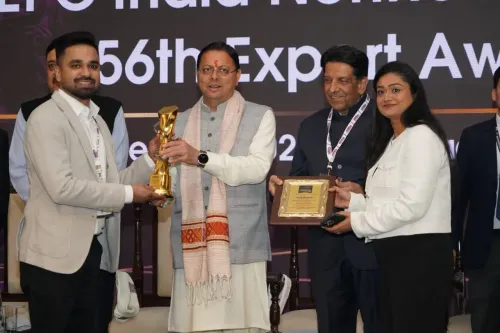
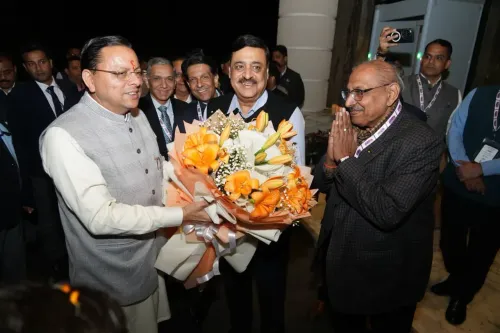
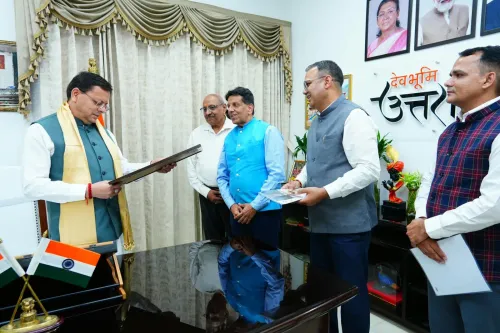
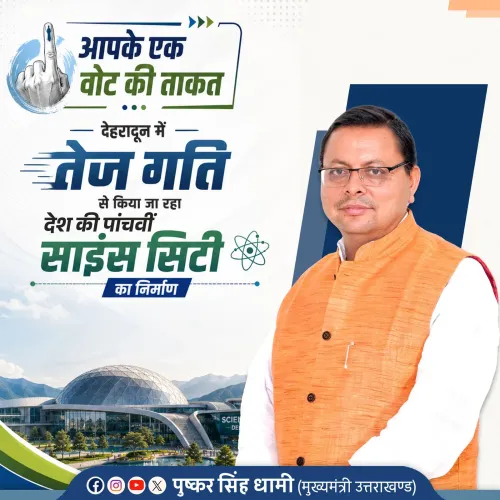
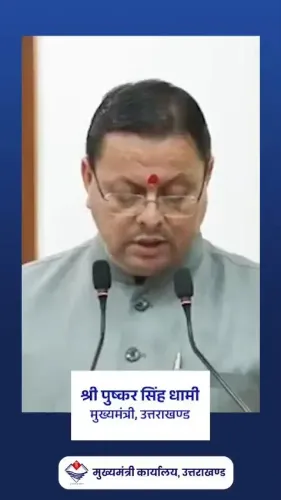
CM Dhami at EEPC India's 56th Export Excellence Awards
Synopsis
Chief Minister Pushkar Singh Dhami attended EEPC India's 56th Northern Regional Export Excellence Awards in Dehradun, honouring top exporters and outlining Uttarakhand's industrial roadmap — from 29,000-plus new MSME units to the ₹1,100 crore Khurpia manufacturing cluster and improved logistics corridors.
Key Takeaways
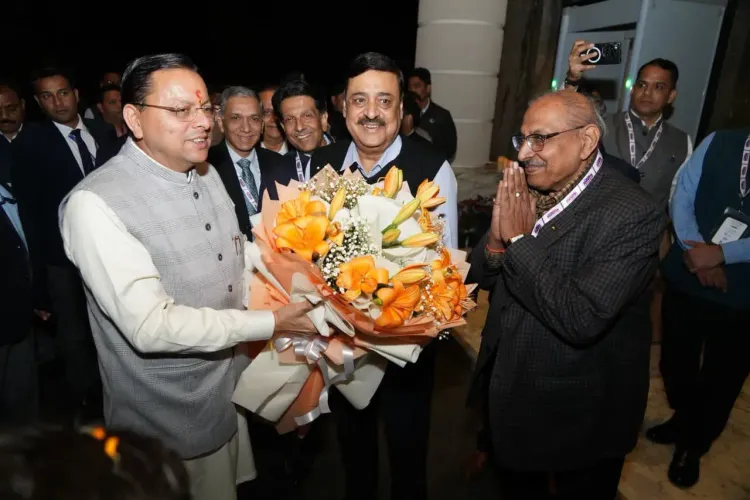
CM Pushkar Singh Dhami attended the 56th EEPC India Northern Regional Export Excellence Awards at Hotel Taj Mussoorie, Dehradun on 16 November 2026 .
Over 29,000 new MSME units established in Uttarakhand in recent years, reportedly generating direct employment for more than 1,27,000 youth (figures cited by CM; unverified independently).
The Khurpia Integrated Manufacturing Cluster in Udham Singh Nagar spans ~ 1,000 acres , with projected investment of ₹1,100 crore and expected total inflows exceeding ₹7,000 crore .
A ₹200 crore venture fund supports the state's Startup Policy, aimed at creating entrepreneurs rather than just job-seekers.
The Delhi-Dehradun Economic Corridor has reduced travel time between the two cities to two to two-and-a-half hours , boosting logistics for exporters.
Uttarakhand's Single Window System now provides 206-plus online services from 26 departments to ease business approvals.
A mountain state once doubted for its industrial potential is now pitching itself as a global manufacturing hub — and Chief Minister Pushkar Singh Dhami made that case forcefully on Monday, 16 November 2026, at the 56th Northern Regional Export Excellence Awards organised by EEPC India at Hotel Taj Mussoorie, Dehradun. Dhami honoured entrepreneurs and exporters who have carried the 'Made in India' stamp to world markets, then laid out Uttarakhand's industrial ambitions in striking detail.
Engineering excellence meets Himalayan ambition
EEPC India — the Engineering Export Promotion Council of India — has for decades been the institutional backbone of the country's engineering goods export ecosystem, recognising regional champions through its annual awards circuit. At the 56th edition of its northern regional ceremony, CM Dhami told the audience that EEPC has played a 'pivotal role in giving global recognition to the talent, hard work and excellence of India's engineering industry.' He praised the honoured exporters for giving 'Made in India' a new identity and prestige on the world stage through quality products and innovation.
The CM's broader message was pointed: in rapidly shifting global markets, a country's reputation is no longer built on volume of production alone, but on 'quality, reliability and innovation.' He framed India's confidence simply — 'the world is its market, and quality is its identity' — and tied that ethos to the Viksit Bharat 2047 goal of becoming a fully developed economy.
From scepticism to investment: Uttarakhand's industrial pivot
Dhami acknowledged a not-so-distant past when Uttarakhand's hilly geography made investors hesitate. 'There was a time when questions were raised about the possibilities of industries and large investments here because it is a mountain state,' he said, adding that the state government had resolved to turn those challenges into opportunities.
The turning point, he argued, was the Global Investors Summit held in Dehradun in 2023, which is now yielding visible ground-level results — new industrial units coming up, fresh employment being generated. Under policies including the Mega Industrial and Investment Policy, the Uttarakhand MSME Policy, and the Uttarakhand Startup Policy, the CM said more than 29,000 new MSME units have been established in recent years, providing direct employment to over 1,27,000 youth. These figures were cited by the CM; independent verification is pending.
The Khurpia cluster and the ₹1,100 crore manufacturing bet
The centrepiece of Uttarakhand's industrial map right now is the Khurpia Integrated Manufacturing Cluster in Udham Singh Nagar — roughly 1,000 acres, with a projected investment of approximately ₹1,100 crore. Dhami said the cluster is expected to attract over ₹7,000 crore in total investment and generate jobs for around 25,000 young people. Beyond Khurpia, land has been identified for industrial parks in Chamoli, Pauri and Almora, a flatted factory is coming up in Haridwar, and similar facilities are planned for Selaqui and Pantnagar.
To ensure industrial development reaches remote mountain areas — not just the plains — the state is promoting industries aligned with local resources, traditional skills, and natural advantages. A ₹200 crore venture fund has been set up alongside the Startup Policy to produce job-creators, not just job-seekers, Dhami said.
Corridors, rail lines, and the logistics logic
None of this industrial push works without connectivity. The Delhi-Dehradun Economic Corridor has already cut the Delhi-to-Dehradun journey to just two to two-and-a-half hours, transforming the logistics calculus for manufacturers and exporters. The Rishikesh-Karnprayag Rail Line, the Chardham All-Weather Road, and an expanding road network are all compressing distance and time for freight movement — making the state genuinely competitive for investors who once wrote it off.
On the ease-of-doing-business front, Uttarakhand's Single Window System now delivers over 206 online services from 26 departments, making regulatory clearances faster and more transparent, Dhami noted.
A state that the world once knew only for its glaciers and pilgrimage sites is quietly rewriting its industrial identity — and the EEPC podium just became its latest platform to say so.
Point of View
Lending political continuity to economic messaging. The Khurpia cluster announcement and the venture fund together suggest the state is trying to graduate from incentive-led investment attraction to ecosystem-building — a more durable but harder-to-execute strategy. How quickly the 29,000-MSME employment claim translates into measurable per-capita income gains in hill districts will be the real test of whether the industrial pivot is rhetoric or reality.
NationPress
16 Nov 2026
Frequently Asked Questions
What is the EEPC India Export Excellence Award?
The EEPC India Export Excellence Award is an annual recognition given by the Engineering Export Promotion Council of India to outstanding exporters and entrepreneurs in the engineering sector. The 56th Northern Regional edition was held in Dehradun on 16 November 2026.
What is the Khurpia Integrated Manufacturing Cluster in Uttarakhand?
The Khurpia Integrated Manufacturing Cluster is a large-scale industrial project being developed on approximately 1,000 acres in Udham Singh Nagar at an estimated cost of ₹1,100 crore. It is expected to attract over ₹7,000 crore in investment and create around 25,000 jobs.
How many MSME units have been set up in Uttarakhand recently?
Chief Minister Pushkar Singh Dhami stated that more than 29,000 new MSME units have been established in Uttarakhand in recent years, providing direct employment to over 1,27,000 young people, though these figures are based on the CM's official address.
How has the Delhi-Dehradun Economic Corridor helped Uttarakhand's industry?
The Delhi-Dehradun Economic Corridor has reduced travel time between Delhi and Dehradun to just two to two-and-a-half hours, making it significantly easier and faster for manufacturers and exporters to move goods and people, improving Uttarakhand's logistics attractiveness.
What is Uttarakhand's venture fund for startups?
Uttarakhand has set up a ₹200 crore venture fund as part of its Startup Policy, aimed at supporting young entrepreneurs and shifting the state's youth from job-seekers to job-creators in line with broader industrial development goals.