CM Dhami Launches ATV Bikes for Youth in Harsil Valley
Synopsis
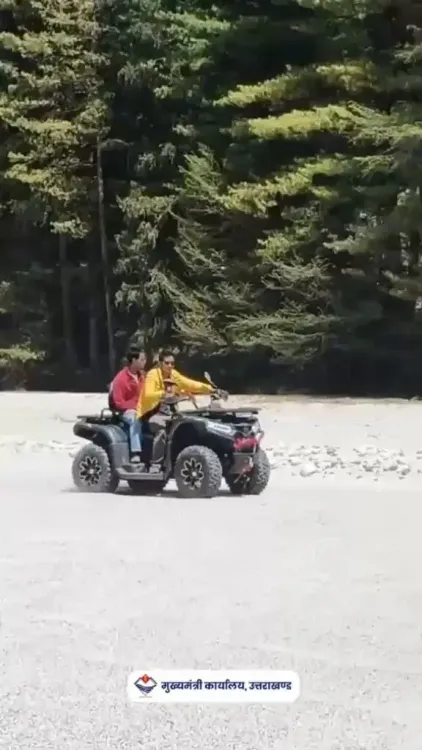
Local youth in Harsil Valley, Uttarkashi, have launched self-employment ATV bike services under CM Pushkar Singh Dhami's scheme, blending adventure tourism with youth economic empowerment along the Char Dham Yatra corridor.
Key Takeaways
The Chief Minister's Office of Uttarakhand announced on 23 May 2026 that local youth in Harsil Valley have begun operating ATV bike services under CM Dhami's self-employment initiative.
Harsil Valley in Uttarkashi district sits on the route to Gangotri , one of the four Char Dham shrines, making it a high-footfall tourism corridor.
The scheme draws from the Mukhya Mantri Swarozgar Yojana (2021-22) , which provides subsidised loans for micro-enterprises including tourism services.
The initiative targets youth out-migration by creating structured, government-backed livelihoods in remote hill districts without requiring relocation.
The move aligns with a broader Himalayan state trend of shifting from purely religious tourism to adventure and experiential products that extend visitor stays and retain income locally.
Similar ATV or e-mobility rollouts in other Char Dham corridors and updates to Uttarakhand tourism policy targets for 2027-28 are the key developments to watch.
The Chief Minister's Office of Uttarakhand announced on Saturday, 23 May 2026 that local youth in Harsil Valley, Uttarkashi district, have begun operating self-employment ATV (all-terrain vehicle) bike services under a scheme initiated by Chief Minister Pushkar Singh Dhami, adding a new dimension to adventure tourism along the Char Dham Yatra corridor.
Context
The post states that Harsil Valley — already a draw for pilgrims and tourists during the Char Dham season — is now seeing local youth launch ATV bike ventures under CM Dhami's self-employment initiative. The original post reads: 'Harsil Ghati mein ab sthaniya yuva Mukhyamantri Pushkar Singh Dhami ki swarozgar ATV bikes ki shuruaat kar sahsik paryatan ko naya aayam de rahe hain' ('Local youth in Harsil Valley are now giving a new dimension to adventure tourism by launching Chief Minister Pushkar Singh Dhami's self-employment ATV bikes'). The move is positioned as a convergence of religious tourism footfall and youth economic empowerment.
Harsil Valley, nestled near Gangotri in Uttarkashi district, has historically been known for its apple orchards and scenic landscape. Its position on the route to one of the four Char Dham shrines makes it a natural staging point for experiential tourism products targeting the millions of pilgrims who pass through each season.
Policy Backdrop
The ATV initiative appears to draw from the Mukhya Mantri Swarozgar Yojana, introduced in 2021-22, which provides subsidised loans to support micro-enterprises in Uttarakhand, including tourism-linked services. CM Dhami, who has helmed the state since 2021, has consistently prioritised youth self-employment and tourism expansion in hill districts as twin pillars of his administration's economic agenda.
The broader infrastructure backbone for this push is the Char Dham all-weather road project, which received Cabinet approval in 2016 to improve year-round access to Yamunotri, Gangotri, Kedarnath and Badrinath. Better road connectivity has gradually made remote valleys like Harsil more accessible to leisure and adventure tourists, not just pilgrims.
Stakeholders and Impact
The primary beneficiaries of the ATV scheme are local youth in Harsil and surrounding areas of Uttarkashi district, who gain a structured, government-backed route into the tourism economy without relocating to urban centres. Youth out-migration from remote Himalayan valleys has been a persistent concern for successive Uttarakhand governments, and self-employment schemes tied to tourism are increasingly seen as a retention tool.
For adventure tourists and Char Dham pilgrims, the addition of ATV services diversifies the valley's offerings beyond sightseeing and trekking. Himalayan state governments have in recent years shifted from purely religious tourism toward experiential and adventure products designed to extend visitor stays and circulate income locally rather than allowing it to flow out to operators based in larger cities.
What's Next
Observers will watch whether similar ATV or electric-mobility schemes are rolled out in other segments of the Char Dham corridor — particularly around Kedarnath and Badrinath, which see the highest footfall. Any revision to Uttarakhand's tourism policy targets for 2027-28 is also likely to reflect the outcomes of pilots like the Harsil ATV launch. If the model proves commercially viable and generates stable local income, it could serve as a template for other remote Himalayan valleys seeking to monetise proximity to high-traffic pilgrimage routes.
Point of View
Year-round economic asset for hill communities. By anchoring a self-employment scheme to an already high-footfall corridor, the Dhami administration is attempting to address youth out-migration — one of the most structurally stubborn problems in Himalayan governance — without large capital outlays. The broader pattern mirrors strategies in Himachal Pradesh and Sikkim, where adventure tourism has been layered onto religious circuits to capture higher-spending visitor segments. Whether Harsil becomes a replicable model depends on whether the ATV operations achieve commercial sustainability beyond the peak Char Dham season.
NationPress
8 Oct 2026
Frequently Asked Questions
What is the ATV bike scheme launched in Harsil Valley Uttarakhand?
Local youth in Harsil Valley, Uttarkashi district, have started operating all-terrain vehicle (ATV) bike services as part of CM Pushkar Singh Dhami's self-employment initiative, offering adventure tourism rides to pilgrims and tourists on the Char Dham Yatra route.
Where is Harsil Valley and why is it significant for Char Dham Yatra?
Harsil Valley is located in Uttarkashi district of Uttarakhand, near Gangotri — one of the four Char Dham shrines. It serves as a scenic stopover for millions of pilgrims and tourists who travel to Gangotri each season.
What is the Mukhya Mantri Swarozgar Yojana in Uttarakhand?
The Mukhya Mantri Swarozgar Yojana, introduced in 2021-22, is an Uttarakhand government scheme that provides subsidised loans to support micro-enterprises, including tourism-linked services, to promote self-employment among local youth.
How does the Harsil ATV scheme help local youth in Uttarakhand?
The scheme gives local youth in remote Harsil Valley a government-backed livelihood option in the tourism economy, reducing the need to migrate to cities and retaining income within the community.
What is CM Pushkar Singh Dhami's tourism policy for Uttarakhand?
CM Dhami, in office since 2021, has prioritised youth self-employment and tourism expansion in hill districts, pairing infrastructure upgrades like the Char Dham all-weather road with self-employment schemes to diversify Uttarakhand's tourism economy beyond religious pilgrimage.