Giriraj Singh Hails India as World's Largest Retail GCC Hub
Synopsis
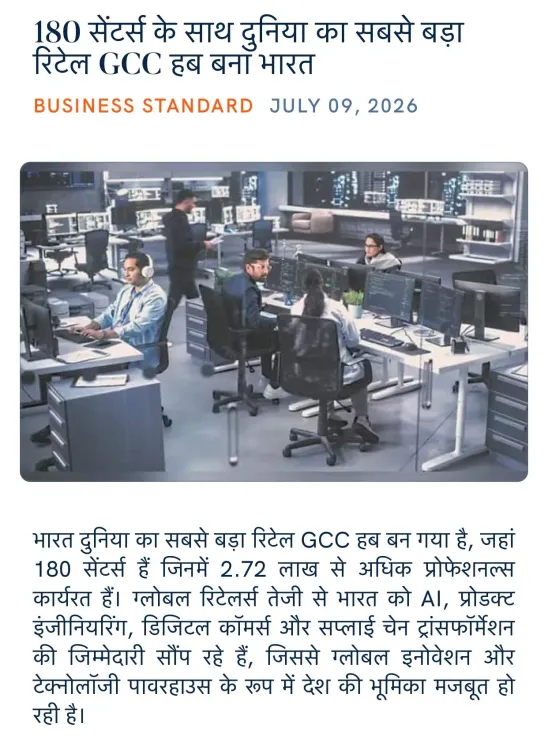
Union Textiles Minister Giriraj Singh on 9 July 2026 highlighted a report stating India has become the world's largest retail Global Capability Centre hub with 180 centres, amplifying the milestone as a sign of India's expanding role in the global services economy.
Key Takeaways
Union Textiles Minister Giriraj Singh shared the milestone on 9 July 2026 via the NaMo App on X.
A published industry report claims India now hosts 180 retail GCC centres , making it the world's largest retail GCC hub.
NASSCOM had documented over 1,500 GCCs across all verticals in India as of 2023–24, reflecting a long-term upward trend.
India's GCC growth is underpinned by FDI liberalisation, a large English-speaking talent pool, and competitive operational costs.
Key retail GCC clusters are concentrated in Bengaluru , Hyderabad , Pune , and Chennai .
Next NASSCOM and RBI data releases will be watched to validate and contextualise the retail GCC figures.
Union Textiles Minister Giriraj Singh on Thursday, 9 July 2026, shared a report on X highlighting that India has become the world's largest retail Global Capability Centre (GCC) hub, with 180 centres now operational across the country. The minister shared the development via the NaMo App, underlining the significance of India's expanding role in the global services economy.
Context
The post, written in Hindi, states: '180 सेंटर्स के साथ दुनिया का सबसे बड़ा रिटेल GCC हब बना भारत' — translated as 'India has become the world's largest retail GCC hub with 180 centres.' Giriraj Singh shared the claim citing a published industry report, amplifying it as a marker of India's growing stature in global business services.
Global Capability Centres are captive offshore units set up by multinational corporations to handle specialised functions — ranging from technology and analytics to supply chain and customer operations. The retail vertical, in particular, has seen rapid expansion as global retailers seek cost-effective hubs for their digital and back-office operations.
Policy Backdrop
India's GCC ecosystem has grown substantially over the past decade, with NASSCOM reporting more than 1,500 GCCs across all verticals as of 2023–24, contributing significantly to services exports and high-skilled employment. The retail-specific segment forms part of a broader vertical diversification trend, moving beyond traditional IT outsourcing into domain-specific capability building.
Successive governments have supported this growth through FDI liberalisation, ease-of-doing-business reforms, and investment in digital infrastructure. India's large English-speaking talent pool and competitive cost structure have made it the preferred destination for multinational captive operations, a trend that accelerated through the early 2010s and has continued since.
While the Textiles Ministry does not directly oversee GCC policy — which falls under the Commerce and IT ministries — senior ministers across portfolios have increasingly amplified economic milestone data as part of the government's broader narrative on India's services-sector competitiveness.
Stakeholders and Impact
The primary beneficiaries of India's retail GCC expansion are global retail multinationals seeking to consolidate analytics, supply chain management, e-commerce operations, and customer experience functions in a single offshore hub. For Indian professionals, the growth translates into high-value employment in cities with established GCC clusters such as Bengaluru, Hyderabad, Pune, and Chennai.
The retail GCC segment also feeds into India's broader services export basket. As global retailers accelerate digital transformation — integrating AI-driven inventory management, omnichannel logistics, and data analytics — India-based GCCs are positioned to capture a growing share of this high-margin work.
What's Next
Analysts and policymakers will look to forthcoming NASSCOM and RBI data releases for updated headcount, export revenue, and sectoral distribution figures that can validate and contextualise the 180-centre retail GCC milestone. The government is expected to continue promoting India's GCC credentials at international investor forums as part of its 'Viksit Bharat' economic positioning.
With global retailers continuing to expand their digital footprints, India's lead in the retail GCC segment — if sustained — could deepen the country's integration into global retail supply chains and strengthen the case for further easing of investment norms in the sector.
Point of View
Even when the subject falls outside their direct ministerial remit. The 180-centre figure, drawn from an industry report, feeds into the government's 'Viksit Bharat' narrative ahead of potential state and national electoral cycles. India's genuine structural advantages in the GCC space lend credibility to the broader claim, but the specific retail ranking will require independent verification from authoritative data bodies. The post reflects how GCC growth has evolved from a niche IT story into a mainstream political talking point about India's global economic ascent.
NationPress
9 Jul 2026
Frequently Asked Questions
What is a retail GCC and why does it matter for India?
A retail GCC (Global Capability Centre) is a captive offshore unit set up by a multinational retailer to manage functions like analytics, supply chain, e-commerce, and customer operations. India's lead in this segment signals high-value job creation and deeper integration into global retail supply chains.
How many retail GCC centres does India have in 2026?
According to the industry report shared by Minister Giriraj Singh on 9 July 2026, India hosts 180 retail GCC centres, which the report claims makes it the world's largest retail GCC hub.
Which cities in India are the biggest GCC hubs?
Bengaluru, Hyderabad, Pune, and Chennai are the primary cities hosting GCC clusters in India, benefiting from established tech talent pools and digital infrastructure.
What is the overall size of India's GCC sector?
NASSCOM reported that India hosted over 1,500 GCCs across all verticals as of 2023–24, contributing significantly to the country's services exports and high-skilled employment.
Why did Textiles Minister Giriraj Singh post about GCCs?
Senior ministers across portfolios routinely amplify positive economic data as part of the government's broader narrative on India's global competitiveness, even when the subject falls outside their specific ministry's mandate.