Giriraj Singh Flags Made-in-India Towels at Wimbledon
Synopsis
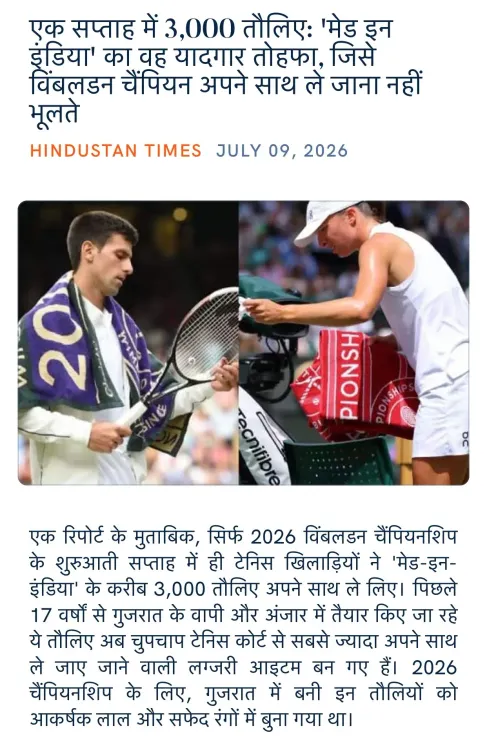
Union Textiles Minister Giriraj Singh spotlighted a report showing Made-in-India towels are now a prized Wimbledon souvenir, with 3,000 distributed in one week — framing it as proof of Indian manufacturing's rising global stature under the Make in India initiative.
Key Takeaways
Union Textiles Minister Giriraj Singh shared the Wimbledon towel story on 9 July 2026 via the NaMo App.
An estimated 3,000 Made-in-India towels were distributed at Wimbledon in a single week, according to the report he cited.
Wimbledon towels are an official player souvenir at the world's oldest Grand Slam, held annually in London .
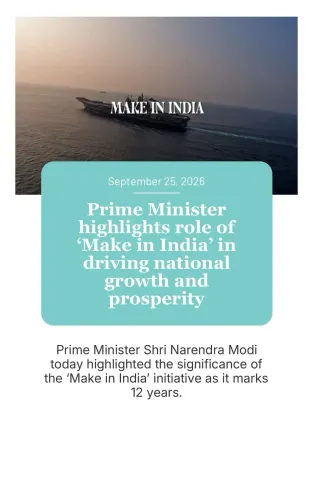
The development connects to the Make in India initiative, launched in September 2014 , which has prioritised textile exports as a key growth pillar.
Indian textile exporters and manufacturers stand to gain both commercial contracts and international brand recognition from such high-profile placements.
Analysts will watch for follow-up policy announcements on expanded textile contracts with global sporting events or updates to the production-linked incentive scheme.
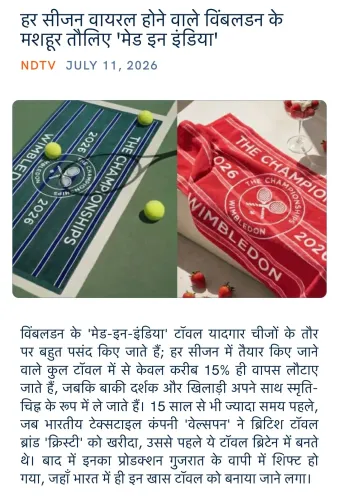
Union Textiles Minister Giriraj Singh on Thursday, 9 July 2026 shared a report highlighting that Indian-made towels have become a coveted souvenir among Wimbledon champions, with an estimated 3,000 towels distributed in a single week at the tournament — drawing attention to the growing global footprint of India's textile sector.
Context
The minister shared the report via the NaMo App, flagging the story as a symbol of Indian manufacturing making its mark on the world's most prestigious tennis tournament. The post, in Hindi, celebrated the milestone as a 'yādgār tohfā' (memorable gift) that Wimbledon champions 'can't leave behind.' Wimbledon, held annually in London, is the oldest Grand Slam in tennis and is globally recognised for presenting players with towels as official souvenirs — a tradition that has now incorporated Indian-made goods.
Policy Backdrop
The spotlight on Wimbledon towels connects directly to the Make in India initiative, launched in September 2014 under the central government to establish India as a global manufacturing and export hub. Textiles have been a cornerstone of this push, with successive policy interventions — including production-linked incentive schemes — aimed at raising India's share of global textile trade.
India is already among the world's largest producers and exporters of cotton and technical textiles. Securing supply contracts with high-visibility international sporting events is part of a broader strategy to embed Indian brands into premium global markets, particularly in Europe.
Stakeholders and Impact
The primary beneficiaries of such placements are Indian textile exporters and manufacturers, who gain both commercial contracts and international brand recognition. For the broader sector, visibility at a tournament watched by millions globally carries significant soft-power value that complements formal trade diplomacy.
The minister's amplification of this story signals that the government views such milestones as validation of its export-promotion architecture. It also reinforces the narrative that 'Made in India' goods are meeting the quality standards demanded by elite international institutions.
What's Next
Attention will now turn to whether the Ministry of Textiles follows up with formal announcements on expanded Indian textile contracts with major sporting events globally, or accelerates updates to the production-linked incentive framework for the sector. Any such moves would indicate that the government intends to convert high-profile placements like Wimbledon into a repeatable export-promotion template.
Point of View
Using Wimbledon's global prestige as a proxy for Indian manufacturing quality. By amplifying a consumer-facing milestone rather than a policy announcement, the minister is translating abstract export statistics into a story that resonates with a broad domestic audience. This fits a sustained pattern of using elite international sporting events as soft-power showcases for Indian goods — a strategy that blurs the line between trade promotion and political messaging. The real test will be whether such moments translate into durable supply-chain relationships and measurable gains in India's share of global textile exports.
NationPress
8 Oct 2026
Frequently Asked Questions
Why is Giriraj Singh talking about Wimbledon towels?
Union Textiles Minister Giriraj Singh shared a report on 9 July 2026 highlighting that Made-in-India towels have become a popular souvenir at Wimbledon, framing it as evidence of Indian manufacturing's growing global reach under the Make in India initiative.
Are Wimbledon towels made in India?
According to the report shared by Minister Giriraj Singh, Indian-made towels are among the souvenirs distributed at Wimbledon, with around 3,000 reportedly given out in a single week, though full supply-chain details have not been officially confirmed by the tournament.
What is the Make in India initiative?
Make in India is a flagship central government scheme launched in September 2014 to boost domestic manufacturing, attract investment, and raise India's profile as a global export hub, with textiles being one of its priority sectors.
How many towels does Wimbledon distribute?
The report cited by Minister Giriraj Singh states that approximately 3,000 towels were distributed at Wimbledon in one week, though NationPress has not independently verified this figure.
What does India's textile export push involve?
India's textile export strategy includes production-linked incentive schemes, trade diplomacy targeting European and other markets, and efforts to secure supply contracts with high-visibility international events like Wimbledon to build global brand recognition for Indian goods.