Giriraj Singh backs 'Made for the World' as pharma export mantra
Synopsis
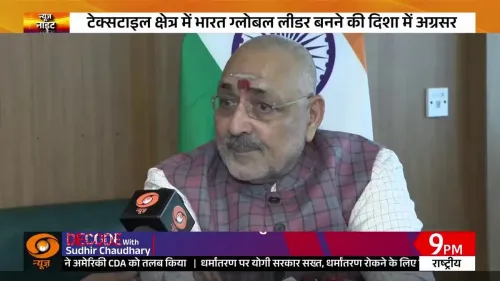
Union Textiles Minister Giriraj Singh on 14 June 2026 amplified the 'Made for the World' framing for India's pharmaceutical exports, building on the Make in India and PLI schemes that have positioned India as the world's largest generic medicine supplier by volume.
Key Takeaways
Union Textiles Minister Giriraj Singh shared content on 14 June 2026 backing a 'Made for the World' export identity for Indian pharma.
India supplies roughly 20 per cent of global generic medicine exports by volume, making it the world's largest generic supplier.
The Make in India initiative, launched in September 2014 , first anchored the domestic pharma manufacturing push.
The PLI scheme for pharmaceuticals , approved in 2020 , added financial incentives to scale up API and formulation output and reduce dependence on Chinese imports.
Key manufacturing hubs include Hyderabad, Ahmedabad, Himachal Pradesh, Gujarat, Telangana, and Andhra Pradesh .
Upcoming PLI reviews and Union Budget announcements will shape the next phase of pharma export promotion.
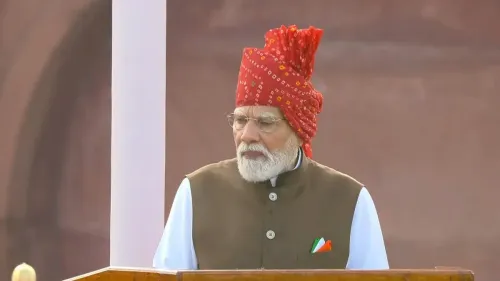
Union Textiles Minister Giriraj Singh on Sunday, 14 June 2026 shared an article arguing that India's pharmaceutical sector has evolved beyond the Make in India framework to embrace a new export identity — 'Made for the World' — signalling the ruling establishment's push to reposition Indian pharma as a global supply powerhouse.
Context
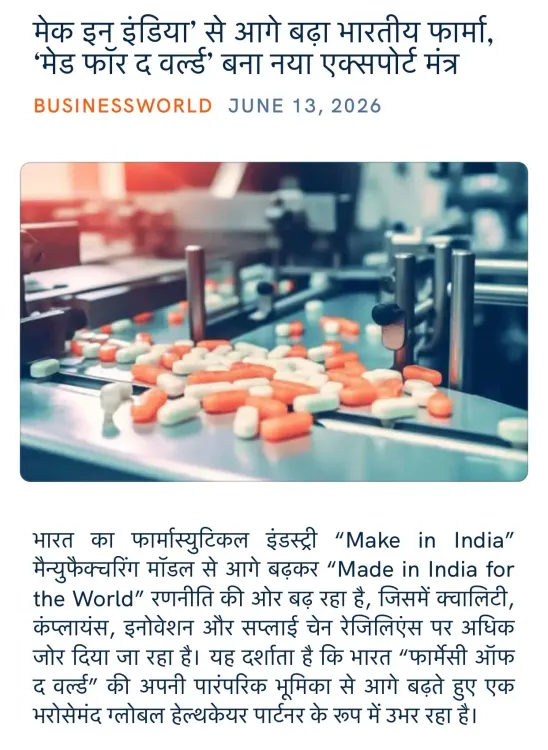
The minister's post, shared via the NaMo App, highlighted a piece contending that 'Make in India se aage badha Bharat ka pharma, Made for the World bana naya export mantra' — broadly translated as 'Indian pharma has moved beyond Make in India, with Made for the World becoming the new export mantra.' While Singh holds the Textiles portfolio, his amplification of a pharma-export narrative reflects the BJP government's broader Atmanirbhar Bharat communication strategy, in which senior ministers routinely champion cross-sectoral economic milestones.
India is already the world's largest supplier of generic medicines by volume, providing affordable drugs to both developing nations and regulated markets in the United States, Europe, and Africa. The country accounts for roughly 20 per cent of global generic medicine exports by volume, a position built over decades of investment in bulk drug manufacturing and formulations.
Policy Backdrop
The 'Made for the World' framing sits atop two foundational policy pillars. The first is the Make in India initiative, launched in September 2014, which set out to attract investment and expand domestic manufacturing capacity across sectors, including pharmaceuticals. The second is the Production Linked Incentive (PLI) scheme for pharmaceuticals, approved in 2020, which offered financial incentives to manufacturers scaling up output of critical bulk drugs and complex formulations.
Together, these schemes were designed to reduce import dependence on Active Pharmaceutical Ingredients (APIs) — many sourced from China — while simultaneously boosting export competitiveness. The PLI scheme in pharma has drawn significant domestic and foreign investment into greenfield and brownfield manufacturing facilities across states including Telangana, Gujarat, Himachal Pradesh, and Andhra Pradesh.
The rhetorical shift from 'Make in India' to 'Made for the World' reflects a maturation in government messaging: domestic manufacturing capacity, once the goal, is now treated as a given, with the emphasis moving firmly toward export market share and global supply chain integration.
Stakeholders and Impact
Indian pharma exporters and generic drug manufacturers stand to benefit most directly from sustained policy attention. Industry bodies representing bulk drug makers and formulation exporters have long sought streamlined regulatory pathways and trade agreements to access new markets, particularly in Africa, Southeast Asia, and Latin America.
For developing nations, India's export-oriented pharma posture carries humanitarian significance — affordable Indian generics underpin public health programmes in dozens of low- and middle-income countries. Any expansion of export capacity and market reach could further lower medicine costs globally. Domestically, the sector is a significant employer, particularly in pharmaceutical clusters in Hyderabad and Ahmedabad.
What's Next
The immediate policy calendar includes the review of ongoing PLI scheme disbursements and performance benchmarks, with outcomes expected to inform the next round of export promotion measures. Industry watchers will look to the upcoming Union Budget and any revisions to India's Foreign Trade Policy for concrete incentives aligned with the 'Made for the World' ambition.
As India deepens trade negotiations with the European Union and pursues bilateral agreements across the Global South, the pharmaceutical sector's export trajectory will serve as a key benchmark for whether the Atmanirbhar Bharat framework can deliver sustained global market gains — not just domestic self-reliance.
Point of View
Despite holding the Textiles portfolio, underscores how the BJP government uses its entire ministerial bench to build a unified economic narrative around Atmanirbhar Bharat. The rhetorical evolution — from 'Make in India' to 'Made for the World' — is deliberate: it frames domestic manufacturing success as already achieved and pivots public attention toward export dominance, a politically useful shift ahead of trade negotiations with the EU and the Global South. The move also signals that pharma, long treated as a strategic sector for supply security, is now being repositioned as an export-led growth engine. Whether the PLI scheme's actual disbursement record and new market access deals can substantiate this ambition remains the critical test.
NationPress
13 Sept 2026
Frequently Asked Questions
What is the 'Made for the World' pharma slogan Giriraj Singh shared?
'Made for the World' is a proposed new export identity for India's pharmaceutical sector, suggesting that Indian pharma has moved beyond domestic manufacturing goals under Make in India and is now focused on capturing larger shares of global medicine markets.
What is India's current position in global pharma exports?
India is the world's largest supplier of generic medicines by volume, accounting for roughly 20 per cent of global generic drug exports, supplying markets across Africa, Southeast Asia, Latin America, Europe, and the United States.
How does the PLI scheme support Indian pharma exports?
The Production Linked Incentive scheme for pharmaceuticals, approved in 2020, offers financial incentives to manufacturers scaling up output of Active Pharmaceutical Ingredients and complex formulations, reducing import dependence on China and boosting export competitiveness.
Why is a Textiles Minister commenting on pharma policy?
Senior BJP ministers routinely amplify cross-sectoral economic achievements as part of the government's unified Atmanirbhar Bharat communication strategy, even when the topic falls outside their direct portfolio.
What policy decisions will shape India's pharma export future?
Upcoming reviews of PLI scheme disbursements, the next Union Budget, and revisions to India's Foreign Trade Policy are the key milestones that will determine the concrete incentives backing the 'Made for the World' ambition.