CM Dhami Credits Public Trust as Force Behind Uttarakhand's Development Push
Synopsis
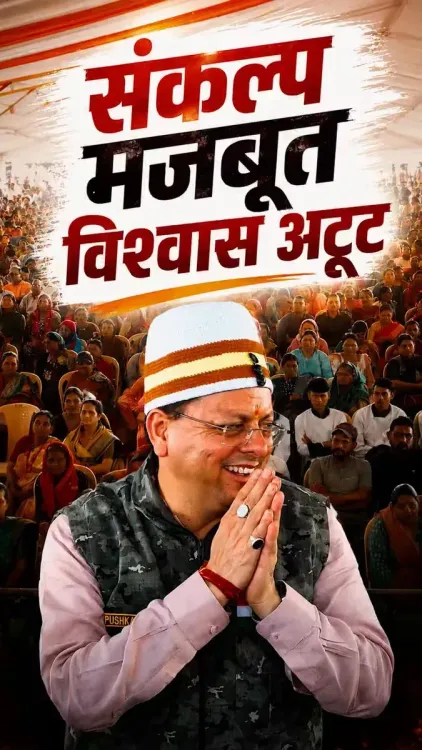
Uttarakhand Chief Minister Pushkar Singh Dhami on 19 July 2026 cited public trust as the foundational force behind his administration's resolve to pursue state development, welfare, and good governance, reaffirming alignment with BJP's national leadership including PM Modi and Amit Shah.
Key Takeaways
CM Pushkar Singh Dhami posted on 19 July 2026 invoking public trust as the source of his government's strength and commitment.
The post was addressed to PM Narendra Modi , Amit Shah , Rajnath Singh , and the BJP's national and state handles.
Dhami's message emphasised three pillars: state development, public welfare, and good governance (su-shasan) .
The BJP has governed Uttarakhand since 2017 and won a second consecutive term in the 2022 assembly elections .
The statement mirrors the BJP's broader national governance narrative rooted in the 'Sabka Saath, Sabka Vikas' framework.
State budget and central scheme reviews later in 2026 are the next expected milestones for concrete policy announcements.
Uttarakhand Chief Minister Pushkar Singh Dhami on Sunday, 19 July 2026, invoked the principle of public trust as the driving force behind his government's commitment to development, welfare delivery, and good governance in the state. The post, addressed to senior BJP leadership including Prime Minister Narendra Modi, Union Home Minister Amit Shah, and Defence Minister Rajnath Singh, underscored the ruling party's continued emphasis on the su-shasan (good governance) narrative.
Context
In his post, CM Dhami wrote in Hindi: 'Janvishwas hi hamare sankalpom ko nayi shakti aur dridhta pradan karta hai' — 'Public trust alone gives new strength and resolve to our commitments.' He added that this very force inspires his administration to move forward with full dedication and devotion on the path of state development, public welfare, and good governance. The message was directed at the BJP's national leadership and the party's Uttarakhand unit handle, signalling alignment between state and central leadership on governance priorities.
Policy Backdrop
The sentiment echoes the BJP's national governance framework — 'Sabka Saath, Sabka Vikas' — first articulated after the party's 2014 general election victory and since operationalised through central and state welfare schemes. Uttarakhand has been governed by the BJP since 2017, and the party secured a second consecutive term in the 2022 assembly elections, campaigning on a platform of development, anti-corruption measures, and administrative efficiency. The Dhami government has consistently framed its policy agenda around linking local delivery of central schemes to visible outcomes for residents of the Himalayan state.
Uttarakhand's governance priorities have centred on infrastructure development, religious tourism — particularly around the Char Dham circuit — and welfare delivery to hill communities. BJP state units across the country routinely issue statements tying public trust to administrative outcomes, a pattern that has become a standard feature of the party's political communication since its return to power at the centre.
Stakeholders and Impact
The primary stakeholders of the governance agenda outlined in CM Dhami's post are the residents of Uttarakhand, a state with a population spread across challenging Himalayan terrain, where delivery of welfare programmes and infrastructure investment carries particular logistical weight. The post's direct mentions of senior central leadership — PM Modi, Amit Shah, and Rajnath Singh — also signal an intent to publicly reaffirm the Uttarakhand government's accountability to the national BJP hierarchy. Such messaging serves both a political and an administrative function, reinforcing the chain of governance responsibility between Dehradun and New Delhi.
For ordinary citizens, the statement represents a reiteration of the state government's self-articulated mandate: that electoral trust translates directly into a continuing obligation to deliver on development and welfare promises made during successive election cycles.
What's Next
State budget presentations and central scheme review meetings expected later in 2026 are likely to provide the next concrete markers of how the Uttarakhand government translates this governance rhetoric into specific allocations and programme targets. Observers will watch whether upcoming policy announcements — particularly in infrastructure, tourism, and social welfare — carry forward the thrust of the messaging CM Dhami has consistently projected since taking office in 2021. The alignment with central leadership signalled in this post suggests coordination on forthcoming policy rollouts remains a priority for the Dehradun administration.
Point of View
Amit Shah, and Rajnath Singh, Dhami publicly positions Uttarakhand's governance agenda as an extension of the national party's vision rather than a standalone state initiative. This vertical alignment serves a dual purpose — reinforcing his own political standing within the party hierarchy while signalling to voters that central resources and attention remain committed to the state. With Uttarakhand's 2027 assembly cycle on the horizon, such messaging is likely to intensify as the government seeks to consolidate its development narrative ahead of the next electoral test.
NationPress
20 Jul 2026
Frequently Asked Questions
What did Uttarakhand CM Pushkar Singh Dhami say in his July 2026 post?
CM Dhami said that public trust gives new strength and resolve to his government's commitments, and that this trust inspires his administration to move forward with dedication on the path of state development, public welfare, and good governance.
Who did CM Dhami tag in his governance post on X?
CM Dhami tagged Prime Minister Narendra Modi, Union Home Minister Amit Shah, Defence Minister Rajnath Singh, and the BJP's national and Uttarakhand party handles in his post.
What is the BJP's governance framework that Dhami's post reflects?
The post reflects the BJP's 'Sabka Saath, Sabka Vikas' framework, a national governance philosophy emphasising inclusive development and welfare delivery that the party has promoted since its 2014 general election victory.
How long has the BJP governed Uttarakhand?
The BJP has governed Uttarakhand since 2017 and secured a second consecutive term in the 2022 state assembly elections, with Pushkar Singh Dhami serving as Chief Minister since 2021.
What are the key governance priorities of the Uttarakhand government under Dhami?
The Dhami government's stated priorities include infrastructure development, religious tourism around the Char Dham circuit, welfare delivery to hill communities, and anti-corruption measures, aligned with central BJP schemes.