CM Dhami Vows New Push for Border Tourism and Youth Jobs
Synopsis
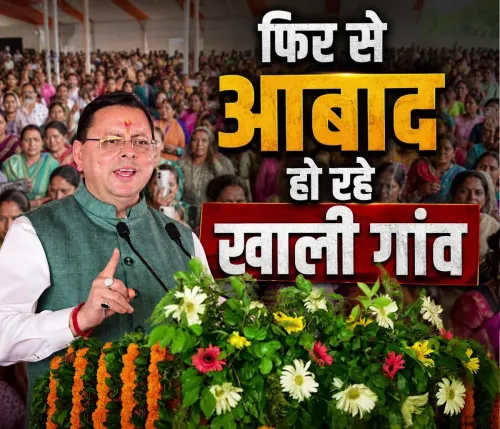
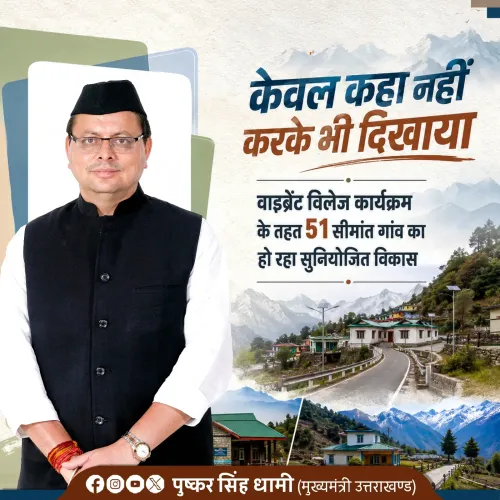
Chief Minister Pushkar Singh Dhami has pledged new momentum for tourism, employment, and youth entrepreneurship in Uttarakhand's frontier districts bordering China and Nepal, building on central schemes such as the Vibrant Villages Programme and the Border Area Development Programme.
Key Takeaways
CM Pushkar Singh Dhami announced a fresh push for tourism, employment, and youth entrepreneurship in Uttarakhand's border districts .
The initiative targets communities along the state's boundaries with China and Nepal , where outmigration has been a persistent problem.
The move aligns with the central government's Vibrant Villages Programme and the long-running Border Area Development Programme (BADP) .
Key beneficiary districts include Chamoli, Pithoragarh, Uttarkashi , and Champawat .
The strategy mirrors border-development models in Ladakh and Arunachal Pradesh that link tourism with population retention.
Concrete scheme details — new tourism circuits, credit windows, or budget allocations — are expected as follow-through to the announcement.
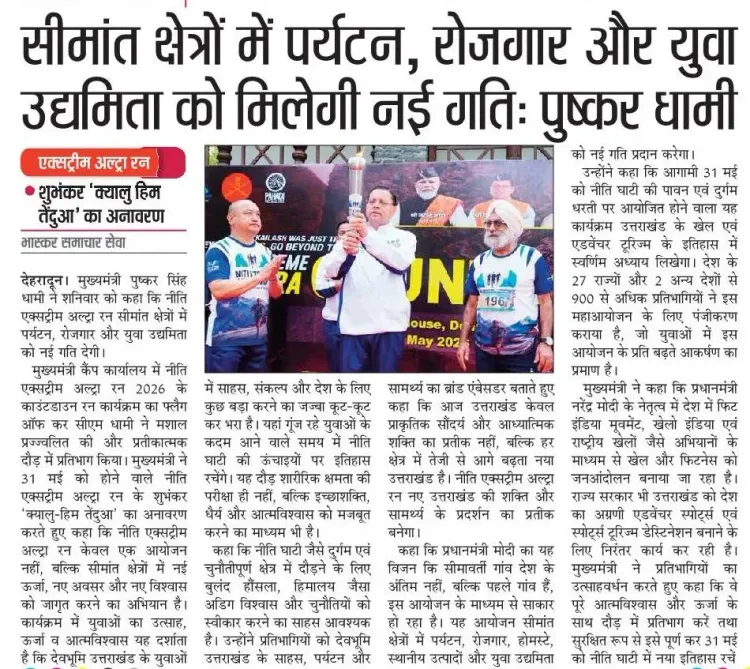
The Chief Minister's Office of Uttarakhand announced on Sunday, 24 May 2026 that the state government is set to accelerate tourism, employment, and youth entrepreneurship in its frontier districts, with Chief Minister Pushkar Singh Dhami personally championing the initiative. The post signals a renewed policy thrust aimed at communities in Uttarakhand's border zones, which share boundaries with China and Nepal.
Context
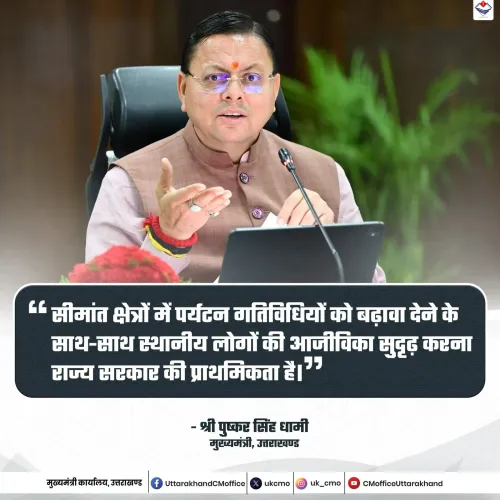
The Chief Minister's Office posted on X that 'सीमांत क्षेत्रों में पर्यटन, रोजगार और युवा उद्यमिता को मिलेगी नई गति' — translated: 'Tourism, employment, and youth entrepreneurship in border areas will receive new momentum.' The statement, attributed directly to CM Pushkar Singh Dhami, frames frontier development as a priority rather than a peripheral concern. Uttarakhand's border districts — including parts of Chamoli, Pithoragarh, Uttarkashi, and Champawat — have historically struggled with outmigration and limited economic opportunity.
Policy Backdrop
The announcement aligns with two overlapping policy frameworks. The central government's Vibrant Villages Programme, launched to develop infrastructure and livelihoods in villages along the northern border, has Uttarakhand among its primary beneficiary states. Separately, the Border Area Development Programme (BADP), administered by the Ministry of Home Affairs, has channelled infrastructure and tourism investment into frontier blocks since the early 2000s.
Uttarakhand's approach — linking tourism circuits to self-employment and youth enterprise — mirrors strategies adopted in Ladakh and Arunachal Pradesh, where border states have increasingly fused strategic population-retention goals with livelihood programming. The Dhami government has previously emphasised connectivity and hill-district development as central to its governance agenda since taking office in 2021.
Stakeholders and Impact
The groups most directly affected are young residents of border villages who currently face limited local employment and often migrate to plains cities. Tourism entrepreneurs — homestay operators, trekking guides, and local artisans — stand to benefit if new circuits or credit schemes are announced as follow-through. Frontier village communities more broadly could see improved infrastructure and footfall if the initiative translates into budget allocations and scheme convergence.
Retaining population in border districts carries an implicit strategic dimension: inhabited, economically active frontier villages strengthen India's administrative and demographic presence along sensitive international boundaries, a rationale that has underpinned central funding under both BADP and Vibrant Villages.
What's Next
Observers will watch for concrete roll-out details — whether the state announces new border tourism circuits, dedicated youth credit windows, or enhanced coordination with central ministries for Vibrant Villages Phase II. Any budget notification or scheme guidelines issued by the Uttarakhand government in the coming weeks will indicate how quickly this stated momentum translates into on-ground programming. The signal from Dehradun is clear: frontier development is being positioned as both an economic and a strategic imperative for the state.
Point of View
The state signals a shift from passive subsidy to active economic activation in frontier zones. This mirrors a broader national pattern — visible in Ladakh and Arunachal Pradesh — where border states are expected to demonstrate demographic vitality as a form of soft sovereignty. The real test will be whether the rhetoric is followed by specific scheme notifications and budget lines in the months ahead.
NationPress
19 Sept 2026
Frequently Asked Questions
What did CM Dhami announce for Uttarakhand border areas?
CM Pushkar Singh Dhami announced that tourism, employment, and youth entrepreneurship in Uttarakhand's frontier districts will receive new momentum, signalling a policy push for communities along the state's borders with China and Nepal.
Which districts in Uttarakhand are border districts?
Uttarakhand's main frontier districts include Pithoragarh, Chamoli, Uttarkashi , and Champawat , which share boundaries with China and Nepal and have historically faced outmigration and limited economic activity.
What is the Vibrant Villages Programme and how does it relate to Uttarakhand?
The Vibrant Villages Programme is a central government initiative to develop infrastructure, tourism, and livelihoods in villages along India's northern border. Uttarakhand is one of its primary beneficiary states, making it directly relevant to CM Dhami's border-development push.
Why is border tourism important for Uttarakhand?
Border tourism can generate local employment and income for frontier communities, reducing the outmigration that has depopulated many villages. A resident population in border zones also strengthens India's administrative presence along sensitive international boundaries.
What is the Border Area Development Programme (BADP)?
The Border Area Development Programme is a Ministry of Home Affairs scheme that has funded infrastructure and tourism projects in Uttarakhand's frontier blocks since the early 2000s, forming the policy foundation on which newer initiatives like Vibrant Villages are built.