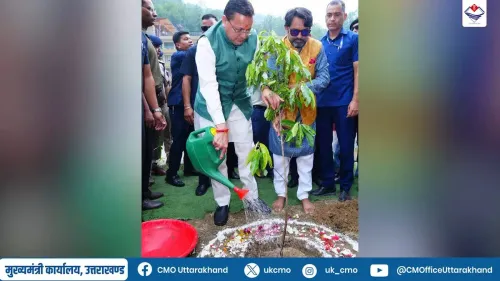
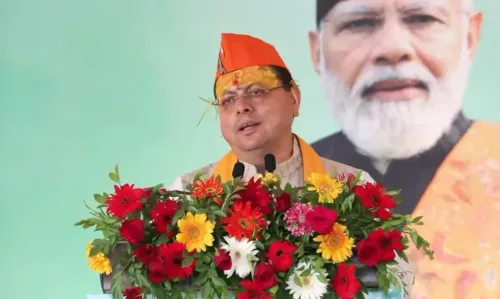
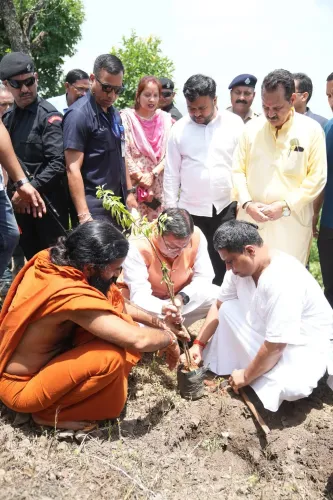
CM Dhami Calls Harela a Mass Movement for Nature and Heritage
Synopsis
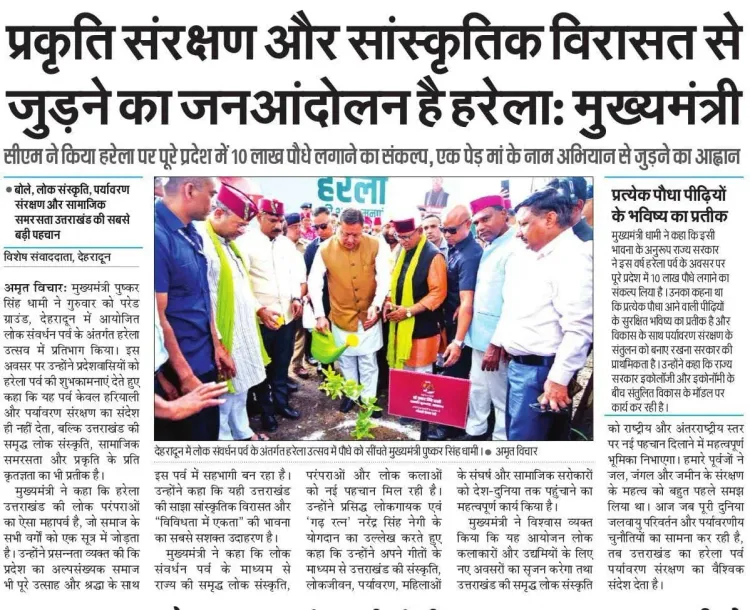
Chief Minister Pushkar Singh Dhami has described Harela as a mass movement for nature conservation and cultural heritage, as Uttarakhand marks the traditional Kumaon festival in mid-July with statewide plantation drives and community participation.
Key Takeaways
CM Pushkar Singh Dhami called Harela a 'mass movement for nature conservation and cultural heritage' in a statement shared by the Chief Minister's Office on 17 July 2026 .
Harela is a traditional festival of Uttarakhand's Kumaon region , observed in mid-July to mark the monsoon onset through sapling plantation and seed sowing.
The statement connects Harela to Uttarakhand's broader ecological identity, rooted in the Chipko movement of 1973 .
Statewide plantation drives and official events are expected to be organised around the festival period.
Hill communities , local environmental groups, schools, and self-help groups are the primary stakeholders mobilised during Harela observances.
The 'jan andolan' framing signals an intent to broaden participation beyond traditional observers to the wider public.
The Chief Minister's Office of Uttarakhand, on Friday, 17 July 2026, shared a statement by Chief Minister Pushkar Singh Dhami describing Harela as a people's movement rooted in nature conservation and cultural heritage, underscoring the state government's push to elevate the traditional festival into a statewide ecological mission.
Context
The post, shared via the official CMO handle, quotes CM Dhami as saying: 'Harela prakriti sanrakshan aur sanskritik virasat se judne ka jan andolan hai' — 'Harela is a mass movement for connecting with nature conservation and cultural heritage.' The statement was issued as communities across Uttarakhand's Kumaon region prepared to observe the festival, which falls each year in mid-July to mark the onset of the monsoon season.
Harela traditionally involves the planting of saplings and the sowing of seeds as a symbolic affirmation of ecological values. The festival holds deep cultural significance for hill communities, linking agrarian cycles with forest stewardship.
Policy Backdrop
Uttarakhand has a long history of community-driven forest conservation, most famously through the Chipko movement that began in 1973, when villagers — largely women — embraced trees to prevent commercial logging in the Himalayan foothills. State administrations have since sought to channel that legacy into formal policy, repeatedly framing traditional festivals as vehicles for afforestation drives and ecological awareness campaigns.
CM Dhami, who has led the state since 2021, has consistently promoted environmental and cultural programmes as twin pillars of Uttarakhand's identity. The Harela observance fits squarely within this pattern, with government agencies typically organising plantation events timed to coincide with the festival.
Stakeholders and Impact
Hill communities across Kumaon and beyond are the primary participants, with local environmental groups, schools, and self-help groups often mobilised for plantation activities. For these communities, Harela represents not just a cultural occasion but a lived practice of ecological responsibility passed down through generations.
The Himalayan region faces acute climate vulnerability — including erratic monsoons, glacial retreat, and deforestation — making community-led conservation efforts particularly significant. By framing Harela as a 'jan andolan' (mass movement), the Chief Minister's statement seeks to broaden participation beyond traditional observers to encompass the wider citizenry.
What's Next
Statewide plantation drives and official events are expected to be organised across Uttarakhand in the days surrounding the Harela observance in mid-July. The government's framing of the festival as a mass movement suggests an intent to scale up public participation and institutional support beyond ceremonial acknowledgement.
How effectively the administration converts cultural momentum into measurable afforestation outcomes will be a key indicator of whether the 'jan andolan' framing translates into lasting ecological impact in one of India's most environmentally sensitive Himalayan states.
Point of View
Lending cultural legitimacy to what are otherwise government-organised plantation drives. This framing serves a dual purpose: it positions the BJP-led administration as a steward of both ecological and cultural heritage in a state where environmental identity is politically potent. The move also reflects a broader national pattern of packaging traditional practices within the vocabulary of civic mobilisation to drive participation in government schemes. Whether it deepens genuine community ownership of conservation or remains largely symbolic will depend on the institutional follow-through beyond the festival season.
NationPress
15 Oct 2026
Frequently Asked Questions
What is Harela festival in Uttarakhand?
Harela is a traditional festival observed primarily in the Kumaon region of Uttarakhand, celebrated in mid-July to mark the onset of the monsoon. It involves planting saplings and sowing seeds as a symbol of ecological values and agrarian well-being.
What did CM Dhami say about Harela in 2026?
Chief Minister Pushkar Singh Dhami described Harela as a 'mass movement for connecting with nature conservation and cultural heritage,' in a statement shared by the Chief Minister's Office of Uttarakhand on 17 July 2026.
How is Harela connected to Uttarakhand's environment policy?
Uttarakhand administrations have long used Harela as a platform for afforestation and ecological awareness, consistent with the state's history of community forest conservation dating back to the Chipko movement of 1973.
When is Harela celebrated in 2026?
Harela falls in mid-July each year, coinciding with the onset of the monsoon season. In 2026, the Chief Minister's Office shared the official statement on 17 July 2026.
What is the Chipko movement and how does it relate to Harela?
The Chipko movement began in 1973 in Uttarakhand, when villagers embraced trees to prevent commercial logging — an early example of community-led forest conservation. CM Dhami's framing of Harela as a 'jan andolan' consciously echoes that grassroots legacy.