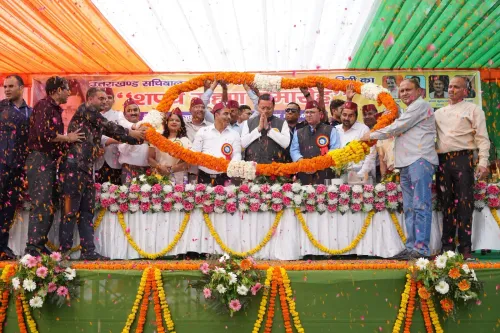
CM Dhami Hikes Uttarakhand State Employee DA to 63%

Synopsis
Chief Minister Pushkar Singh Dhami approved a 3% dearness allowance hike for Uttarakhand state employees on 5 November 2026, raising DA from 60% to 63% effective 1 July 2026 — matching the central government revision — with cash arrears payable for July–October 2026.
Key Takeaways
Dearness Allowance for Uttarakhand state employees raised from 60% to 63% , a 3 percentage point increase.
The revised rate is effective 1 July 2026 , mirroring the Government of India 's central DA revision under the 7th Central Pay Commission .
Coverage extends beyond regular state staff to employees of local bodies , aided educational institutions , state and technical universities , and UGC pay-scale employees.
DA difference for the period 1 July 2026 to 31 October 2026 will be disbursed as cash arrears to all eligible employees.
The decision follows the standard Indian administrative practice of states aligning with central DA revisions post-7th CPC, in place since 2016 .
Thousands of Uttarakhand government employees woke up to better pay on Thursday, 5 November 2026 — Chief Minister Pushkar Singh Dhami approved a 3 percentage point hike in Dearness Allowance for state employees, lifting the rate from 60% to 63%, effective 1 July 2026.
Matching New Delhi: Why 63% and Why Now
The move is a direct response to a parallel revision by the Government of India, which had already raised DA to 63% for central employees under the 7th Central Pay Commission framework — also effective 1 July 2026. The Chief Minister's Office of Uttarakhand confirmed that the state has aligned its rates to maintain parity with the Centre, a practice that has been standard across Indian states since the 7th CPC was rolled out in 2016. When New Delhi moves, the states that follow the same pay-commission architecture typically follow within weeks, to prevent the kind of pay-disparity resentment that can quickly become a political headache.
Who Gets the Raise — and the Arrears
The benefit is wide-ranging. Beyond regular state government personnel, the hike covers employees of local bodies, aided educational institutions, state universities, technical educational institutions, and eligible staff drawing UGC pay scales. That is a substantial cross-section of Uttarakhand's public-sector workforce — from a schoolteacher in a grant-in-aid college in Pauri to a municipal worker in Dehradun.
Crucially, the gap between the old rate and the new one will not simply vanish into a future salary slip. The Chief Minister's approval specifies that the DA differential for the period 1 July 2026 to 31 October 2026 will be paid as a cash arrear to all eligible employees — a lump-sum back-payment that provides an immediate financial cushion ahead of the winter season.
The 7th Pay Commission Mechanism Behind Every DA Revision
The 7th Central Pay Commission, whose recommendations took effect from 1 January 2016, established the current architecture under which DA is revised twice a year — in January and July — based on inflation data tracked through the All India Consumer Price Index. Each central revision sets a de-facto benchmark that state governments, particularly those running their pay structures on 7th CPC scales, feel institutional pressure to match. Uttarakhand's latest approval is a textbook instance of that cascade in action.
With arrears to be disbursed and a revised monthly outgo kicking in, the state's finance department now faces the task of calibrating the enhanced DA liability into existing budget allocations — the next immediate variable to watch in Dehradun.
Point of View
Approving it quickly — and specifying cash arrear disbursement — signals administrative responsiveness ahead of a season when government employees' purchasing power is a live political variable. The broader pattern underscores how the 7th Pay Commission continues, a decade on, to function as a de-facto national pay governance framework, constraining state fiscal autonomy even as it delivers predictable, inflation-linked relief to a large formal workforce.
NationPress
5 Nov 2026
Frequently Asked Questions
By how much has dearness allowance been increased for Uttarakhand state employees in 2026?
The DA has been increased by 3 percentage points — from 60% to 63% — effective 1 July 2026 , as approved by Chief Minister Pushkar Singh Dhami .
Who all will benefit from the Uttarakhand DA hike?
The hike covers regular state government employees , staff of local bodies , employees of aided educational institutions , state universities , technical educational institutions , and eligible personnel on UGC pay scales .
Will Uttarakhand employees receive arrears for the DA hike?
Yes. The DA differential for 1 July 2026 to 31 October 2026 will be paid as a cash arrear to all eligible employees, as per CM Dhami's approval.
Why did Uttarakhand align its DA with the central government rate?
Uttarakhand follows the 7th Central Pay Commission pay structure. Indian states using this framework routinely match central DA revisions to maintain pay parity and prevent employee discontent — a practice in place since 2016 .
What is the current DA rate for central government employees under the 7th Pay Commission?
The Government of India revised the DA to 63% for 7th CPC employees, also effective 1 July 2026 , which Uttarakhand has now matched.