CM Dhami pays tribute to Mahasweta Devi on death anniversary
Synopsis
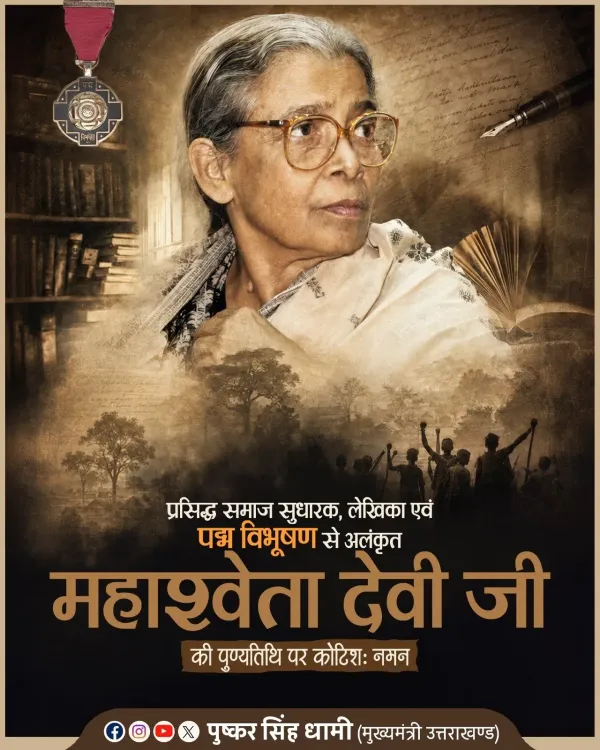
Uttarakhand Chief Minister Pushkar Singh Dhami on 28 July 2026 honoured Padma Vibhushan recipient and Bengali author Mahasweta Devi on her death anniversary, saluting her lifelong literary advocacy for tribal and marginalised communities at national and global levels.
Key Takeaways
CM Pushkar Singh Dhami posted a tribute to Mahasweta Devi on her death anniversary on 28 July 2026 .
Mahasweta Devi was a Padma Vibhushan-decorated Bengali writer and social activist known for championing Adivasi and marginalised communities.
Dhami credited her with giving the voices of the 'deprived, exploited, and tribal society' recognition at national and global levels.
Her notable works include Hajar Churashir Maa and Aranyer Adhikar , and she received the Jnanpith Award and Sahitya Akademi Award .
The tribute is part of a broader pattern of Indian political leaders publicly honouring literary and reformist figures on death anniversaries.
Uttarakhand Chief Minister Pushkar Singh Dhami on Tuesday, 28 July 2026 paid homage to celebrated Bengali writer and social reformer Mahasweta Devi on her death anniversary, honouring her legacy of amplifying the voices of tribal and marginalised communities through literature.
Context
In his post, CM Dhami offered 'kotishaha naman' — salutations in crores — to Mahasweta Devi, describing her as a prasiddh samaj sudharak, prakhyat lekhika (renowned social reformer and distinguished writer) who used her pen to give national and global recognition to the voices of the deprived, exploited, and tribal society. He also noted her distinction as a recipient of the Padma Vibhushan, one of India's highest civilian honours.
The tribute reflects a well-established practice among Indian political leaders of publicly acknowledging literary and reformist figures on their death anniversaries, connecting contemporary governance with the historical struggle for social equity.
Policy Backdrop
Mahasweta Devi was one of independent India's most consequential literary voices, best known for works such as Hajar Churashir Maa and Aranyer Adhikar, which documented the exploitation of Adivasi and bonded-labour communities. She was awarded the Padma Vibhushan in 2006, having earlier received the Sahitya Akademi Award and the Jnanpith Award for her body of work.
Her activism extended beyond fiction: she edited the journal Bortika and campaigned relentlessly for the rights of tribal peoples, particularly in West Bengal and Jharkhand. Her writings are widely credited with placing Adivasi rights on India's national literary and political agenda.
Stakeholders and Impact
Tributes of this nature carry symbolic weight for tribal communities, Dalit groups, and civil-society organisations that draw on Mahasweta Devi's work as a reference point for ongoing advocacy. When senior political figures publicly invoke her legacy, it signals at least rhetorical alignment with the causes she championed — land rights, bonded labour abolition, and indigenous cultural preservation.
For the Bharatiya Janata Party, whose governments have faced scrutiny over tribal welfare policy, such commemorations also serve as a bridge to a broad, cross-partisan cultural consensus around literary icons who transcended party lines.
What's Next
State governments and literary bodies across India typically mark such anniversaries with seminars, readings, and commemorative events. Observers will watch whether Uttarakhand or other BJP-governed states follow the tribute with concrete programmatic steps — such as curriculum inclusion or support for Adivasi cultural institutions — that translate homage into policy action.
Point of View
Signalling cultural breadth beyond their core ideological base. Mahasweta Devi's work was explicitly critical of state neglect of tribal peoples, making the invocation a politically nuanced gesture. For the BJP, associating with her memory helps soften perceptions on Adivasi welfare — a constituency that has grown increasingly significant in electoral arithmetic. Whether such symbolic recognition translates into substantive policy for tribal communities remains the central question observers will press.
NationPress
28 Jul 2026
Frequently Asked Questions
Who was Mahasweta Devi?
Mahasweta Devi was a celebrated Bengali writer and social activist known for her fiction and journalism documenting the exploitation of tribal and marginalised communities in India. She received the Padma Vibhushan in 2006 , the Jnanpith Award , and the Sahitya Akademi Award .
When did Mahasweta Devi die?
Mahasweta Devi passed away on 28 July 2016 in Kolkata , and her death anniversary is observed on that date each year.
Why did CM Dhami pay tribute to Mahasweta Devi?
Uttarakhand CM Pushkar Singh Dhami paid tribute on her death anniversary, honouring her contributions as a social reformer and writer who amplified the voices of tribal and marginalised communities at national and global levels.
What is Mahasweta Devi famous for?
She is best known for literary works such as Hajar Churashir Maa and Aranyer Adhikar , and for her activism on behalf of Adivasi rights and bonded-labour communities, particularly in West Bengal and Jharkhand .
What is the Padma Vibhushan award?
The Padma Vibhushan is India's second-highest civilian honour, awarded by the Government of India for exceptional and distinguished service to the nation in any field.