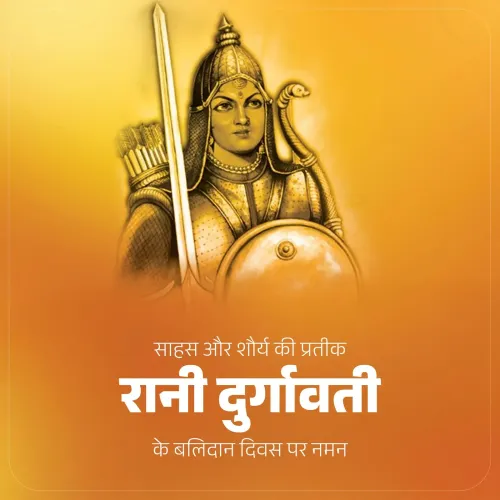
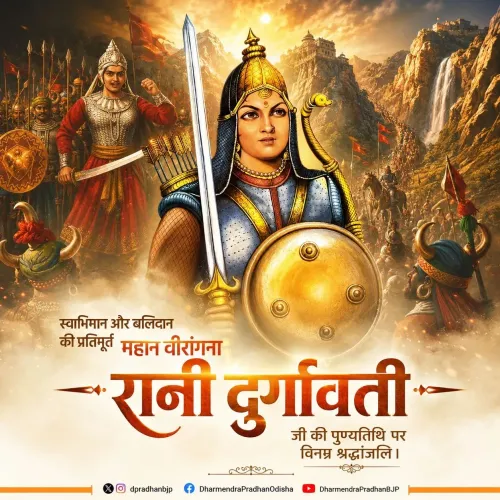
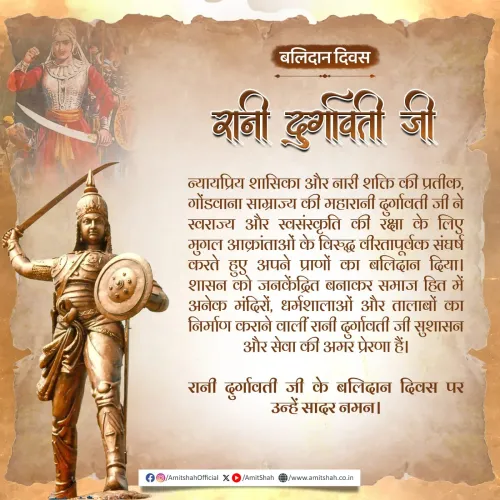
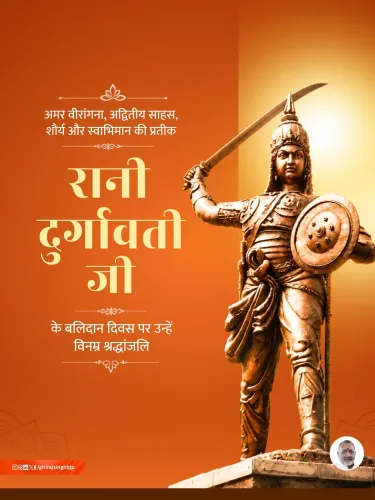
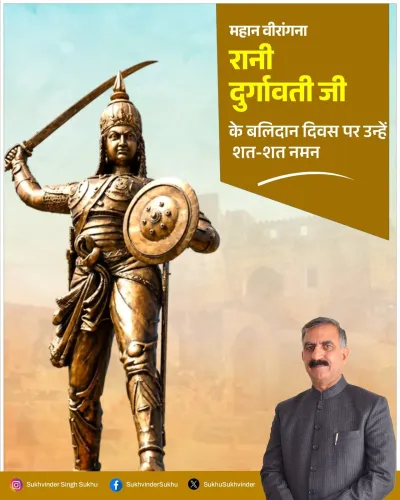
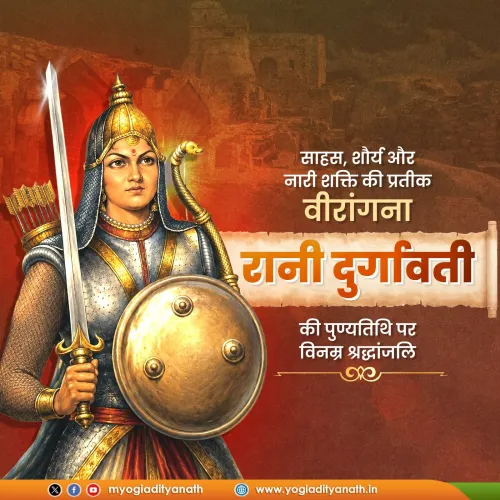
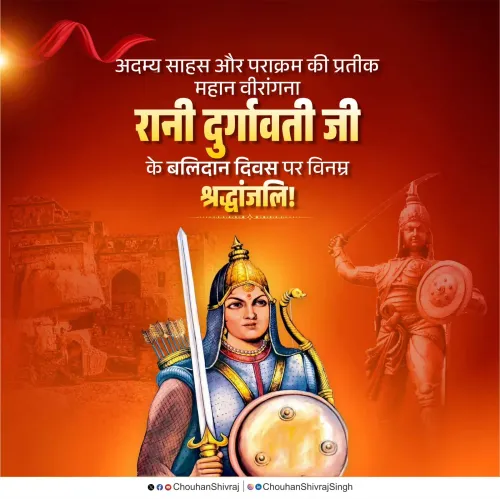
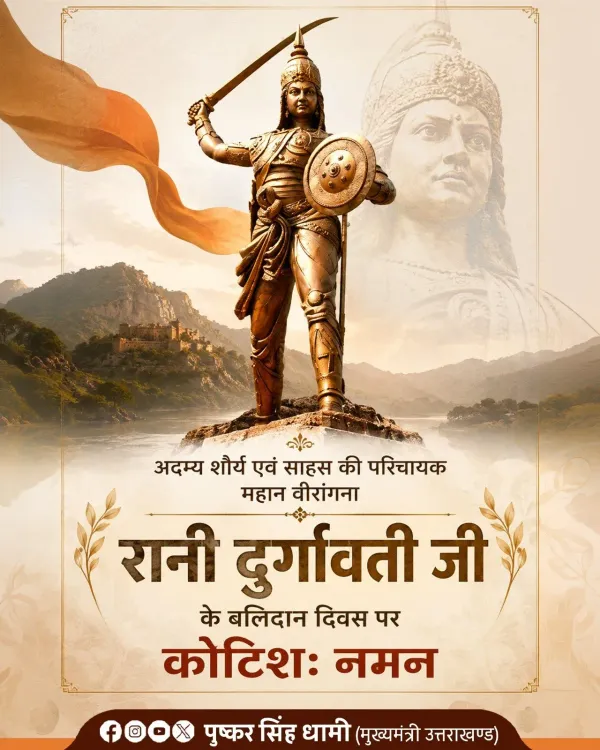
CM Dhami pays tribute to Rani Durgavati on her Balidan Diwas
Synopsis
Uttarakhand Chief Minister Pushkar Singh Dhami on 24 June 2026 paid tribute to 16th-century Gond warrior queen Rani Durgavati on her martyrdom anniversary, saluting her sacrifice for the motherland and invoking her legacy as an inspiration for national service.
Key Takeaways
CM Pushkar Singh Dhami posted a tribute to Rani Durgavati on her martyrdom anniversary, 24 June 2026 .
Rani Durgavati was a 16th-century Gond queen who died fighting Mughal forces under Asaf Khan in 1564 .
She ruled the Garha-Mandla kingdom in the Gondwana region, covering present-day Madhya Pradesh and Chhattisgarh .
Madhya Pradesh established memorials and renamed institutions after her in 2021-22 .
The tribute is part of a broader BJP pattern of marking pre-colonial warrior anniversaries to reinforce cultural-nationalist messaging.
Her legacy holds particular significance for tribal communities of the Gondwana belt.
Uttarakhand Chief Minister Pushkar Singh Dhami on Wednesday, 24 June 2026 paid homage to Rani Durgavati, the 16th-century Gond warrior queen, on her martyrdom anniversary, hailing her as an embodiment of indomitable courage and sacrifice in defence of the motherland.
Context
In his post, CM Dhami wrote: 'मां भारती की रक्षा हेतु अपना सर्वस्व न्योछावर करने वाली अदम्य शौर्य एवं साहस की परिचायक महान वीरांगना रानी दुर्गावती जी के बलिदान दिवस पर कोटिशः नमन' — meaning, 'I offer countless salutations on the martyrdom day of the great warrior queen Rani Durgavati, who epitomises indomitable valour and courage and who sacrificed everything for the protection of Mother India.' He added that her saga of bravery would continue to inspire service to the nation.
Rani Durgavati ruled the Garha-Mandla kingdom in the Gondwana region — present-day Madhya Pradesh and Chhattisgarh — and fell in battle against Mughal forces commanded by Asaf Khan in 1564. She chose death over surrender and is venerated across central India as a symbol of resistance, sovereignty, and feminine martial spirit.
Policy Backdrop
The tribute fits a broader pattern of BJP-led state governments reclaiming pre-colonial warrior figures as part of a cultural-nationalist heritage agenda. Since 2014, state-level leaders have systematically marked death anniversaries of medieval and early-modern Indian rulers through social-media posts, statues, renaming drives, and school-curriculum inclusions.
Madhya Pradesh took concrete steps in 2021-22, establishing memorials, museums, and renamed institutions in honour of Rani Durgavati. Such initiatives have elevated her profile from a regional Gond historical figure to a pan-Indian icon of resistance, drawing particular resonance among tribal communities of the Gondwana belt.
Stakeholders and Impact
The tribute carries significance for tribal communities of Madhya Pradesh and Chhattisgarh, for whom Rani Durgavati is a deeply rooted ancestral symbol. History educators and cultural organisations that advocate inclusion of women warriors in mainstream national narratives also view such high-profile commemorations positively.
For CM Dhami, the post reinforces his positioning as a leader attentive to pan-Indian historical memory, even as Uttarakhand itself has no direct territorial connection to the queen's reign. The message signals solidarity with a wider BJP cultural messaging strategy that links regional heroism to a unified national identity.
What's Next
Observers will watch whether the Uttarakhand government follows this social-media tribute with any institutional action — such as curriculum updates, heritage tourism initiatives, or events honouring women warriors — during the upcoming state assembly session or in the months ahead. Physical commemorations at the state level would mark a shift from symbolic messaging to policy action.
The annual observance of Rani Durgavati's Balidan Diwas on 24 June is likely to continue gaining visibility as competing state governments seek to associate themselves with her legacy, particularly ahead of assembly elections in central Indian states.
Point of View
Dhami signals that the party's heritage agenda transcends geography and reaches tribal as well as mainstream Hindu constituencies. This practice, intensifying since 2014, functions simultaneously as symbolic statecraft and political mobilisation — keeping the party's base energised between electoral cycles. The real test will be whether such tributes translate into tangible policy actions like curriculum reform or heritage infrastructure in the months ahead.
NationPress
22 Sept 2026
Frequently Asked Questions
Who was Rani Durgavati?
Rani Durgavati was a 16th-century Gond queen who ruled the Garha-Mandla kingdom in present-day Madhya Pradesh and Chhattisgarh. She is celebrated for her resistance against Mughal forces and died in battle against Asaf Khan in 1564 rather than surrender.
When is Rani Durgavati's Balidan Diwas observed?
Rani Durgavati's Balidan Diwas, or martyrdom anniversary, is observed on 24 June each year, marking the date she fell in battle in 1564.
Why did CM Dhami pay tribute to Rani Durgavati?
Uttarakhand Chief Minister Pushkar Singh Dhami paid tribute on her martyrdom anniversary as part of a broader BJP practice of honouring pre-colonial Indian warrior figures to promote cultural nationalism and national pride.
What memorials exist for Rani Durgavati?
Madhya Pradesh established memorials, museums, and renamed institutions after Rani Durgavati in 2021-22 as part of state-level heritage initiatives recognising her legacy.
What is the significance of Rani Durgavati for tribal communities?
Rani Durgavati is a deeply rooted ancestral symbol for tribal communities of the Gondwana region in Madhya Pradesh and Chhattisgarh, representing sovereignty, courage, and resistance against external domination.