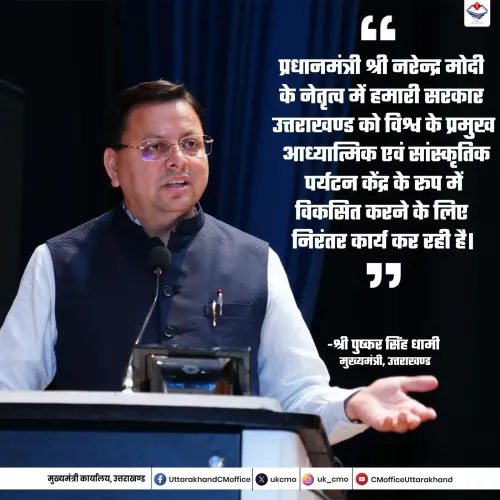
CM Dhami drives record tourist surge at Adi Kailash, Om Parvat

Synopsis
Uttarakhand's CMO reports an unprecedented rise in tourists at Adi Kailash and Om Parvat in Pithoragarh, crediting CM Pushkar Singh Dhami's border-area development drive and religious tourism push.
Key Takeaways
The Chief Minister's Office of Uttarakhand announced on 27 May 2026 that tourist numbers at Adi Kailash and Om Parvat have risen unprecedentedly.
Adi Kailash (also called Chhota Kailash ) and Om Parvat are located in Pithoragarh district near the Indo-China border .
The growth is attributed to CM Pushkar Singh Dhami 's focus on border-area development and religious tourism since 2021 .
The Border Area Development Programme (BADP) has funded infrastructure upgrades in frontier villages of Pithoragarh , improving pilgrim access.
Official tourist-arrival statistics for the 2026-27 yatra season are awaited to confirm the scale of the reported increase.
The Chief Minister's Office of Uttarakhand announced on Wednesday, 27 May 2026 that tourist arrivals at Adi Kailash and Om Parvat in Pithoragarh district have recorded an unprecedented rise under the leadership of Chief Minister Pushkar Singh Dhami, attributing the growth to the state government's sustained push on border-area development and religious tourism promotion.
The official post stated: 'सीमांत क्षेत्रों के विकास और धार्मिक पर्यटन को बढ़ावा देने के क्रम में आदि कैलाश और ओम पर्वत में पर्यटकों की संख्या में अभूतपूर्व वृद्धि दर्ज की गई है' ('In the course of developing border areas and promoting religious tourism, an unprecedented increase in tourist numbers has been recorded at Adi Kailash and Om Parvat').
Context
Adi Kailash, also known as Chhota Kailash, is a sacred peak in the remote Pithoragarh district, situated close to the Indo-China border. Om Parvat, a neighbouring summit in the Kumaon Himalayas, draws pilgrims and trekkers drawn to its natural snow formation that resembles the sacred syllable 'Om'. Both sites have long been considered spiritually significant but remained difficult to access due to limited road connectivity and high-altitude terrain.Policy Backdrop
The Uttarakhand government began positioning Adi Kailash as a viable alternative to the Kailash Mansarovar Yatra — which crosses into Chinese-administered territory — as early as 2018, investing in road upgrades and pilgrim facilities along the route. The Border Area Development Programme (BADP), a central-government scheme with renewed emphasis after 2020, has channelled infrastructure funds into frontier villages across Pithoragarh, improving last-mile connectivity that directly benefits yatra logistics. CM Dhami, in office since 2021, has repeatedly cited border-region tourism as a dual-purpose strategy: generating livelihoods for local communities while reinforcing the state's presence in strategically sensitive zones.Stakeholders and Impact
The primary beneficiaries of the tourist surge are Pithoragarh's border-area residents, many of whom depend on seasonal pilgrim traffic for income through homestays, porter services, and local provisioning. Religious pilgrims — particularly those unable to undertake the Kailash Mansarovar Yatra due to diplomatic or physical constraints — form the core visitor group. Local tourism businesses, including trekking operators and transport providers, stand to gain from higher footfall, while improved road and amenity infrastructure raises the quality of life for permanent residents in these remote villages.What's Next
Attention will now turn to the release of official tourist-arrival data for the 2026-27 Adi Kailash yatra season, which would provide verifiable baseline figures to substantiate the claimed growth. The state government is also expected to announce further investments in road widening and possible heliport development in Pithoragarh to handle higher visitor volumes safely. As domestic religious tourism continues its post-pandemic expansion, Uttarakhand's Himalayan border circuits are likely to feature prominently in the state's upcoming tourism policy calendar.Point of View
Blending developmental optics with strategic geography at a time when India's Himalayan frontier remains in focus. By highlighting Adi Kailash as a thriving pilgrimage alternative, the state is quietly consolidating civilian presence in sensitive border zones — a pattern consistent with broader national policy since 2020. The absence of hard arrival figures, however, leaves the 'unprecedented' claim open to scrutiny once official data is published. How the government manages the infrastructure load of a genuine tourist surge will test whether the policy ambition translates into durable local benefit.
NationPress
10 Oct 2026
Frequently Asked Questions
Where is Adi Kailash located?
Adi Kailash , also known as Chhota Kailash , is located in Pithoragarh district of Uttarakhand , close to the Indo-China border in the Kumaon Himalayas .
Why is Adi Kailash called an alternative to Kailash Mansarovar?
Adi Kailash is considered an alternative to the Kailash Mansarovar Yatra because it offers a similar spiritual experience within Indian territory, making it accessible to pilgrims who cannot travel to Tibet due to diplomatic or physical restrictions.
What is Om Parvat famous for?
Om Parvat in Pithoragarh is famous for a natural snow formation on its face that resembles the sacred Hindu syllable 'Om' , drawing religious tourists and trekkers to the remote Himalayan peak.
What is the Border Area Development Programme?
The Border Area Development Programme (BADP) is a central-government scheme that funds infrastructure — roads, amenities, and connectivity — in villages near India's international borders, including those in Pithoragarh district of Uttarakhand .
How has CM Dhami promoted tourism in Uttarakhand's border areas?
Since taking office in 2021 , CM Pushkar Singh Dhami has prioritised road upgrades, pilgrim facilities, and the BADP to improve access to sites like Adi Kailash and Om Parvat , positioning border-region religious tourism as a key economic and strategic initiative.