Uttarakhand CMO: Adi Kailash emerging as major pilgrim draw
Synopsis
The Chief Minister's Office of Uttarakhand said Adi Kailash Dham in Pithoragarh has emerged as a major attraction for devotees and tourists from India and abroad, crediting Prime Minister Narendra Modi's visit and Chief Minister Pushkar Singh Dhami's tourism policies for the rising profile of the sacred Himalayan peak near the India-Tibet border.
Key Takeaways
Uttarakhand CMO posted on 3 June 2026 highlighting Adi Kailash Dham's rising appeal.
Credit given to PM Narendra Modi's visit and CM Pushkar Singh Dhami's tourism policies.
Site is located in remote Pithoragarh district near the India-Tibet border.
Push aligns with state strategy to expand religious tourism beyond Char Dham sites.
Tourism is seen as a livelihood driver for border communities in Kumaon.
Post tagged #AdiKailash, #Uttarakhand and #Pithoragarh, with a video attached.
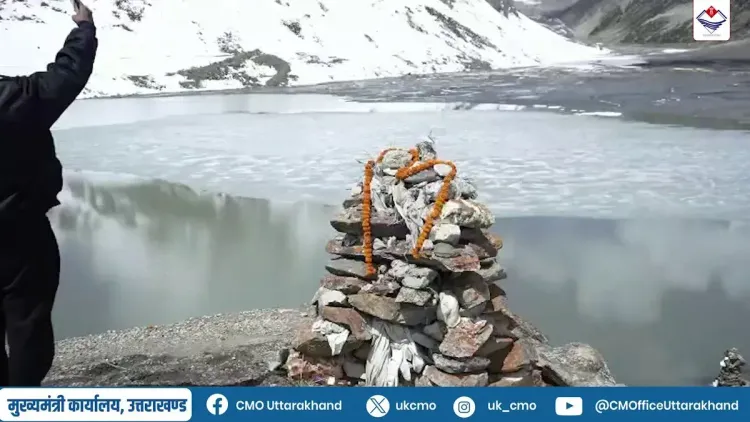
The Chief Minister's Office of Uttarakhand on 3 June 2026 said that Adi Kailash Dham in Pithoragarh district has emerged as a major attraction for pilgrims and tourists from India and abroad, crediting the trajectory to Prime Minister Narendra Modi's visit to the site and the tourism policies of Chief Minister Pushkar Singh Dhami. The post, accompanied by a video, was shared on the official handle of the state's top office.
Context
In its post, the CMO wrote that following 'Pradhanmantri Shri Narendra Modi ke Adi Kailash aagman' (Prime Minister Narendra Modi's arrival at Adi Kailash) and the 'visionary tourism policies' of CM Dhami, the dham has become a 'big centre of attraction for devotees and tourists from the country and abroad'. The message was tagged #AdiKailash, #Uttarakhand and #Pithoragarh.
Adi Kailash, a sacred peak in the inner Himalayas of Pithoragarh, lies close to the India-Tibet border and is revered by devotees as a domestic counterpart to Mount Kailash. The region, long considered remote and difficult to access, has in recent years been folded into the state's wider Himalayan pilgrimage circuit.
Policy backdrop
The push to develop Adi Kailash sits within a broader state and central strategy to expand religious tourism beyond the saturated Char Dham sites of Badrinath, Kedarnath, Gangotri and Yamunotri. The Char Dham Pariyojana, a road-widening project launched in 2016, has progressively improved connectivity to multiple Himalayan shrines, with allied works upgrading routes toward the Kumaon high Himalayas.
For the Dhami government, promoting frontier-area pilgrimage doubles as a development and strategic instrument. Tourism inflows are positioned to generate livelihoods in Dharchula, Munsiyari and adjoining valleys, while a steady civilian footfall is seen as reinforcing presence in border regions adjoining the Line of Actual Control.
Stakeholders and impact
Local communities in Pithoragarh, including homestay operators, porters, drivers and guides, are among the most direct beneficiaries of rising visitor numbers. The district's economy has historically depended on subsistence agriculture and remittances, and tourism is being projected as a third leg.
For pilgrims, the appeal of Adi Kailash lies in a circuit that typically includes Om Parvat and the Parvati Sarovar, set amid alpine meadows and glacial terrain. The CMO's framing of the site as drawing 'devotees and tourists from the country and abroad' signals an intent to position the dham not only as a domestic spiritual destination but also as part of an international Himalayan tourism offer.
State agencies have in parallel worked on facilities such as helipad services, road links and accommodation along the Pithoragarh route, easing what was once a multi-day trek-and-drive journey. Critics have, however, raised concerns about the ecological carrying capacity of fragile high-altitude landscapes if footfall scales sharply.
What's next
Attention will turn to the state tourism department's release of annual footfall data for Adi Kailash, and to any fresh budget allocations for facilities or road links in Pithoragarh. Decisions on regulating visitor numbers, waste management and permit systems for the inner-line area will shape how the site evolves.
If footfall continues to climb, the Adi Kailash circuit could become a template for activating other lesser-known Himalayan dhams, while testing the state's ability to balance pilgrimage promotion with the ecological limits of the high Himalayas.
Point of View
The message reinforces a political narrative that pairs cultural revival with infrastructure delivery. The harder test lies ahead in regulating footfall, protecting a fragile high-altitude ecology and converting tourist inflows into durable local employment in Pithoragarh.
NationPress
16 Oct 2026
Frequently Asked Questions
Where is Adi Kailash located?
Adi Kailash is a sacred peak in Pithoragarh district of Uttarakhand, in the inner Himalayas close to the India-Tibet border. It is often described as a domestic counterpart to Mount Kailash and is part of a pilgrimage circuit that includes Om Parvat and Parvati Sarovar.
Why is Adi Kailash in the news?
The Chief Minister's Office of Uttarakhand has said the dham has become a major attraction for devotees and tourists from India and abroad. The CMO credited Prime Minister Narendra Modi's visit to the site and Chief Minister Pushkar Singh Dhami's tourism policies for its rising profile.
How can pilgrims reach Adi Kailash?
Pilgrims typically travel via Pithoragarh town and onward through Dharchula into the high-altitude valleys, with road, helicopter and trek segments depending on the season. Access requires inner-line permits as the area lies close to the border.
What is the Char Dham Pariyojana?
The Char Dham Pariyojana is a road-widening project launched in 2016 to improve connectivity to Himalayan pilgrimage sites in Uttarakhand. Allied infrastructure work has progressively improved routes toward Kumaon, including the corridor leading to Adi Kailash.
Who is the Chief Minister of Uttarakhand?
Pushkar Singh Dhami is the Chief Minister of Uttarakhand. His government has placed religious and Himalayan tourism at the centre of its development pitch, with a focus on lesser-known dhams in border districts.