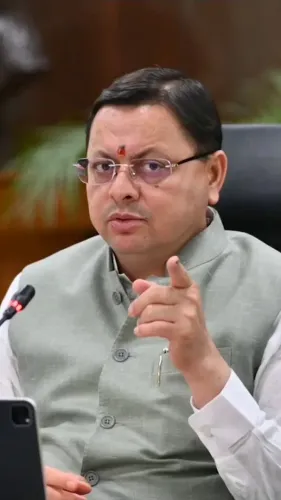
CM Dhami unveils three-pillar, nine-point policy for Uttarakhand SDGs

Synopsis
Chief Minister Pushkar Singh Dhami has unveiled a three-pillar, nine-point policy framework for Uttarakhand to achieve Sustainable Development Goals by bridging the gap between economic growth and ecological preservation in the Himalayan state.
Key Takeaways
CM Pushkar Singh Dhami announced a formal three-pillar, nine-point policy on 29 May 2026 to achieve Sustainable Development Goals in Uttarakhand.
The policy seeks to establish better coordination between the state's economy (arthiki) and ecology (paristhitiki) .
Uttarakhand adopted the UN 2030 SDG Agenda in line with India's national commitment made in 2015 .
Hill communities and the tourism and pilgrimage sector are identified as the primary stakeholders of this framework.
The policy continues a broader pattern of Himalayan states aligning development with green economy principles under India's National Action Plan on Climate Change.
Implementation will be tracked through state budget allocations and pilot projects in the next fiscal year.
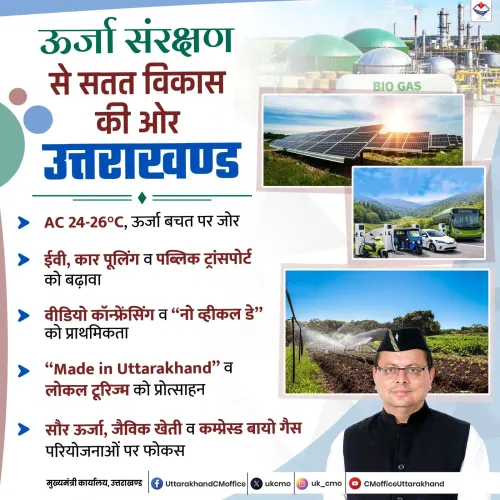
Chief Minister Pushkar Singh Dhami of Uttarakhand has announced a three-pillar, nine-point policy framework aimed at achieving Sustainable Development Goals (SDGs) by establishing better coordination between the state's economy and its ecology. The announcement was made on Friday, 29 May 2026, through the official Chief Minister's Office account on X.
The post, shared in Hindi, states: 'Mukhyamantri Shri Pushkar Singh Dhami ne satat vikas ke lakshyon ko hasil karne ke liye arthiki aur paristhitiki ke beech behtar samanvay sthapit karne ke liye tristambhiya aur nau sutreey neeti banayi hai' — meaning Chief Minister Dhami has formulated a three-pillar and nine-point policy to achieve sustainable development goals by establishing better coordination between economy and ecology.
Context
Uttarakhand is a Himalayan state in northern India whose development model has long been shaped by competing pressures: a fragile mountain ecosystem on one hand, and a growing economy driven by pilgrimage tourism, hydropower, and agriculture on the other. Successive state governments have sought frameworks that allow economic expansion without degrading the forests, rivers, and biodiversity that underpin the state's identity and livelihoods.
The new policy signals that the Dhami government is formalising this balance into a structured, multi-point framework — moving beyond ad hoc project approvals toward a coherent governance architecture for sustainable growth.
Policy Backdrop
India adopted the UN 2030 Agenda for Sustainable Development in 2015, committing all states to align planning with the 17 SDGs. At the national level, the National Action Plan on Climate Change (2008) had already outlined eight missions integrating environmental sustainability with economic development, providing a template that state governments have since adapted to local conditions.
Uttarakhand's approach — framing development explicitly around green economy principles — is consistent with a broader pattern among Himalayan states that must protect water sources, forest cover, and pilgrimage corridors while delivering growth to hill communities. CM Dhami's three-pillar, nine-point structure represents an attempt to institutionalise this balance at the policy level.
Stakeholders and Impact
Hill communities across Uttarakhand stand to be the most directly affected, as the policy's economy-ecology coordination framework will shape decisions on land use, infrastructure projects, and livelihood schemes in ecologically sensitive zones. The tourism and pilgrimage sector — a primary economic driver for the state — will also be a key stakeholder, given that its long-term viability depends on preserving the natural environment that draws visitors.
Environmental groups and local governance bodies (gram sabhas) in forested and riverine areas are likely to watch implementation closely, particularly how the nine-point framework translates into on-ground project approvals and budget allocations.
What's Next
The immediate focus will be on how the three-pillar, nine-point framework is operationalised — specifically, whether it is backed by dedicated state budget allocations in the next fiscal cycle and whether pilot projects are identified in priority ecological zones. Analysts will also watch for any alignment with central government schemes in green hydrogen, climate finance, or forest conservation that could provide additional resources to the state's SDG agenda.
The policy's credibility will ultimately be tested by whether it produces measurable changes in how development projects are evaluated and approved across Uttarakhand's ecologically sensitive districts.
Point of View
Nine-point framework is a deliberate attempt to move Uttarakhand's development governance from reactive project clearances to a structured, SDG-aligned architecture — a politically useful signal ahead of any state budget cycle. For a BJP-governed Himalayan state, institutionalising the economy-ecology balance also serves a dual purpose: it reinforces the party's 'development with conservation' narrative while pre-empting criticism from environmental advocates. The real test, however, lies in whether the framework produces enforceable criteria for project approvals or remains a declaratory document. If backed by budget allocations and measurable indicators, it could set a replicable template for other ecologically sensitive Indian states.
NationPress
13 Oct 2026
Frequently Asked Questions
What is CM Dhami's three-pillar nine-point policy for Uttarakhand?
Chief Minister Pushkar Singh Dhami has announced a three-pillar, nine-point policy framework designed to achieve Sustainable Development Goals in Uttarakhand by creating better coordination between the state's economic activities and its ecological systems.
Why is economy-ecology balance important for Uttarakhand?
Uttarakhand is a Himalayan state whose economy depends heavily on pilgrimage tourism, hydropower, and agriculture — all of which are directly linked to the health of its forests, rivers, and biodiversity, making ecological preservation a prerequisite for sustained economic growth.
What are Sustainable Development Goals and how does India follow them?
The Sustainable Development Goals are 17 targets set by the United Nations under the 2030 Agenda, adopted by India in 2015. Indian states are expected to align their planning and budgeting with these goals, covering areas from poverty to climate action.
Who are the main stakeholders of Uttarakhand's new SDG policy?
Hill communities who depend on natural resources for their livelihoods, and the tourism and pilgrimage sector which drives a large share of the state's economy, are the primary stakeholders of this new economy-ecology coordination framework.
What should we watch for in the implementation of this Uttarakhand policy?
Key indicators to watch include state budget allocations dedicated to the framework, identification of pilot projects in ecologically sensitive areas, and any alignment with central government schemes on climate finance or green energy in the next fiscal year.