CM Dhami: Uttarakhand built on women, youth, veterans and migrants
Synopsis
Chief Minister Pushkar Singh Dhami has declared that a prosperous and self-reliant Uttarakhand is being built through the collective participation of women, youth, statehood agitators, ex-servicemen and the state's migrant diaspora — five constituencies central to the state's identity and economy.
Key Takeaways
CM Pushkar Singh Dhami on 24 July 2026 reaffirmed the state's vision of an 'Atmanirbhar Uttarakhand' built on inclusive participation.
Five groups are explicitly identified as builders of the state: women , youth , statehood agitators , ex-servicemen and migrant Uttarakhandis .
Uttarakhand was formed in November 2000 after a decade-long statehood movement, giving andolankaris a foundational status in state politics.
The state has one of India's highest concentrations of ex-servicemen households, making veterans a key economic and social constituency.
The 'Atmanirbhar' framing aligns state policy with the national Atmanirbhar Bharat programme launched in 2020 .
Policy watchers will track the next state budget session for scheme launches targeting these five groups.
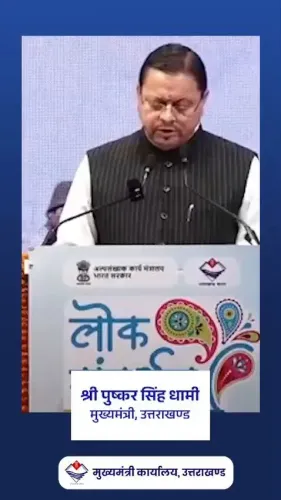
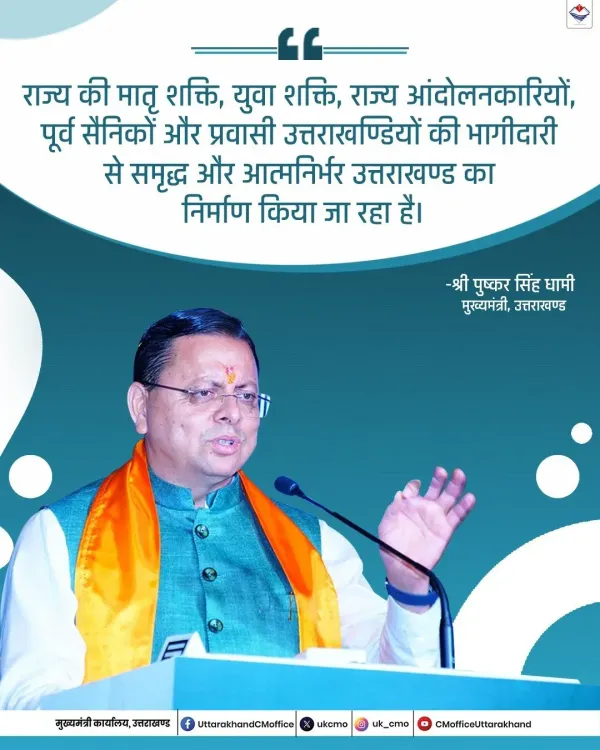
The Chief Minister's Office of Uttarakhand on Friday, 24 July 2026 quoted Chief Minister Pushkar Singh Dhami reaffirming that a prosperous and self-reliant Uttarakhand is being built through the active participation of the state's women, youth, statehood agitators, ex-servicemen and the Uttarakhand diaspora.
In his statement, CM Dhami said: 'Rajya ki matru shakti, yuva shakti, rajya andolankariyon, purv sainikon aur pravasi Uttarakhandiyon ki bhagidari se samridh aur atmanirbhar Uttarakhand ka nirman kiya ja raha hai' — meaning, 'A prosperous and self-reliant Uttarakhand is being built through the participation of the state's women power, youth power, statehood agitators, ex-servicemen and migrant Uttarakhandis.'
Context
Uttarakhand was carved out as a separate state in November 2000 following a sustained statehood movement through the 1990s. The state has a distinct demographic profile: a large proportion of households have at least one member serving or retired from the armed forces, and decades of economic out-migration have created a substantial diaspora, particularly in Delhi, Mumbai and the Gulf. CM Dhami's statement positions each of these groups as active contributors to, rather than passive beneficiaries of, state development.
Policy Backdrop
The framing of 'Atmanirbhar Uttarakhand' draws directly from the national Atmanirbhar Bharat programme announced in 2020, which encouraged states to pursue self-reliant economic models by leveraging local strengths. Uttarakhand has in recent years aligned several of its flagship initiatives — including women's self-help groups, ex-servicemen welfare schemes and return-migration incentives — with this overarching framework. The explicit mention of andolankaris (statehood agitators) is significant: this community has historically demanded recognition and welfare benefits as founders of the state.
Stakeholders and Impact
Women (matru shakti) and youth (yuva shakti) together constitute the two largest demographic cohorts the state government is seeking to mobilise for economic activity, particularly in rural and hill districts where out-migration has reduced the working-age population. Ex-servicemen bring skills, discipline and pension incomes that can anchor local economies, while pravasi Uttarakhandis — the migrant diaspora — represent a potential source of investment, remittances and skill transfer. Statehood agitators occupy a symbolic and political role, their inclusion signalling continuity with the founding aspirations of the state.
What's Next
Observers will watch the next Uttarakhand state budget session and forthcoming policy announcements for concrete scheme launches targeting these five constituencies. Measures such as expanded self-help group financing, migrant return-entrepreneurship packages and enhanced ex-servicemen welfare funds would operationalise the vision articulated by CM Dhami. The statement sets a political benchmark against which the government's delivery to each of these groups can be measured in the months ahead.
Point of View
Bundling five distinct and historically significant constituencies — women, youth, veterans, statehood activists and the diaspora — into a single developmental narrative. The invocation of andolankaris is particularly deliberate: it ties the ruling government's agenda to the moral legitimacy of those who fought for the state's creation, a recurring device in Uttarakhand politics. The 'Atmanirbhar' framing allows the state to present its development model as aligned with national priorities while retaining a distinctly local identity. Whether this vision translates into targeted budgetary allocations or remains aspirational rhetoric will be the real test in the months ahead.
NationPress
24 Jul 2026
Frequently Asked Questions
What did CM Pushkar Singh Dhami say about Uttarakhand's development?
CM Dhami stated that a prosperous and self-reliant Uttarakhand is being built through the participation of women, youth, statehood agitators, ex-servicemen and the migrant Uttarakhand diaspora.
Who are the 'andolankaris' mentioned by CM Dhami?
'Andolankaris' refers to the statehood agitators who participated in the Uttarakhand movement of the 1990s that led to the creation of Uttarakhand as a separate state in November 2000. They are recognised as a distinct community in state politics and have long sought formal welfare recognition.
What is Atmanirbhar Uttarakhand?
Atmanirbhar Uttarakhand is the state government's vision of a self-reliant Uttarakhand, inspired by the national Atmanirbhar Bharat programme launched in 2020, aiming to mobilise local human and economic resources for sustainable development.
Why are ex-servicemen important to Uttarakhand's development?
Uttarakhand has one of the highest concentrations of ex-servicemen households in India. Veterans bring skills, discipline and pension incomes that can support local economies, particularly in hill districts affected by out-migration.
What role do pravasi Uttarakhandis play in the state's development?
Pravasi Uttarakhandis — Uttarakhandis living outside the state, particularly in cities like Delhi and Mumbai or abroad — are seen as a source of investment, remittances and skills that can be channelled back into the state's economy.