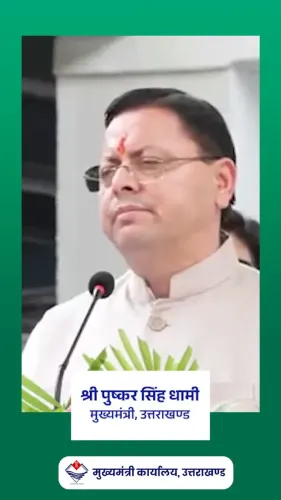
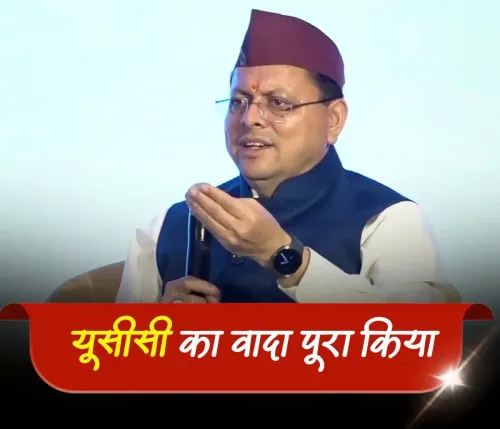
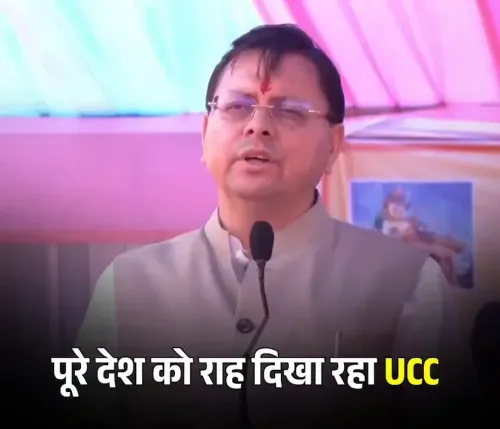
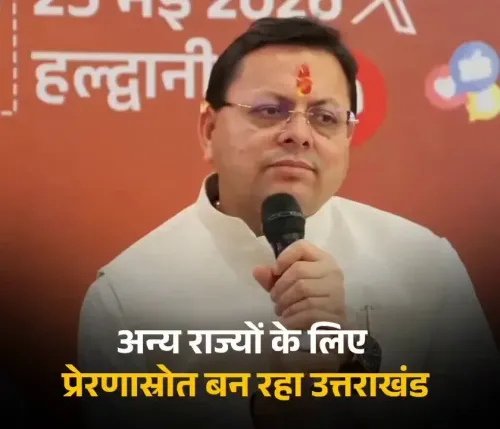
CM Dhami: Uttarakhand Led India on UCC, Now Empowers Rural Women
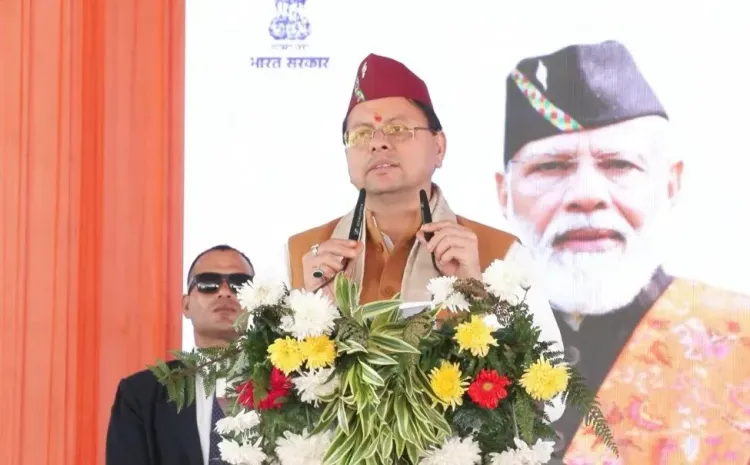
Synopsis
Chief Minister Pushkar Singh Dhami highlights Uttarakhand's dual win on women's rights: enacting India's first state-level Uniform Civil Code in February 2024, and scaling self-help groups to bring rural women into the economic mainstream.
Key Takeaways
Uttarakhand passed the Uniform Civil Code Bill on 7 February 2024 , becoming the first state in independent India to enact such a law.
The UCC replaces religion-specific personal laws with a single framework covering marriage, divorce, inheritance and adoption .
The state is simultaneously linking rural women to Self Help Groups for economic empowerment and financial self-reliance.
SHGs in India have been scaled under the DAY-NRLM since 2011 , providing micro-credit and livelihood support to village-level women's collectives.
CM Dhami frames both moves as fulfilling Uttarakhand's commitment to the protection, dignity and equal rights of maatrishakti — women's collective strength.
Uttarakhand's UCC enactment is closely watched as a potential federal template, with rules, notifications and court challenges still unfolding.
Uttarakhand became the first state in independent India to enact a Uniform Civil Code — and Chief Minister Pushkar Singh Dhami is now framing that legal milestone alongside a parallel economic push: linking rural women to self-help groups to make them financially self-reliant. The Chief Minister's Office of Uttarakhand posted these remarks on Tuesday, 17 November 2026, underlining the state's twin-track agenda on women's rights.
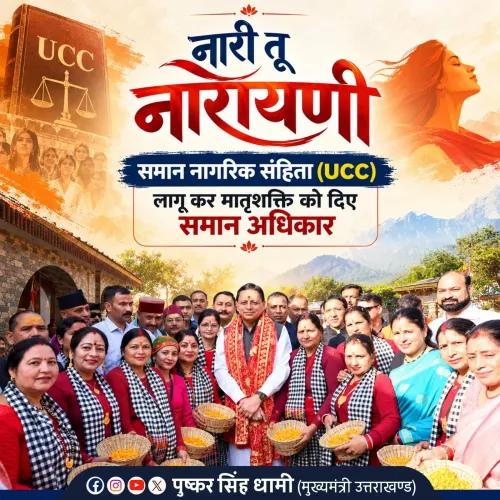
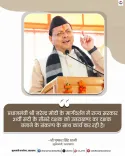
Quoting CM Dhami directly, the post states: 'Maatrishakti ki suraksha, samman aur saman adhikar sunishchit karne ki disha mein Uttarakhand desh mein saman nagrik sanhita lagoo karne wala pehla rajya bana.' — 'In the direction of ensuring the protection, dignity and equal rights of women, Uttarakhand became the first state in the country to implement a Uniform Civil Code.' The statement ties the legal reform explicitly to the welfare of maatrishakti — the collective strength of women.The UCC milestone: what Uttarakhand's February 2024 law actually did
The Uttarakhand Legislative Assembly passed the Uniform Civil Code Bill on 7 February 2024 — the first state legislature in post-independence India to do so. The law replaces religion-based personal laws with a single statutory framework governing marriage, divorce, inheritance and adoption for all citizens of the state, regardless of faith. It fulfilled a long-standing commitment rooted in Article 44 of the Constitution, which lists a uniform civil code among the Directive Principles of State Policy — an aspiration that sat dormant at the national level for over seven decades.
The legislation's passage made Uttarakhand a test case for the rest of the federation. How its rules, roll-out notifications and any court challenges unfold carries implications far beyond the Himalayas.
Self-help groups: the economic engine running alongside legal reform
The second pillar of Dhami's statement is the state's push to connect rural women to Self Help Groups (SHGs) — village-level savings and credit collectives that have been scaled nationally under the Deendayal Antyodaya Yojana–National Rural Livelihoods Mission (DAY-NRLM) since 2011. These groups give women access to micro-credit, pooled savings and market linkages that formal banking has historically bypassed in remote hill districts.
Uttarakhand's geography — dispersed mountain villages, seasonal migration, limited road connectivity — makes SHG outreach both more difficult and more consequential than in plains states. The CM's framing presents legal equality and economic independence as two sides of the same policy coin: rights on paper mean little without the income to exercise them.
A federal template or a state-level experiment?
The broader pattern here matters. By pairing a path-breaking personal-law reform with a proven microfinance programme, the Dhami government is building a narrative of Uttarakhand as a governance laboratory. Both interventions touch women across religious communities and across the urban-rural divide — constituencies that rarely share the same policy conversation. Whether this dual model is cited as a template by other states or faces legal and administrative headwinds will define its legacy beyond 2026.
Uttarakhand has drawn the blueprint. Now comes the harder work of making it real, district by district, group by group.
Point of View
Uttarakhand's model could either become a replicable playbook or a cautionary tale, depending on how implementation and legal challenges unfold in the coming months.
NationPress
17 Nov 2026
Frequently Asked Questions
Which state was the first in India to implement a Uniform Civil Code?
Uttarakhand was the first state in independent India to implement a Uniform Civil Code, after its Legislative Assembly passed the UCC Bill on 7 February 2024.
What does the Uttarakhand UCC cover?
The Uttarakhand Uniform Civil Code replaces religion-based personal laws with a single statutory framework governing marriage, divorce, inheritance and adoption for all residents of the state.
How are self-help groups helping rural women in Uttarakhand?
Self-help groups connect rural women to pooled savings, micro-credit and livelihood programmes under the DAY-NRLM, giving them access to financial tools that formal banking has often bypassed in remote hill areas.
What is Article 44 of the Indian Constitution?
Article 44 is a Directive Principle of State Policy that calls on the state to secure a Uniform Civil Code for all citizens — an aspiration that remained unimplemented at the national level until Uttarakhand enacted it at the state level in 2024.
What is the DAY-NRLM and when did it start?
The Deendayal Antyodaya Yojana–National Rural Livelihoods Mission (DAY-NRLM) is a central government scheme launched in 2011 to organise rural poor women into self-help groups and link them to savings, credit and market opportunities.