CM Dhami: Uttarakhand to be spiritual and economic powerhouse
Synopsis
Chief Minister Pushkar Singh Dhami reaffirms Uttarakhand's dual ambition — spiritual power centre and economic powerhouse — calling on industry, traders, investors, and youth to drive the state's growth forward.
Key Takeaways
CM Pushkar Singh Dhami declared on 17 October 2026 that the Uttarakhand government is advancing on a twin goal: spiritual and economic empowerment.
He identified four stakeholder groups as central to this mission: the industrial sector, traders, investors, and youth .
Uttarakhand has pursued a dual-identity development model since its formation in 2000 , leveraging the Char Dham pilgrimage circuit alongside industrial incentives.
Youth employment and private investment remain the state's critical economic pressure points, with out-migration a persistent challenge.
The statement signals continued outreach to private capital as the government frames spiritual branding and economic ambition as complementary, not competing, goals.
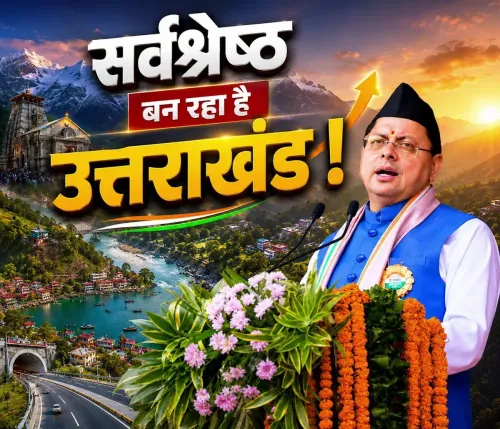
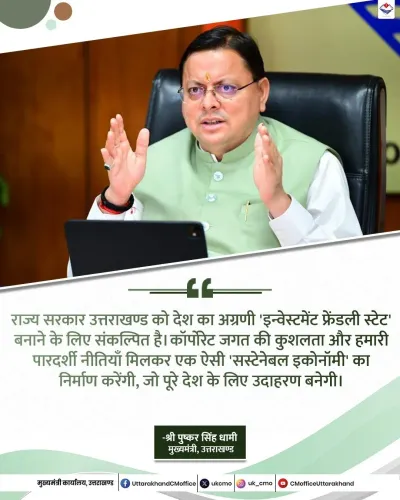
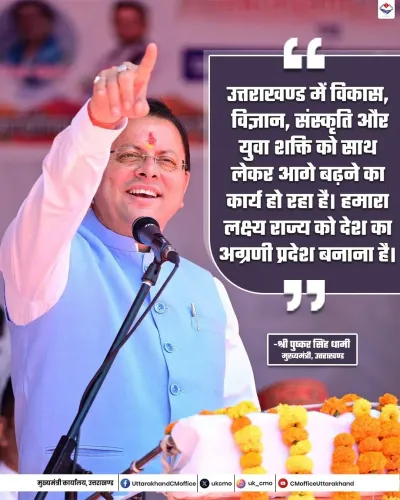
Uttarakhand will not choose between its ancient soul and its economic ambitions — it intends to build both. Chief Minister Pushkar Singh Dhami, speaking in a statement shared by the Chief Minister's Office of Uttarakhand on Saturday, 17 October 2026, declared that the state government is advancing steadily on its twin mission: establishing Uttarakhand as a spiritual power centre while simultaneously making it economically robust.
Translating his words: 'Sarkar Uttarakhand ko aadhyatmik shakti kendra ke saath arthik roop se bhi sashakt rajya banane ki disha mein nirantar aage badh rahi hai' — 'The government is continuously moving forward to make Uttarakhand not only a spiritual power centre but also an economically empowered state.' CM Dhami specifically named four pillars of this vision: the industrial sector, traders, investors, and youth.
A hill state's enduring dual identity
Uttarakhand was carved out as a separate state in 2000, partly on the premise that its distinctive Himalayan geography and world-famous pilgrimage circuit — the Char Dham — could be the engine of a unique development model. Successive governments have since tried to square that spiritual heritage with the harder economics of a landlocked hill state: thin flatlands, difficult logistics, and a brain-drain of youth to larger plains cities.
The Dhami government has repeatedly returned to this framing — spiritual credibility as a brand anchor, private investment as the growth lever. Industrial policy incentives targeting both hill and plains districts have been a recurring feature of the state's economic outreach, aimed at keeping young Uttarakhandi workers from migrating out.
Industry, investors, and the youth equation
CM Dhami's explicit call-out of traders and investors alongside youth signals a demand for private-sector co-ownership of the state's growth story. For a state that remains heavily dependent on central transfers and tourism receipts, sustained industrial investment — whether in manufacturing belts around Haridwar and Dehradun or in the services sector — is the lever that can change fiscal fundamentals. Youth employment, in particular, remains a political and economic pressure point: Uttarakhand's young population has historically sought opportunities outside state borders. Any credible answer to that outward flow requires both jobs policy and investor commitment to act in concert.
Point of View
Particularly ahead of investor summits or budget cycles. What makes Uttarakhand's version distinctive is structural: a hill state with genuine pilgrimage pull must convert footfall into lasting industry, not just seasonal receipts. Whether this rhetoric translates into measurable industrial investment or youth employment data will be the real test of the vision.
NationPress
17 Oct 2026
Frequently Asked Questions
What is CM Dhami's vision for Uttarakhand's development?
CM Pushkar Singh Dhami envisions Uttarakhand as both a spiritual power centre and an economically empowered state, with industry, traders, investors, and youth playing central roles in achieving that goal.
Why is Uttarakhand called a spiritual power centre?
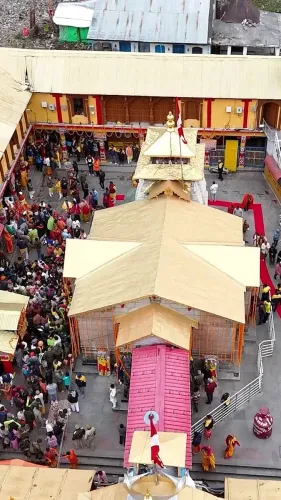
Uttarakhand is home to the Char Dham pilgrimage circuit — Badrinath, Kedarnath, Gangotri, and Yamunotri — making it one of India's most significant Hindu religious destinations and a major draw for spiritual tourism.
What economic challenges does Uttarakhand face?
Uttarakhand, a hill state formed in 2000, faces difficult logistics, limited flat land for industry, dependence on central transfers, and significant youth out-migration to larger cities in the plains.
How has Uttarakhand tried to attract investment?
Successive Uttarakhand governments have offered industrial policy incentives targeting both hill and plains districts, framing the state's spiritual tourism brand as an asset to attract private investment alongside manufacturing and services growth.
What is the role of youth in Uttarakhand's economic plan?
Youth are a key pillar of CM Dhami's growth vision; addressing youth unemployment and reducing out-migration from the state are central political and economic priorities that hinge on sustained private-sector investment and job creation.