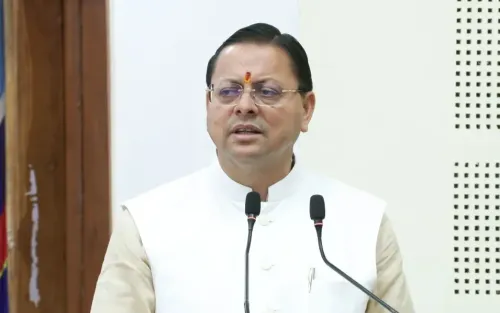
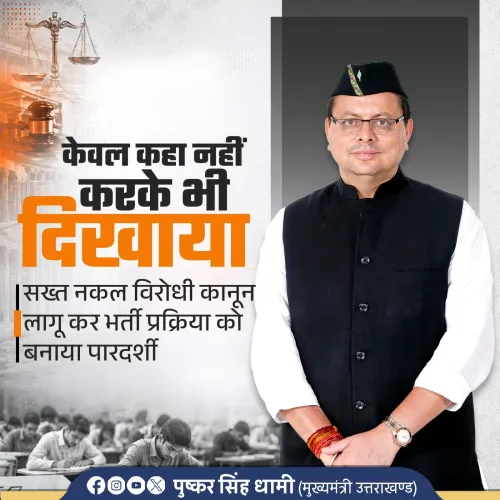
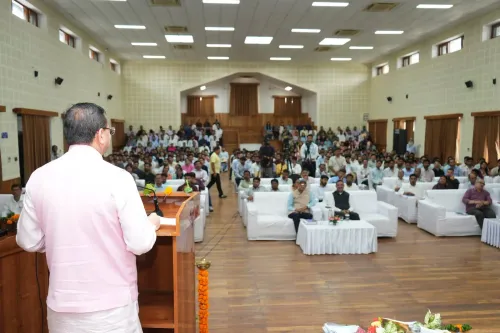
CM Dhami: Uttarakhand's anti-cheat law gave 34,000 youth govt jobs
Synopsis
Chief Minister Pushkar Singh Dhami says Uttarakhand's strict 2023 anti-cheating law has produced a transparent recruitment system that delivered over 34,000 government jobs with full impartiality over four years, setting a potential model for other states battling exam fraud.
Key Takeaways
CM Pushkar Dhami credited the Uttarakhand Competitive Examination (Prevention of Unfair Means) Act, 2023 with cleaning up the state's public recruitment process.
He claimed more than 34,000 government jobs were filled with full impartiality over the past four years .
The law was enacted specifically to combat organised exam-cheating networks and paper leaks that had derailed earlier recruitment cycles.
Uttarakhand positioned its legislation as the strictest anti-cheating law in the country , imposing imprisonment and fines for violations.
Multiple Indian states have passed similar laws after repeated paper-leak scandals; Uttarakhand's jobs claim adds a measurable outcome to the debate.
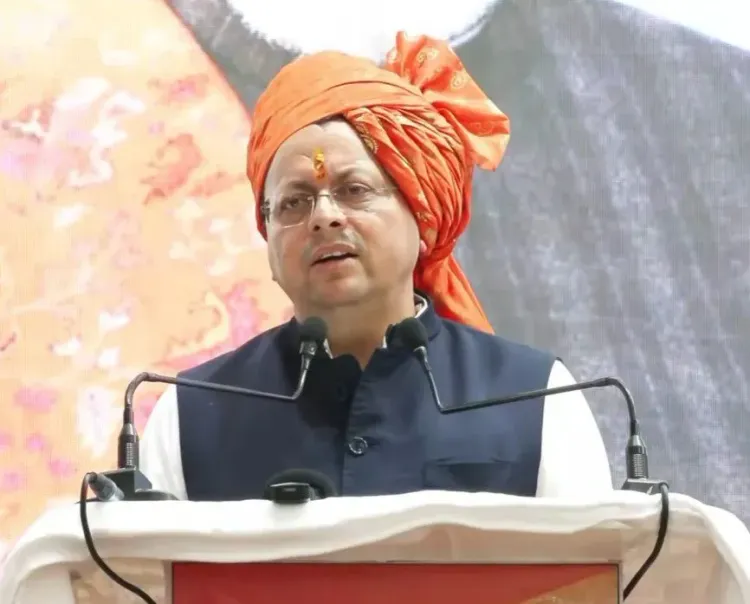
Four years after Uttarakhand declared war on its exam-cheating mafia, Chief Minister Pushkar Singh Dhami is pointing to a number that tells the story: more than 34,000 young people have received government jobs through a system the state now calls genuinely fair. The Chief Minister's Office of Uttarakhand shared the remark on Saturday, 1 August 2026, framing it as proof that the state's landmark anti-cheating legislation has delivered real results.
In his own words, CM Dhami said: 'हमने नकल माफिया के खिलाफ निर्णायक लड़ाई लड़ते हुए देश का सबसे सख्त नकल विरोधी कानून लागू किया।' ('We fought a decisive battle against the exam-cheating mafia and enacted the country's strictest anti-copying law.') The outcome, he argued, is a transparent recruitment system that has placed over 34,000 candidates in government posts with full impartiality over the past four years.
The law that changed the game: Uttarakhand's 2023 anti-cheating Act
The legislation at the centre of this claim is the Uttarakhand Competitive Examination (Prevention of Unfair Means) Act, 2023. Enacted in response to repeated paper-leak scandals that had paralysed public recruitment in the state, the law introduced severe penalties — including imprisonment and heavy fines — for anyone involved in cheating, impersonation, or leaking question papers.
The move was part of a broader national reckoning. Across India, state after state had watched recruitment cycles collapse under the weight of organised cheating networks, leaving lakhs of aspirants stranded and disillusioned. Uttarakhand chose a legislative sledgehammer over incremental fixes, positioning its law as among the harshest in the country.
What 34,000 jobs mean for Uttarakhand's aspirants
For a hill state with limited private-sector employment, a government job is not just a salary — it is security, status, and often the only reason a young person stays rather than migrates to the plains. The claim that 34,000-plus appointments were made with full impartiality in four years carries enormous weight for families who have spent years and savings preparing for competitive exams.
The state's job aspirants and their families are the direct stakeholders here. If the recruitment machinery has indeed been cleaned up, the downstream effect is a restored faith in the system — something no amount of policy language can manufacture without actual hiring outcomes to back it.
A template other states are watching
Uttarakhand's experiment is being observed beyond its own borders. The pattern of paper leaks followed by public outrage followed by legislative response has played out in Rajasthan, Bihar, Gujarat, and several other states. What distinguishes Uttarakhand's pitch is the combination of a strict law and a specific jobs number — a concrete, auditable claim that invites scrutiny as much as it invites credit.
Whether subsequent recruitment cycles hold up, and whether any convictions under the new law survive court challenges, will determine if this becomes a genuine governance model or a political talking point. The numbers are on the table. The accountability clock is running.
Point of View
000 jobs shifts the narrative from punitive legislation to positive outcomes, a rhetorically smart move. The real test, however, is independent auditability: if the figure holds up to scrutiny, Uttarakhand could genuinely become a recruitment-reform template for other states still struggling with exam fraud.
NationPress
1 Aug 2026
Frequently Asked Questions
What is the Uttarakhand anti-cheating law?
The Uttarakhand Competitive Examination (Prevention of Unfair Means) Act, 2023 is a state law that imposes strict penalties — including imprisonment and heavy fines — for cheating, impersonation, and question-paper leaks in government recruitment examinations.
How many government jobs has Uttarakhand filled under the new system?
Chief Minister Pushkar Dhami has stated that more than 34,000 government jobs were filled with full impartiality over the past four years under the transparent recruitment system enabled by the anti-cheating law. This figure has not been independently verified.
What is naqal mafia and why is it a problem in India?
Naqal mafia refers to organised networks that leak question papers or facilitate cheating in competitive exams, often for large sums of money. These networks have derailed government recruitment cycles in multiple Indian states, leaving genuine aspirants at a disadvantage.
Is Uttarakhand's anti-cheating law the strictest in India?
CM Dhami has claimed it is the country's strictest anti-copying law. Several other states have passed similar legislation, but Uttarakhand's 2023 Act is widely noted for its severity of penalties.
Which other states have passed anti-cheating laws for government exams?
States including Rajasthan, Bihar , and Gujarat have enacted or strengthened laws against exam fraud following repeated paper-leak scandals. The broader national trend reflects growing pressure to restore credibility in public hiring.