CM DK Shivakumar lays foundation for two Bengaluru flyovers
Synopsis
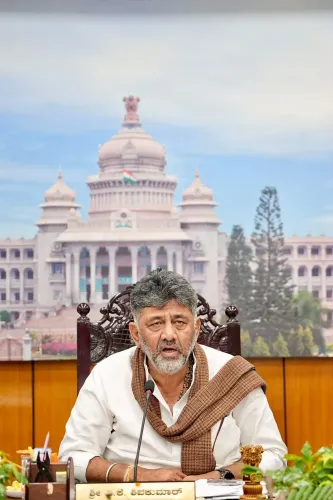
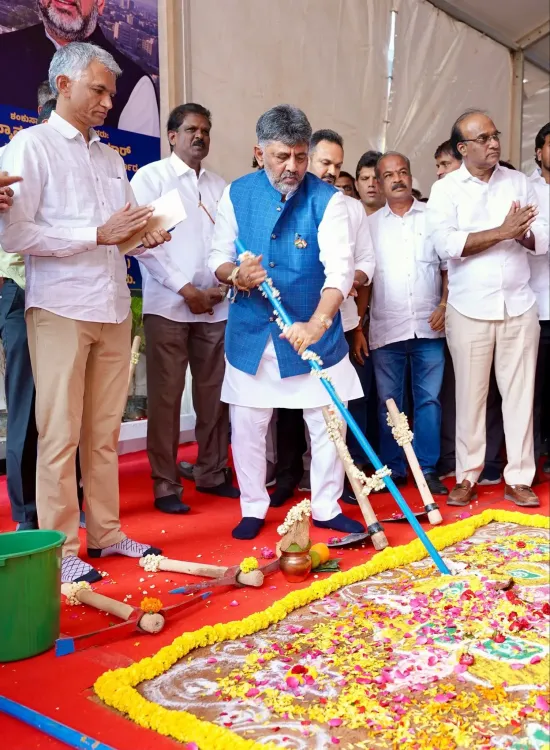
Chief Minister D.K. Shivakumar on November 18, 2026, laid foundation stones for a new rotary flyover at Bengaluru's IOC Junction and a Baiyyappanahalli railway flyover expansion, with Urban Development Minister Krishna Byre Gowda and local legislators in attendance.
Key Takeaways
Shivakumar laid foundation stones for two Bengaluru flyover projects on November 18, 2026 .
A new rotary flyover will be constructed at the IOC Junction on Maruthi Sevanagara Main Road .
The Baiyyappanahalli Railway Flyover expansion is a combined road-rail widening scheme in east Bengaluru.
Urban Development Minister Krishna Byre Gowda , MLA A.C.
Srinivas , and Congress leaders Rana George and D.K.
Mohan Babu attended the ceremony.
Specific project budgets and completion deadlines were not disclosed at the foundation-laying event.
Both projects are part of Karnataka's ongoing efforts to ease traffic congestion in Bengaluru , India's fastest-growing major city.
Two new flyover projects got their formal start in Bengaluru on Wednesday, November 18, 2026, as Chief Minister D.K. Shivakumar laid the foundation stones for a rotary flyover at the IOC Junction on Maruthi Sevanagara Main Road and a combined expansion project for the Baiyyappanahalli Railway Flyover — a twin infrastructure push aimed squarely at easing the city's grinding traffic.
What is coming up at IOC Junction and Baiyyappanahalli
The IOC Junction rotary flyover on Maruthi Sevanagara Main Road is a new construction, while the Baiyyappanahalli railway flyover expansion is a combined widening scheme designed to increase throughput at one of east Bengaluru's busiest rail-road crossings. Both projects were greenlit in a single ceremony, signalling a coordinated push on two distinct but congestion-critical corridors.
Bengaluru Urban Development Minister Krishna Byre Gowda, MLA A.C. Srinivas, and Congress leaders Rana George and D.K. Mohan Babu were among the dignitaries present, underscoring cross-departmental political backing for the initiative.
Why these two corridors matter to Bengaluru's mobility
Bengaluru, India's fastest-growing major city, has long battled a mismatch between its road network and its explosive population. The Maruthi Sevanagara–IOC Junction stretch feeds arterial traffic between multiple residential and commercial zones, while Baiyyappanahalli — anchoring a busy metro and rail interchange in the east — has remained a bottleneck even after earlier upgrades.
Karnataka governments have pursued a steady cadence of flyover and grade-separator projects across the city, and this dual foundation-laying continues that pattern. The involvement of both the Urban Development Ministry and local legislators at a single event reflects the kind of coordinated state-municipal machinery that large-scale urban infrastructure demands.
Timelines and what commuters should watch
Specific project budgets and completion deadlines were not announced at the ceremony. Commuters on both corridors can expect phased traffic disruptions during the construction period — the precise duration of which will become clearer once contractors publish their work schedules. Progress on these two projects will be a visible test of the state government's ability to deliver urban infrastructure within its stated timelines.
For a city that adds thousands of vehicles to its roads every month, the question is not whether Bengaluru needs more flyovers — it plainly does. The question is how fast the concrete can keep up with the commute.
Point of View
And flyover inaugurations are a tangible, photogenic deliverable for a ruling party seeking to demonstrate governance. The presence of the Urban Development Minister alongside the CM signals that the state intends these projects to move through bureaucratic channels at pace. Whether execution matches announcement will be the real measure — Bengaluru has a history of stalled urban infrastructure projects that promised transformation and delivered delay.
NationPress
18 Nov 2026
Frequently Asked Questions
What projects did CM DK Shivakumar inaugurate in Bengaluru on November 18 2026?
CM D.K. Shivakumar laid the foundation stones for two projects: a new rotary flyover at the IOC Junction on Maruthi Sevanagara Main Road, and a combined expansion scheme for the Baiyyappanahalli Railway Flyover.
Where is the IOC Junction flyover being built in Bengaluru?
The rotary flyover is planned at the IOC Junction on Maruthi Sevanagara Main Road in Bengaluru.
What is the Baiyyappanahalli railway flyover expansion project?
It is a combined widening and extension scheme for the existing Baiyyappanahalli railway flyover in east Bengaluru, aimed at easing traffic at one of the city's congested rail-road crossings.
Who else attended the Bengaluru flyover foundation stone laying ceremony?
Bengaluru Urban Development Minister Krishna Byre Gowda, MLA A.C. Srinivas, and Congress leaders Rana George and D.K. Mohan Babu were among the dignitaries present.
When will the Bengaluru IOC Junction and Baiyyappanahalli flyovers be completed?
Specific completion timelines and project budgets were not announced at the ceremony; details are expected once contractors publish their construction schedules.