CM Fadnavis Deploys 15 Depts in Anti-Drug Drive
Synopsis
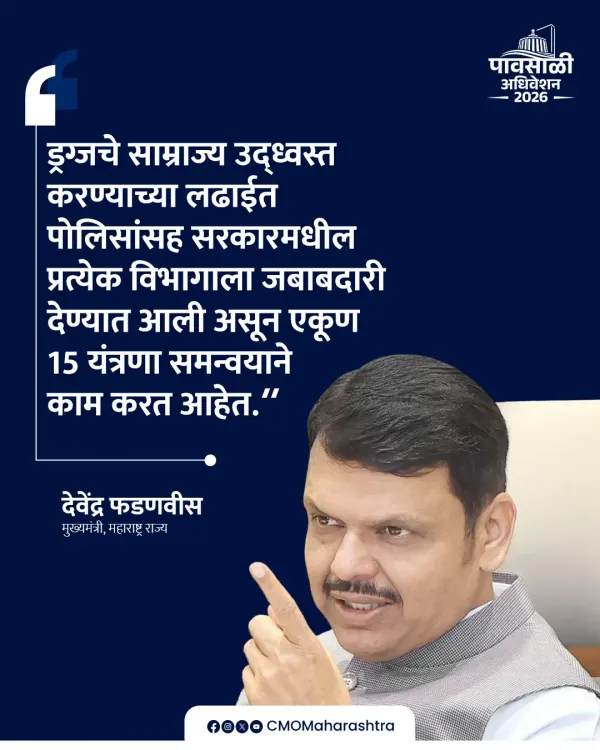
Maharashtra's Chief Minister's Office announced on 23 June 2026 that 15 state departments are jointly combating drug abuse under a 'Whole of Government' framework, with CM Devendra Fadnavis at the helm of the coordinated drive.
Key Takeaways
15 Maharashtra state departments are now working together under a unified 'Whole of Government' anti-drug framework.
The announcement was made by the Chief Minister's Office of Maharashtra on 23 June 2026 , tagging CM Devendra Fadnavis .
The initiative aligns with the national Nasha Mukt Bharat Abhiyan , launched in 2020 to integrate state and central anti-drug efforts.
The framework moves away from siloed departmental responses toward shared intelligence, enforcement, and rehabilitation responsibilities.
Key stakeholders include Maharashtra's youth , law enforcement agencies, and communities in coastal and border districts vulnerable to drug trafficking.
Progress reports, budgetary allocations, and enforcement metrics will be watched to assess real-world implementation.
The Chief Minister's Office of Maharashtra on Tuesday, 23 June 2026, announced that 15 state government departments are working in concert under a 'Whole of Government' approach to combat drug abuse and trafficking across the state, tagging Chief Minister Devendra Fadnavis in the post.
The post, written in Marathi, states: 'ड्रग्जविरोधी लढ्यात Whole of Government दृष्टिकोनानुसार राज्य सरकारचे 15 विभाग एकत्रितपणे कार्यरत' — meaning, 'In the fight against drugs, 15 departments of the state government are working together under the Whole of Government approach.'
Context
The announcement signals a deliberate shift in Maharashtra's counter-narcotics strategy — away from isolated departmental action toward a unified, cross-sectoral response. The 'Whole of Government' framework, increasingly adopted in public administration globally, requires ministries and departments to share intelligence, resources, and enforcement responsibilities rather than operate in silos. By naming CM Devendra Fadnavis directly, the official communication underscores that the initiative carries the Chief Minister's personal ownership, lending it political weight and signalling accountability at the top of the executive.Policy Backdrop
Maharashtra's move aligns with the national Nasha Mukt Bharat Abhiyan, launched in 2020 by the Union Ministry of Social Justice and Empowerment to reduce substance abuse through coordinated awareness campaigns and enforcement drives. The central scheme was designed precisely to encourage states to link their home, health, education, and social welfare machinery into a single operational chain. Several Indian states have experimented with inter-departmental narcotics task forces, but a formal 15-department convergence of this scale — if fully operationalised — would represent one of the more expansive state-level implementations of the integrated model. The departments likely span home (police), health, education, social welfare, finance, ports, transport, and excise, among others, though specific operational details have not been independently confirmed.Stakeholders and Impact
The primary beneficiaries of a successful integrated anti-drug drive would be Maharashtra's youth, who remain among the most vulnerable to substance abuse, particularly in urban centres such as Mumbai, Pune, and Nagpur. Law enforcement agencies — from the state police to the Narcotics Control Bureau's regional units — stand to gain from streamlined inter-agency communication and shared intelligence. For communities in coastal districts and border regions, where drug smuggling routes have historically posed challenges, coordinated action across the home, ports, and customs-adjacent departments could translate into more effective interdiction. Civil society groups working in rehabilitation also stand to benefit if health and social welfare departments are formally looped into the framework.What's Next
Attention will now turn to how Maharashtra translates this announcement into measurable outcomes. Observers will watch for progress reports on inter-departmental coordination, any dedicated budgetary allocations in the state assembly, and whether enforcement metrics — seizures, arrests, rehabilitation admissions — reflect the claimed convergence. Legislative action or a formal government resolution codifying the 15-department structure would be a significant next step in institutionalising the approach beyond the current political cycle.Point of View
Education, and welfare alongside police action. This mirrors a broader national pattern where states are under pressure to demonstrate alignment with the Nasha Mukt Bharat Abhiyan through structural, not merely rhetorical, commitments. The announcement is strategically timed for visibility, but the real test lies in whether inter-departmental coordination produces verifiable enforcement and rehabilitation outcomes. Without formal institutional mechanisms — a dedicated task force, shared data systems, or legislative backing — such frameworks risk remaining aspirational rather than operational.
NationPress
23 Jun 2026
Frequently Asked Questions
What is the 'Whole of Government' approach to fighting drugs in Maharashtra?
The 'Whole of Government' approach means that multiple state departments — spanning home, health, education, social welfare, and others — work together in a coordinated manner rather than independently, sharing intelligence and resources to tackle drug abuse and trafficking more effectively.
How many departments are involved in Maharashtra's anti-drug drive?
According to the Chief Minister's Office of Maharashtra, 15 state government departments are jointly working under this integrated framework.
What is the Nasha Mukt Bharat Abhiyan and how does it relate to Maharashtra's drive?
The Nasha Mukt Bharat Abhiyan is a national programme launched in 2020 by the Union Ministry of Social Justice and Empowerment to reduce substance abuse. Maharashtra's 15-department coordination aligns with and builds on this central initiative.
Who is leading Maharashtra's anti-drug coordination effort?
Chief Minister Devendra Fadnavis is at the helm of the initiative, as indicated by the official Chief Minister's Office post tagging him directly in the announcement.
Which areas in Maharashtra are most affected by drug trafficking?
Urban centres such as Mumbai , Pune , and Nagpur , as well as coastal and border districts, have historically faced significant challenges related to drug smuggling and substance abuse.