CM Saini Launches Paperless Registry 2.0, Auto Intkal in Haryana
Synopsis
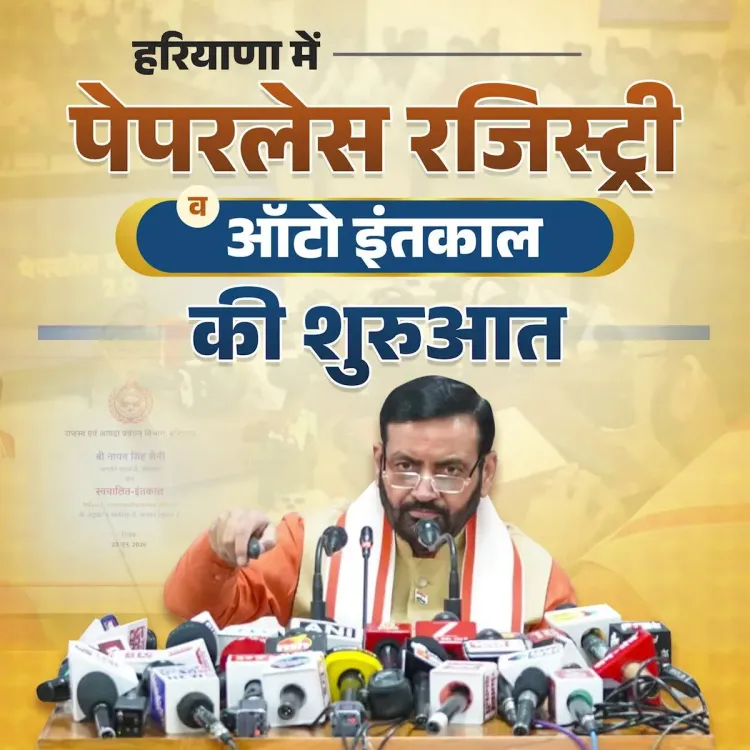
Haryana Chief Minister Nayab Singh Saini launched Paperless Registry 2.0 and the Auto Intkal system on 23 June 2026, creating an end-to-end digital pipeline for property registration and automated land-record mutation to advance transparency and reduce corruption in revenue administration.
Key Takeaways
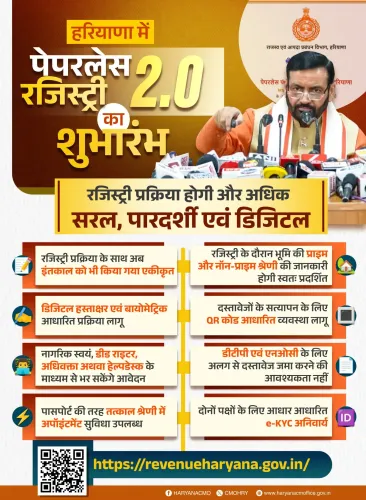
Paperless Registry 2.0 was launched in Haryana on 23 June 2026 by Chief Minister Nayab Singh Saini to eliminate physical documents in property registration.
The Auto Intkal system automates land-record mutation, updating ownership details immediately after registration without a separate manual application.
The two systems together create a seamless, end-to-end digital workflow from property sale to updated revenue record.
The initiative builds on the National Land Records Modernization Programme (2008) and the Digital India (2015) framework.
Primary beneficiaries include landowners , property buyers , and revenue officials across Haryana's districts.
District-wise rollout timelines and reductions in registration processing time will be key metrics to watch over the next six to twelve months .
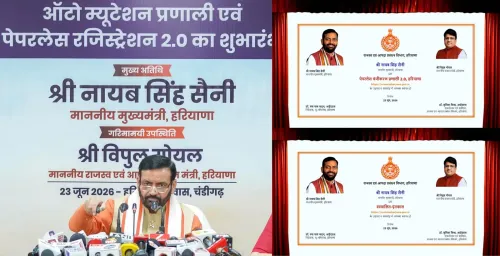
Haryana Chief Minister Nayab Singh Saini on Tuesday, 23 June 2026, launched two significant digital governance initiatives in the state — Paperless Registry 2.0 and the Auto Intkal system — marking a major step toward transparent, document-free property registration and automated land-record mutation.
Announcing the launch on X, CM Saini stated: 'Sushasan, pardarshita aur digital sevaon ko nayi gati dete hue aaj Haryana mein Paperless Registry 2.0 tatha Auto Intkal pranali ki shuruaat ki gayi' — ('Giving new momentum to good governance, transparency and digital services, Paperless Registry 2.0 and the Auto Intkal system were launched today in Haryana.')
Context
Paperless Registry 2.0 is an upgraded digital platform for property registration in Haryana designed to eliminate physical documents and significantly accelerate the registration process. The Auto Intkal system complements it by automating the mutation of land records — updating ownership details immediately after a registration is completed, removing the need for a separate, manual application.
Together, the two systems aim to create a seamless, end-to-end digital pipeline from property sale to updated revenue record, reducing the scope for delays, errors, and rent-seeking at sub-registrar offices.
Policy Backdrop
The launches sit within a well-established national policy lineage. The National Land Records Modernization Programme (NLRMP), initiated in 2008, supported the computerisation of land records and registration systems across Indian states, including Haryana. The Digital India programme, launched in 2015, further accelerated paperless governance and online service delivery at the state level.
Haryana's move follows similar e-registration upgrades implemented in states such as Maharashtra and Karnataka over the preceding decade. The state has been progressively building on its earlier digital registration infrastructure, and the '2.0' designation signals a second-generation upgrade rather than a first-time rollout.
Stakeholders and Impact
The primary beneficiaries are landowners, property buyers, and revenue officials across Haryana's districts. For citizens, the elimination of physical documents reduces the need for multiple visits to government offices and cuts dependence on intermediaries. For revenue officials, automated mutation removes a significant backlog-generating step from the workflow.
Land registration and mutation have historically been among the most corruption-prone points in India's revenue administration. Digitising both steps in a single integrated flow directly addresses the friction that creates opportunities for unofficial payments and procedural delays.
What's Next
Attention will now turn to the district-wise rollout timeline and whether the systems achieve measurable reductions in average registration processing time over the next six to twelve months. The scale and speed of adoption across Haryana's diverse urban and rural districts will determine whether the initiative translates into sustained administrative efficiency or remains concentrated in larger urban centres. CM Saini's government is likely to track these metrics closely ahead of the next state electoral cycle.
Point of View
The Saini government aligns Haryana with the more advanced e-registration models already operational in southern states. The initiative also carries clear political utility: land disputes and registration delays are perennial grievances in Haryana's agrarian districts, and demonstrable efficiency gains could strengthen the BJP's governance credentials ahead of future electoral contests. The real test, however, will be equitable rollout across rural tehsils where digital infrastructure and literacy remain uneven.
NationPress
23 Jun 2026
Frequently Asked Questions
What is Paperless Registry 2.0 in Haryana?
Paperless Registry 2.0 is an upgraded digital platform launched by the Haryana government on 23 June 2026 that allows property registration without physical documents, speeding up the process and reducing opportunities for corruption.
What is the Auto Intkal system launched in Haryana?
The Auto Intkal system is an automated land-record mutation tool that updates property ownership details in revenue records immediately after registration is completed, eliminating the need for a separate manual mutation application.
Who launched Paperless Registry 2.0 and Auto Intkal in Haryana?
Haryana Chief Minister Nayab Singh Saini launched both systems on 23 June 2026, announcing the initiative on his official X account.
How does the Auto Intkal system benefit property buyers in Haryana?
It removes a major procedural bottleneck by automatically reflecting ownership changes in land records right after registration, saving buyers from filing a separate mutation request and waiting for manual processing.
Is Haryana the first Indian state to launch paperless property registration?
No. States such as Maharashtra and Karnataka implemented similar e-registration upgrades over the preceding decade. Haryana's Paperless Registry 2.0 is a second-generation upgrade that builds on earlier digital infrastructure and national programmes like the NLRMP and Digital India.