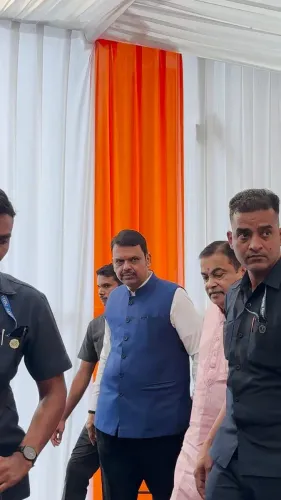
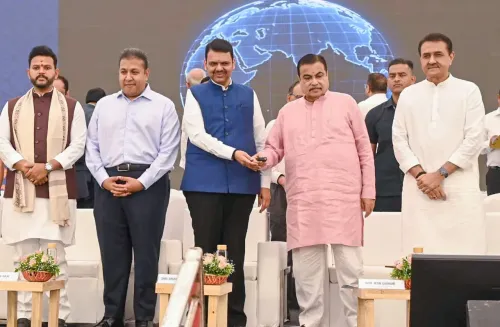
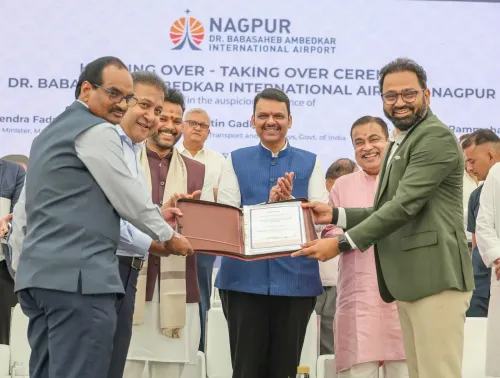
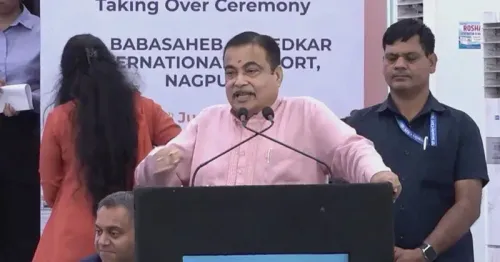
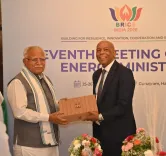
CM Fadnavis, Gadkari at Nagpur Airport Handover Ceremony

Synopsis
Chief Minister Devendra Fadnavis joined Union Ministers Nitin Gadkari and Ram Mohan Naidu in Nagpur on 25 June 2026 for the formal Handing Over-Taking Over Ceremony of Dr. Babasaheb Ambedkar International Airport, marking a key shift in the airport's operational management under national infrastructure policy.
Key Takeaways
Chief Minister Devendra Fadnavis , Union Minister Kinjarapu Ram Mohan Naidu (Civil Aviation), and Union Minister Nitin Gadkari (Road Transport) attended the ceremony together.
The event marks a formal Handing Over-Taking Over of Dr.
Babasaheb Ambedkar International Airport, Nagpur .
The transition is part of India's broader airport privatisation and public-private partnership policy framework initiated around 2018-2019 .
Nagpur 's airport is linked to the long-running MIHAN multi-modal hub project, launched in 2002 .
The handover aligns with the PM Gati Shakti national master plan for integrated infrastructure development.
Capacity expansion, new routes, and operational changes at the airport are expected to follow the management transition.
The Chief Minister's Office of Maharashtra announced on Thursday, 25 June 2026, that Chief Minister Devendra Fadnavis, Union Minister for Civil Aviation Kinjarapu Ram Mohan Naidu, and Union Minister for Road Transport and Highways Nitin Gadkari attended the Handing Over-Taking Over Ceremony at Dr. Babasaheb Ambedkar International Airport, Nagpur, marking a significant shift in the airport's operational management.
Context
Dr. Babasaheb Ambedkar International Airport is Nagpur's primary aviation gateway, serving central India and functioning as a critical node in the region's connectivity network. The ceremony, livestreamed officially, brought together key figures from both the Maharashtra state government and the Union government, signalling the coordinated nature of this transition. The presence of three senior leaders underscores the political and economic weight attached to the event.
Policy Backdrop
The handover fits within a broader national policy framework under which the Airports Authority of India (AAI) has progressively transitioned airport operations to new management entities through a public-private partnership model, a direction formalised around 2018-2019. Nagpur has long been at the centre of ambitious regional infrastructure planning, most notably through the MIHAN (Multi-modal International Cargo Hub and Airport at Nagpur) project, initiated in 2002, which envisioned the airport as an integrated cargo, logistics, and passenger hub for central India. The current ceremony represents a continuation of that long-running state-centre coordination on aviation infrastructure.
The transition also aligns with the PM Gati Shakti national master plan, under which the Union government has sought to synchronise airport upgrades with road, rail, and logistics networks to maximise economic impact in Tier-2 cities. Nagpur, as a geographic centre of India and a key highway junction championed by Nitin Gadkari, holds a strategic position in this multi-modal vision.
Stakeholders and Impact
For Nagpur's residents and business community, a change in airport management typically signals the prospect of capacity expansion, improved passenger facilities, and new route announcements. Local industries — including the MIHAN special economic zone's manufacturing and logistics tenants — stand to benefit directly from enhanced air connectivity and cargo handling capabilities. The aviation sector at large will watch whether the new operational arrangement accelerates the airport's growth trajectory.
Union Minister Ram Mohan Naidu, as the nodal minister for civil aviation policy, brings central government authority to the transition, while Chief Minister Fadnavis represents the state's stake in ensuring the airport's upgrade translates into regional economic dividends. Gadkari's involvement reflects the multi-modal dimension of the project, linking air infrastructure to the highway and logistics grid he oversees.
What's Next
Following the formal handover, attention will turn to any announcements regarding capacity expansion, terminal upgrades, new domestic or international route additions, and changes to cargo-handling operations at Dr. Babasaheb Ambedkar International Airport. The terms of the new management arrangement and the identity of the incoming operator are expected to be clarified in the coming days. Observers will also track how quickly operational improvements become visible to passengers and freight clients using the airport.
The ceremony marks the beginning of a new administrative chapter for one of central India's most strategically located airports, with the combined presence of state and central leadership suggesting strong political will to accelerate its development.
Point of View
Not routine administration. For Gadkari, whose political identity is deeply tied to Nagpur's development, the event is also a homecoming moment that reinforces his legacy on regional infrastructure. The ceremony fits a pattern in which the ruling coalition uses infrastructure milestones in key constituencies to project governance delivery ahead of electoral cycles. The real test, however, will be whether the management change translates into measurable improvements in connectivity and passenger experience at the airport.
NationPress
25 Jun 2026
Frequently Asked Questions
What happened at Nagpur airport on 25 June 2026?
A formal Handing Over-Taking Over Ceremony was held at Dr. Babasaheb Ambedkar International Airport, Nagpur , marking a transition in the airport's operational management, attended by CM Devendra Fadnavis and Union Ministers Nitin Gadkari and Kinjarapu Ram Mohan Naidu .
Who attended the Nagpur airport handover ceremony?
Maharashtra Chief Minister Devendra Fadnavis , Union Minister for Civil Aviation Kinjarapu Ram Mohan Naidu , and Union Minister for Road Transport and Highways Nitin Gadkari were present at the ceremony.
What is Dr. Babasaheb Ambedkar International Airport?
Dr. Babasaheb Ambedkar International Airport is the primary airport serving Nagpur in central India, previously managed under the Airports Authority of India and connected to the larger MIHAN multi-modal hub project.
What is the MIHAN project in Nagpur?
The MIHAN (Multi-modal International Cargo Hub and Airport at Nagpur) project was initiated in 2002 to develop Nagpur airport into an integrated cargo, logistics, and passenger hub for central India, involving both state and central government coordination.
What changes can Nagpur airport passengers expect after the handover?
Following the management transition, passengers and businesses can expect potential capacity expansion, terminal upgrades, new domestic and international route additions, and improvements to cargo-handling operations, though specific details are yet to be announced.