CM Fadnavis, Gadkari Unveil ₹18,000 Cr Pune Road Plan
Synopsis
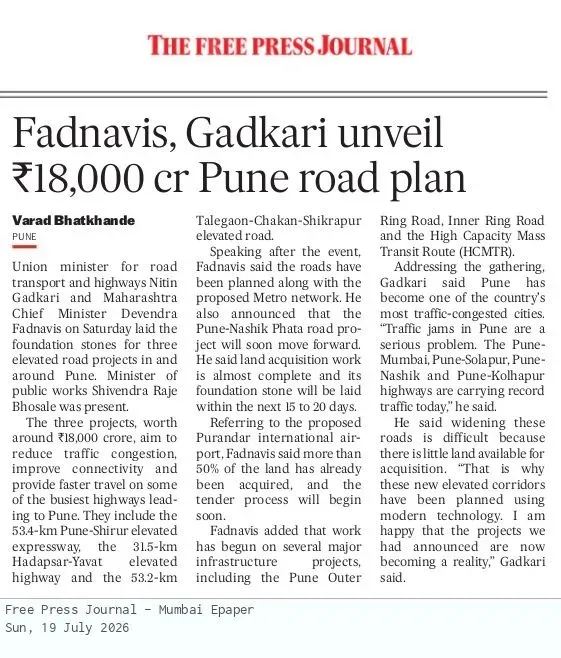
Chief Minister Devendra Fadnavis and Union Minister Nitin Gadkari jointly unveiled a ₹18,000 crore road infrastructure plan for Pune on 19 July 2026, signalling a major coordinated push by the Maharashtra government and the Union Ministry of Road Transport to address the city's chronic congestion.
Key Takeaways
CM Devendra Fadnavis and Union Minister Nitin Gadkari jointly unveiled the plan on 19 July 2026 .
The road infrastructure package for Pune is valued at ₹18,000 crore .
The plan builds on Pune Metropolitan Region Development Authority corridor proposals identified as far back as 2018–19 .
The announcement reflects the central-state collaboration model established under the Bharatmala Pariyojana framework launched in 2015 .
Key next steps include tender awards, land acquisition, and environmental clearances expected over the next 12–18 months .
Pune commuters, local contractors, and the city's IT and manufacturing sectors are the primary stakeholders.
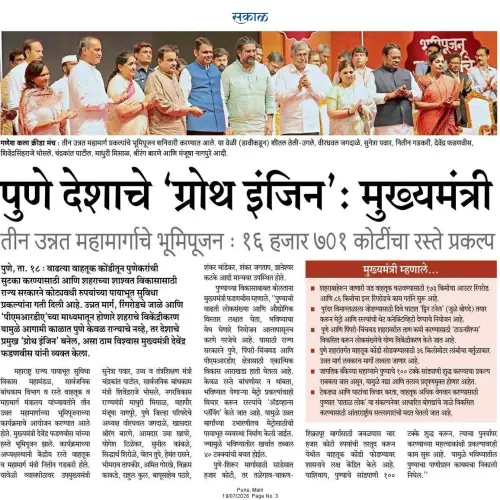
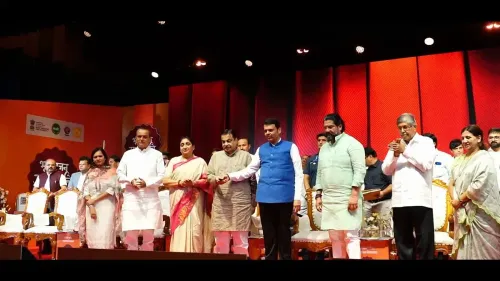
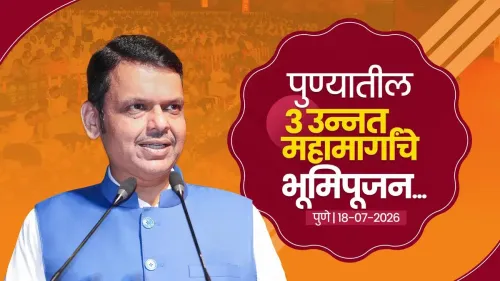
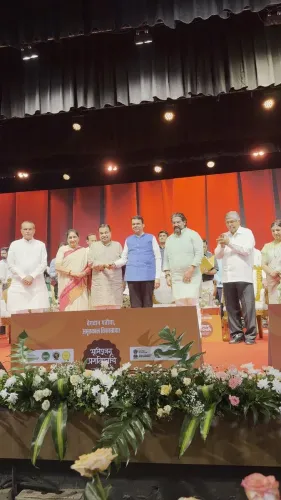
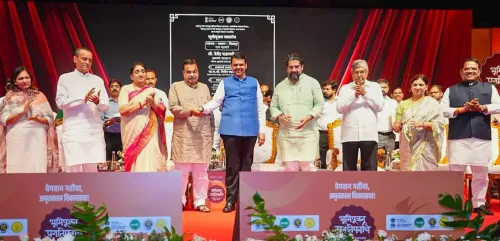
The Chief Minister's Office of Maharashtra announced on Sunday, 19 July 2026 that Chief Minister Devendra Fadnavis and Union Minister Nitin Gadkari jointly unveiled a road infrastructure plan for Pune valued at ₹18,000 crore, marking one of the largest single-city road investment announcements in the state's recent history.
Context
Pune, Maharashtra's second-largest city and a major hub for information technology and manufacturing, has long struggled with acute traffic congestion across its arterial corridors. The city's rapid economic expansion over the past two decades has consistently outpaced road infrastructure, making large-scale upgrades a recurring demand from residents, industry bodies, and urban planners alike.
The joint unveiling by CM Fadnavis and Union Minister Gadkari signals a coordinated push between the state government and the Union Ministry of Road Transport and Highways to address Pune's infrastructure deficit through a single consolidated plan rather than piecemeal project announcements.
Policy Backdrop
The announcement fits within a well-established framework of central-state collaboration on urban road networks. The Bharatmala Pariyojana, launched in 2015, created the structural basis for joint expressway and ring-road projects in Maharashtra, with Nitin Gadkari overseeing national highway expansion from the Union ministry since 2014.
Earlier plans drawn up by the Pune Metropolitan Region Development Authority (PMRDA) in 2018–19 had already identified multiple arterial road corridors requiring upgrades — corridors that are widely understood to form the backbone of current large-scale proposals. Devendra Fadnavis, across his tenures as Chief Minister, has consistently prioritised urban connectivity as a pillar of Maharashtra's development agenda.
Maharashtra has seen successive phases of road investment under both Bharatmala and state infrastructure programmes since 2014, reflecting a durable policy consensus that physical connectivity in western India's economic heartland is essential for sustaining growth and reducing logistics costs.
Stakeholders and Impact
The most immediate beneficiaries of a ₹18,000 crore road overhaul would be Pune's daily commuters, who navigate some of the most congested stretches in Maharashtra. Easing traffic flow is also expected to lower last-mile logistics costs for the city's large manufacturing and IT sectors, which depend on efficient movement of goods and workers.
Local contractors and the construction supply chain stand to gain significantly from a project of this scale, with tender awards likely to generate substantial employment in the region. Land acquisition processes and environmental clearances will, however, determine how quickly on-ground work can begin across the identified corridors.
What's Next
The immediate milestones to watch are the issuance of tenders, the pace of land acquisition, and the securing of environmental clearances for individual road corridors — processes that typically unfold over a 12–18 month window following a major announcement of this kind. Progress on these fronts will determine whether the ₹18,000 crore plan translates into visible construction activity within the near term.
For Pune, the scale of the commitment — backed by both the state's top executive and the Union minister who controls the national highways budget — suggests stronger institutional momentum behind delivery than previous standalone announcements. How the central and state agencies coordinate on funding disbursement and project execution will be closely watched by urban planners and citizens alike.
Point of View
Who has built his political identity around urban development, a ₹18,000 crore commitment to Pune — a city critical to the BJP's western Maharashtra electoral arithmetic — reinforces that identity ahead of any future electoral cycle. Gadkari's presence ties the plan to the national highways budget and Bharatmala's credibility, lending institutional heft that purely state-funded announcements often lack. The real test, as with all large urban road projects in India, will be execution speed on land acquisition and environmental clearances, where past Maharashtra plans have frequently stalled.
NationPress
20 Jul 2026
Frequently Asked Questions
What is the ₹18,000 crore Pune road plan announced by CM Fadnavis and Gadkari?
It is a large-scale road infrastructure package for Pune, Maharashtra's second-largest city, unveiled jointly by Chief Minister Devendra Fadnavis and Union Minister Nitin Gadkari on 19 July 2026 to address the city's severe traffic congestion.
Who announced the Pune road infrastructure plan in July 2026?
Chief Minister Devendra Fadnavis and Union Minister for Road Transport and Highways Nitin Gadkari jointly unveiled the plan, as announced by the Chief Minister's Office of Maharashtra.
How much money is being invested in Pune's road development?
The road plan carries an investment of ₹18,000 crore, making it one of the largest single-city road investment announcements in Maharashtra's recent history.
How does the Pune road plan connect to Bharatmala Pariyojana?
The Bharatmala Pariyojana, launched in 2015, established the central-state collaboration framework for expressway and ring-road projects in Maharashtra that underpins large-scale urban road investments such as this Pune plan.
When will construction on the Pune road project begin?
Tender awards, land acquisition, and environmental clearances are the immediate next steps and typically take 12–18 months after such an announcement before significant on-ground construction activity begins.