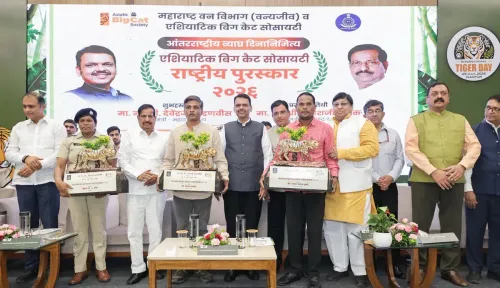
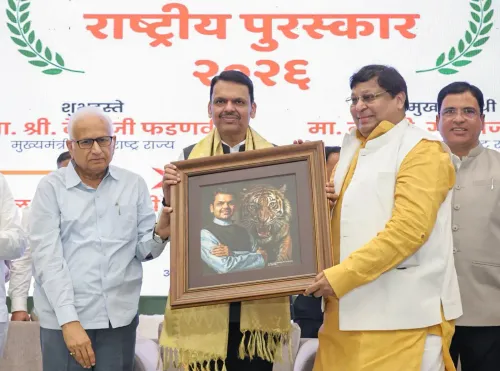
CM Fadnavis Launches AI Wildlife Monitoring Platform in Nagpur

Synopsis
Chief Minister Devendra Fadnavis inaugurated an AI-based Human-Wildlife Monitoring Platform by Marvel Company in Nagpur on International Tiger Day 2026, marking Maharashtra's push toward predictive technology in tiger conservation and human-wildlife conflict management.
Key Takeaways
Chief Minister Devendra Fadnavis inaugurated the AI-based Human-Wildlife Monitoring Platform in Nagpur on 29 July 2026 .
The platform was developed by Marvel Company and is designed to monitor human-wildlife interactions using artificial intelligence.
The launch was timed to International Tiger Day , an annual global observance held every 29 July.
Nagpur is the gateway to Maharashtra's key tiger reserves, including Tadoba-Andhari and Pench .
The initiative builds on India's conservation technology lineage from Project Tiger (1973) to the NTCA's M-STrIPES system.
Field deployment results and potential integration with national monitoring systems remain the key metrics to watch.
On International Tiger Day, 29 July 2026, Maharashtra took a significant step in wildlife conservation — Chief Minister Devendra Fadnavis inaugurated an AI-based Human-Wildlife Monitoring Platform developed by Marvel Company at a ceremony in Nagpur, the city that sits at the heart of India's central tiger landscape.
What the platform does — and why Nagpur
The platform is designed to monitor interactions between humans and wildlife in real time, using artificial intelligence to flag conflict zones and track movement patterns. Nagpur is no accidental choice: the city is the gateway to some of Maharashtra's most critical tiger reserves, including Tadoba-Andhari and Pench, where human-wildlife conflict has long been a pressure point for forest managers and border communities alike.
The Chief Minister's Office of Maharashtra announced the inauguration on X, tagging forest and wildlife officials alongside CM Fadnavis in a post that underscored the state's framing of the launch as a conservation milestone timed to the global observance.
From camera traps to predictive AI — Maharashtra's technology arc
India's tiger conservation infrastructure has evolved steadily since Project Tiger was launched in 1973. The National Tiger Conservation Authority introduced the M-STrIPES digital monitoring system in the 2010s, shifting field staff from paper-based records to structured data collection. The Marvel platform represents the next step on that arc — moving from reactive documentation to predictive, AI-driven surveillance.
Maharashtra's tiger reserves have been under sustained scrutiny from both state and central frameworks. Integrating an AI layer into that infrastructure signals a deliberate push toward predictive analytics: the system is meant to anticipate conflict before it turns fatal, for either the animal or the person.
The stakes for communities on the forest edge
For the forest officials, local communities, and wildlife conservationists who form the operational backbone of tiger conservation in Maharashtra, the platform's real test will come in the field. Camera traps and GPS collars have already improved situational awareness; AI-based monitoring promises to synthesise that data at a scale no patrol team can match manually.
Whether the platform integrates with national monitoring systems or remains a state-level tool is a question conservationists will watch closely — as will the communities living on the edges of forests who bear the daily cost of sharing territory with tigers.
Maharashtra has put AI on the tiger's side. The forest will deliver the verdict.
Point of View
Particularly as human-wildlife conflict around tiger reserves intensifies with expanding settlements. Timing the launch on International Tiger Day is a deliberate act of political branding — connecting a domestic tech deployment to a global conservation narrative. The real test will be whether the platform achieves genuine field integration or remains a ceremonial showcase. If the data feeds into national frameworks like M-STrIPES, it could set a replicable model for other tiger-range states.
NationPress
29 Jul 2026
Frequently Asked Questions
What is the AI-based Human-Wildlife Monitoring Platform launched in Nagpur?
It is an artificial intelligence platform developed by Marvel Company, inaugurated by Chief Minister Devendra Fadnavis in Nagpur on 29 July 2026, designed to monitor interactions between humans and wildlife and help manage conflict in tiger landscapes.
Why was the platform launched on International Tiger Day?
International Tiger Day is observed every 29 July to promote global tiger conservation awareness. Maharashtra timed the launch to align the state's conservation technology initiative with this global observance.
Which tiger reserves are near Nagpur that this platform could cover?
Nagpur is the gateway to Maharashtra's major tiger reserves, including Tadoba-Andhari Tiger Reserve and Pench Tiger Reserve, both of which experience significant human-wildlife conflict.
How does this AI platform differ from existing wildlife monitoring tools in India?
India already uses tools like the NTCA's M-STrIPES system for data-based tiger monitoring. The AI platform adds a predictive layer, aiming to anticipate and flag human-wildlife conflict zones in real time rather than only documenting incidents after they occur.
What is Project Tiger and how does this launch relate to it?
Project Tiger is India's national tiger conservation programme launched in 1973. The AI monitoring platform represents the latest technological evolution in that decades-long effort, moving from traditional patrolling toward AI-driven predictive analytics.