CM Fadnavis Pays Tribute to Gandhi on Jayanti 2026

Synopsis
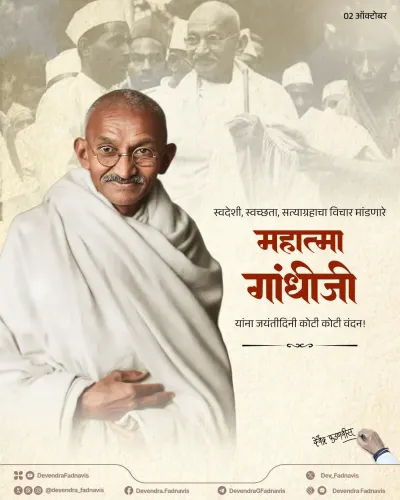
Maharashtra Chief Minister Devendra Fadnavis marked Gandhi Jayanti 2026 by saluting Mahatma Gandhi's four pillars — cleanliness, Satyagraha, Swadeshi, and self-reliance — calling them the bedrock of India's nation-building journey.
Key Takeaways
CM Devendra Fadnavis posted a bilingual tribute (English and Marathi) on Gandhi Jayanti, 2 October 2026 .
He highlighted Gandhi's four principles: Swachhata (cleanliness), Satyagraha , Swadeshi , and Swavalamban (self-reliance).
Gandhi Jayanti is also observed globally as the UN International Day of Non-Violence .
Gandhi's connection to Maharashtra includes the Quit India Movement launch at Gowalia Tank Maidan, Mumbai, in 1942 .
The CM's emphasis on Swadeshi and self-reliance resonates with the national 'Atmanirbhar Bharat' policy framework.
On the 156th birth anniversary of Mahatma Gandhi, Maharashtra Chief Minister Devendra Fadnavis paid tribute to the Father of the Nation on Friday, 2 October 2026, invoking Gandhi's four founding pillars — cleanliness, Satyagraha, Swadeshi, and self-reliance — as enduring guides for the republic he helped build.
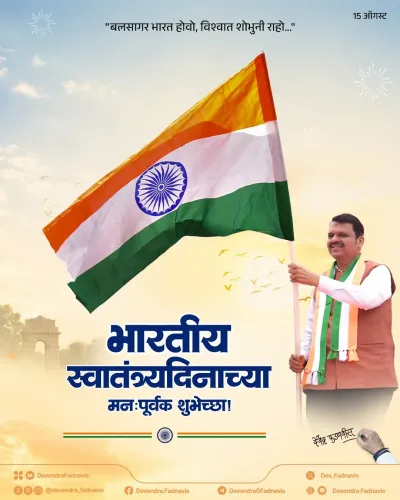
In his post, CM Fadnavis wrote in both English and Marathi, offering 'कोटी कोटी वंदन' (countless salutations) to Gandhi on the occasion of Gandhi Jayanti. He framed Gandhi's legacy not merely as a freedom struggle, but as a blueprint for nation-building — linking Swadeshi (self-sufficiency in goods), Swachhata (cleanliness), Satyagraha (non-violent resistance), and Swavalamban (self-reliance) as the four pillars that shaped modern India's founding conscience.
Gandhi Jayanti and its national resonance in 2026
Gandhi Jayanti, observed on 2 October every year, is a national holiday in India and is also recognised by the United Nations as the International Day of Non-Violence. The occasion draws tributes from political leaders across the spectrum — but the specific vocabulary a leader chooses reveals the lens through which they read Gandhi's legacy.
CM Fadnavis's framing is notable: by foregrounding Swadeshi and Swavalamban alongside non-violence, he echoes the current national discourse around economic self-sufficiency — themes that connect Gandhi's spinning wheel to present-day 'Atmanirbhar Bharat' ('self-reliant India') policy architecture. The choice is neither accidental nor new, but it is pointed.
Why a Maharashtra CM's words carry particular weight today
Gandhi's ties to Maharashtra run deep — from his formative associations with the state's social reform tradition to the iconic Dandi March, which drew inspiration from a broader western Indian mass movement. Mumbai, Maharashtra's capital and India's commercial heartbeat, hosted some of Gandhi's most consequential political moments, including the Quit India Movement launch at Gowalia Tank Maidan in 1942.
For a sitting Maharashtra CM to invoke cleanliness and self-reliance on Gandhi Jayanti is also a nod to two live policy fronts: urban sanitation drives in Maharashtra's cities and the state's push to boost local manufacturing. The tribute is ceremonial, but the language is calibrated.
On a day when India pauses to remember the man who led it to freedom with a spinning wheel and a salt march, CM Fadnavis's salutation asks a quiet but persistent question: how much of Gandhi's blueprint has the nation actually built?
Point of View
Invoking Gandhi's legacy carries particular historical weight given the state's central role in the freedom movement. The tribute, while ceremonial in form, is politically conscious in vocabulary — signalling continuity between Gandhi's economic nationalism and the ruling dispensation's self-reliance agenda. It is also a reminder that Gandhi's legacy remains fiercely contested real estate in Indian politics, with every party staking a claim on which facet of the Mahatma to amplify.
NationPress
2 Oct 2026
Frequently Asked Questions
Why is Gandhi Jayanti celebrated on 2 October?
Gandhi Jayanti is celebrated on 2 October every year because it marks the birth anniversary of Mahatma Gandhi , who was born on this date in 1869 . The day is a national holiday in India and is also observed as the International Day of Non-Violence by the United Nations.
What did CM Devendra Fadnavis say on Gandhi Jayanti 2026?
CM Fadnavis posted a bilingual tribute in English and Marathi, saluting Gandhi's four pillars — cleanliness, Satyagraha, Swadeshi, and self-reliance — and offered 'countless salutations' to the Mahatma on his birth anniversary.
What are Gandhi's four principles mentioned by Fadnavis?
CM Fadnavis cited Swachhata (cleanliness), Satyagraha (non-violent resistance), Swadeshi (promotion of indigenous goods and self-sufficiency), and Swavalamban (self-reliance) as Gandhi's core contributions to nation-building.
What is the connection between Mahatma Gandhi and Maharashtra?
Gandhi had deep ties to Maharashtra — the state's social reform tradition influenced his thinking, and he launched the Quit India Movement from Gowalia Tank Maidan in Mumbai on 8 August 1942 , making Maharashtra central to India's independence struggle.
What is 'Atmanirbhar Bharat' and how does it connect to Gandhi's Swadeshi?
'Atmanirbhar Bharat' is the Indian government's self-reliance initiative aimed at boosting domestic manufacturing and reducing import dependence. It draws philosophical inspiration from Gandhi's Swadeshi movement, which encouraged Indians to produce and consume locally made goods during the freedom struggle.