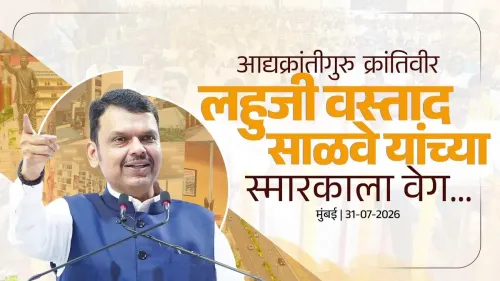
CM Fadnavis Pays Tribute to Lahuji Vastad Salve on Birth Anniversary
Synopsis
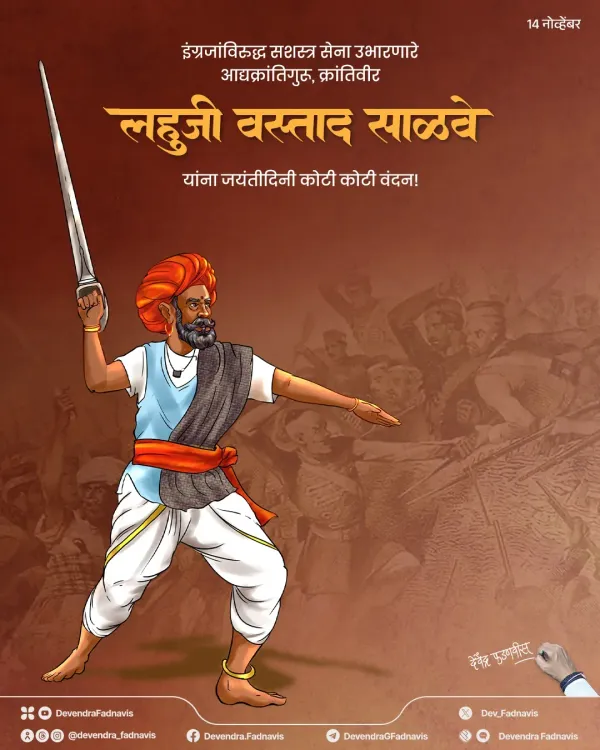
On his birth anniversary, Maharashtra CM Devendra Fadnavis honoured Lahuji Vastad Salve — the 19th-century revolutionary credited with raising armed resistance against British rule and championing social equality — in a bilingual tribute on 14 November 2026.
Key Takeaways
Maharashtra CM Devendra Fadnavis marked the birth anniversary of revolutionary Lahuji Vastad Salve on 14 November 2026 .
Salve is remembered as Adya Krantiveer — 'the first revolutionary' — for organising armed resistance against British colonial rule in 19th-century Maharashtra.
A trained wrestling master ( vastad ), Salve used his akhada as a centre for both physical training and ideological resistance among oppressed communities.
Fadnavis's tribute was posted in both English and Marathi , highlighting Salve's dual legacy of anti-colonialism and social equality.
Maharashtra chief ministers routinely commemorate such anniversaries, connecting contemporary leadership with the state's rich reformist and revolutionary heritage.
A 19th-century warrior, wrestling master, and anti-colonial organiser from Maharashtra received a heartfelt salute on Saturday, 14 November 2026, as Maharashtra Chief Minister Devendra Fadnavis marked the birth anniversary of Lahuji Vastad Salve — the man credited with raising an armed resistance against British rule long before India's formal independence movement took shape.
Fadnavis posted his tribute in both English and Marathi, writing: 'इंग्रजांविरुद्ध सशस्त्र सेना उभारणारे आद्यक्रांतिगुरू, क्रांतिवीर लहुजी वस्ताद साळवे यांना जयंतीदिनी कोटी कोटी वंदन!' — meaning, 'Crores of salutations on the birth anniversary of Lahuji Vastad Salve, the pioneering revolution-guru who raised an armed force against the British!' He called Salve a 'great revolutionary whose courage, sacrifice and commitment to social equality continue to inspire generations.'
Who Was Lahuji Vastad Salve?
Lahuji Vastad Salve was a 19th-century Maharashtra revolutionary and social reformer, widely remembered as one of the earliest organised voices against British colonial authority in the region. A master of the traditional wrestling tradition — vastad meaning a skilled trainer or master — he used his akhada (training ground) not merely as a sporting institution but as a space to build physical and ideological resistance among the oppressed communities he championed.
Salve is particularly celebrated for his work in promoting social equality alongside his anti-colonial activities, placing him at the intersection of two defining struggles of 19th-century Maharashtra. His legacy is closely tied to the broader egalitarian reform movements that defined the region's social fabric in that era. The title Adya Krantiveer — meaning 'the first revolutionary' — reflects the esteem in which Maharashtra's historical memory holds him.
Maharashtra's Tradition of Honouring Its Revolutionary Calendar
Fadnavis's tribute follows a well-established pattern among Maharashtra's chief ministers: publicly marking the birth anniversaries of the state's revolutionary and reformist figures. Maharashtra's historical calendar is dense with such figures — from social reformers to armed resisters — and each anniversary is an occasion for the state's leadership to publicly reaffirm continuity with that legacy.
For a ruling party keen to demonstrate its roots in Maharashtra's plural, reform-oriented social history, these commemorations carry both cultural and political weight. Salve's legacy, cutting across both anti-colonial resistance and social equality, makes him a figure whose anniversary draws acknowledgement across the political spectrum.
The revolutionary whose akhada once trained minds and bodies for resistance now lives on in the salutes of a state government — a reminder that Maharashtra's political identity remains deeply tethered to its 19th-century reformers.
Point of View
The ruling party signals an inclusive historical vision. These commemorations also serve as soft-power moments that reinforce the chief minister's cultural credibility ahead of Maharashtra's dense political calendar. The pattern reflects how Maharashtra's complex social history continues to be an active, contested resource in contemporary politics.
NationPress
14 Nov 2026
Frequently Asked Questions
Who was Lahuji Vastad Salve?
Lahuji Vastad Salve was a 19th-century Maharashtra revolutionary and social reformer, known for organising armed resistance against British colonial rule and championing social equality. He is honoured with the title Adya Krantiveer, meaning 'the first revolutionary.'
Why is Lahuji Vastad Salve called Adya Krantiveer?
He is called Adya Krantiveer — meaning 'the pioneer revolutionary' — because he is credited with being among the earliest figures in Maharashtra to organise armed resistance against British rule, predating the formal independence movement.
What did Devendra Fadnavis say about Lahuji Vastad Salve?
CM Fadnavis described Salve as a 'great revolutionary whose courage, sacrifice and commitment to social equality continue to inspire generations,' and offered crores of salutations in Marathi on his birth anniversary.
When is Lahuji Vastad Salve Jayanti celebrated?
Lahuji Vastad Salve's birth anniversary, known as Jayanti, falls on 14 November, as marked by Maharashtra's leadership including CM Devendra Fadnavis in 2026.
What was Lahuji Vastad Salve's connection to social reform?
Beyond his anti-colonial activities, Salve was a champion of social equality, working among oppressed communities in Maharashtra. His akhada — a traditional wrestling training ground — served as a centre for both physical resistance and social empowerment.