CM Fadnavis to Revamp Maharashtra Procurement Policy
Synopsis
Chief Minister Devendra Fadnavis has announced a revamp of Maharashtra's public procurement policy, building on the state's 2015 e-tendering reforms and aligning with national GeM integration efforts. The move affects vendors, MSME suppliers, and all state departments that award contracts.
Key Takeaways
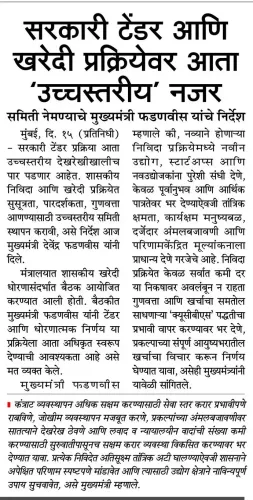
CM Devendra Fadnavis announced on 16 July 2026 that Maharashtra's public procurement policy will be revamped.
The announcement was made via the official Chief Minister's Office of Maharashtra account on X.
Maharashtra previously introduced a statewide e-tendering portal in 2015 under the first Fadnavis government to curb discretionary contract awards.
The revamp is expected to affect state departments, vendors, and MSME suppliers across Maharashtra.
Observers will watch for integration with the central government's Government e-Marketplace (GeM) portal as a key outcome of the reform.
Maharashtra's move mirrors procurement framework updates in states such as Karnataka and Gujarat .
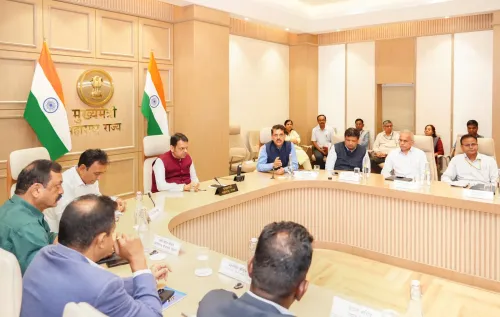
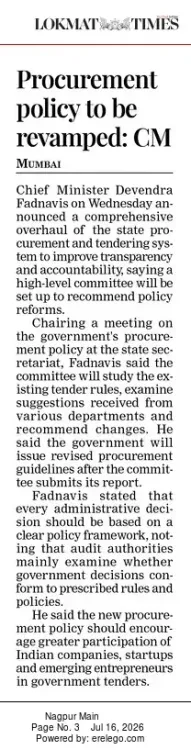
The Chief Minister's Office of Maharashtra announced on Thursday, 16 July 2026 that Chief Minister Devendra Fadnavis has declared plans to revamp the state's public procurement policy, signalling a significant overhaul of how the Maharashtra government awards tenders and contracts.
Context
The announcement, shared via the official CMO Maharashtra account, carries the direct attribution of CM Devendra Fadnavis, indicating that the initiative has top-level political ownership. Procurement reform has been a recurring theme in Maharashtra's governance agenda, touching everything from infrastructure contracts to supplies for social welfare schemes.
The revamp signals a fresh push to modernise the rules and processes that govern how the state spends public money on goods, services, and works — a domain that directly affects thousands of vendors, contractors, and government departments across the state.
Policy Backdrop
Maharashtra has a notable history of procurement reform. In 2015, the first Fadnavis government introduced a statewide e-tendering portal to replace manual tendering, reduce discretionary award of contracts, and improve transparency. That move was part of a broader national wave of digitising government procurement.
Since then, the central government's Government e-Marketplace (GeM) portal has become a major instrument for public procurement across India, and states have been encouraged to integrate their own frameworks with it. General Financial Rules revisions have also pushed states toward faster vendor payments and wider participation, particularly for MSME suppliers. Maharashtra's latest move mirrors similar policy updates undertaken by states such as Karnataka and Gujarat.
Stakeholders and Impact
The revamp, once formalised, would directly affect state government departments that initiate tenders, as well as the large ecosystem of vendors and MSME suppliers who participate in government contracts. Simpler rules, faster payment cycles, and reduced discretion in award decisions are among the outcomes that stakeholders in this space typically seek from such reforms.
For MSME suppliers in particular, procurement policy changes can determine whether smaller enterprises can practically compete for government business — a concern that has driven policy attention at both the state and central levels in recent years.
What's Next
The immediate focus will be on the release of a draft revised policy document, which will clarify the scope and timeline of the proposed changes. Observers will watch closely for any mandated integration with the GeM portal, new transparency requirements, or revised payment norms for contractors.
As Maharashtra is one of India's largest state economies, any significant shift in its procurement framework could serve as a template for other states and add momentum to the broader national agenda of making government purchasing more competitive and accountable.
Point of View
The Chief Minister's Office is also setting an accountability marker: stakeholders will now expect a concrete draft document. The timing aligns with the Centre's push to deepen GeM adoption across states, suggesting Maharashtra may be positioning itself to lead on compliance. How far the revamp goes on MSME access and payment timelines will determine whether it represents incremental tinkering or a structural shift.
NationPress
16 Jul 2026
Frequently Asked Questions
What is the Maharashtra procurement policy revamp announced by CM Fadnavis?
Chief Minister Devendra Fadnavis announced on 16 July 2026 that Maharashtra's public procurement policy will be overhauled. The revamp is expected to update the rules and processes governing how the state government awards tenders and contracts for goods, services, and works.
How does this affect MSME suppliers in Maharashtra?
MSME suppliers who bid for government contracts in Maharashtra could see changes in eligibility norms, payment timelines, and the tendering process itself. Procurement reforms in other states have generally aimed at making it easier for smaller enterprises to participate in government tenders.
What was Maharashtra's previous procurement reform?
In 2015, the Fadnavis government introduced a statewide e-tendering portal to replace manual tendering and reduce discretion in the award of government contracts, as part of a broader digitisation drive.
Will Maharashtra's procurement policy be linked to the GeM portal?
That has not been confirmed in the announcement, but integration with the central government's Government e-Marketplace portal is among the key developments observers are watching for, given the national push for states to align with GeM.
When will the revised Maharashtra procurement policy be released?
No specific date has been announced yet. The next step expected is the release of a draft revised policy document that will detail the scope, timeline, and specific changes proposed under the revamp.