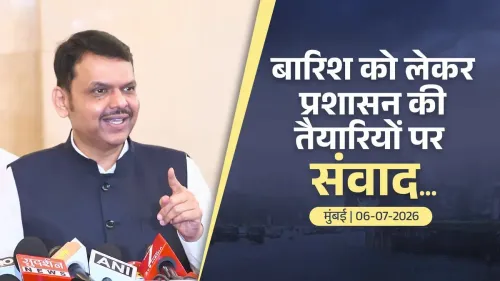
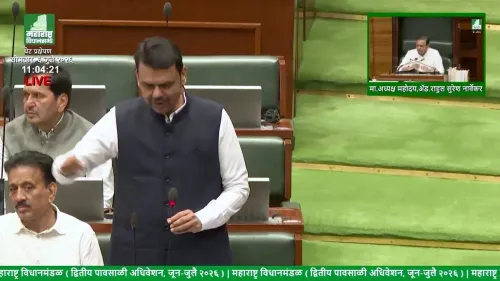
CM Fadnavis Unveils ₹13,000 Cr Flood Control Plan for Mumbai
Synopsis
Chief Minister Devendra Fadnavis has announced a ₹13,000 crore integrated flood control plan for Mumbai, aiming to protect the city's residents from recurring monsoon flooding. The announcement builds on decades of drainage reform efforts following the catastrophic 2005 Mumbai deluge.
Key Takeaways
The Chief Minister's Office of Maharashtra announced a ₹13,000 crore integrated flood control plan for Mumbai on 8 July 2026 .
Chief Minister Devendra Fadnavis is the driving force behind the plan, which is framed as a comprehensive, unified flood-management framework.
The announcement follows decades of incremental drainage investments, including the BRIMSTOWAD project initiated after the 2005 Mumbai deluge .
The plan aims to protect Mumbai's over 2 crore residents , particularly those in flood-prone low-lying zones.
Key next steps include phased rollout timelines, tendering, and coordination with central government ministries for funding.
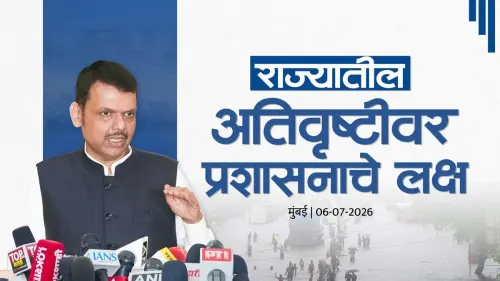
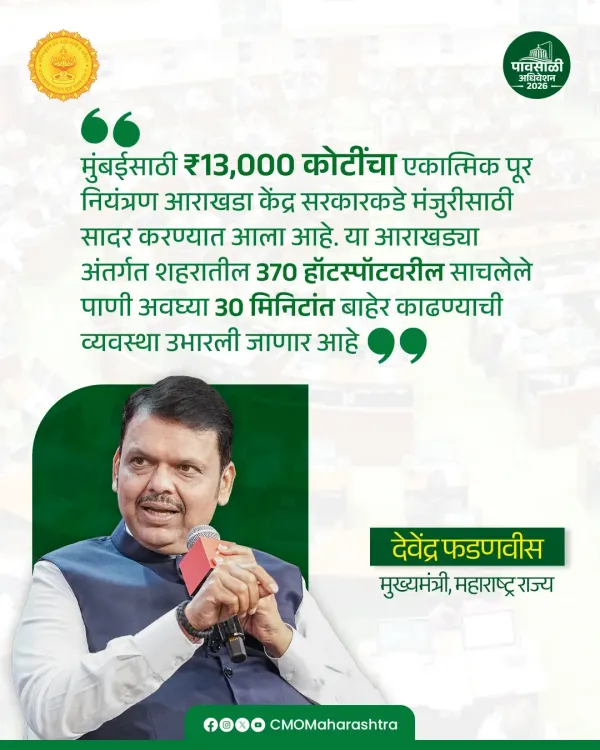
The Chief Minister's Office of Maharashtra announced on Wednesday, 8 July 2026 that Chief Minister Devendra Fadnavis has unveiled an integrated flood control plan worth ₹13,000 crore aimed at protecting the residents of Mumbai from recurring monsoon flooding.
The post, shared from the official CMO handle, read in Marathi: 'मुंबईकरांच्या सुरक्षिततेसाठी ₹13,000 कोटींचा एकात्मिक पूर नियंत्रण आराखडा!' — translating to 'An integrated flood control plan of ₹13,000 crore for the safety of Mumbaikars!'
Context
Mumbai, India's financial capital, has long battled catastrophic monsoon flooding that disrupts transport, damages property, and claims lives every year. The city's vulnerability was most starkly exposed during the 2005 Mumbai deluge, which caused widespread destruction and accelerated demand for systemic drainage reform.
That disaster gave rise to the Brihanmumbai Storm Water Drainage (BRIMSTOWAD) project, a multi-phase initiative to upgrade the city's drainage network. Despite successive investments, flooding remains a persistent challenge across low-lying neighbourhoods and arterial roads every monsoon season.
Policy Backdrop
Devendra Fadnavis, who has served multiple terms as Chief Minister of Maharashtra, has consistently prioritised urban infrastructure and disaster preparedness as pillars of his governance agenda. The new integrated plan is positioned as a comprehensive, single-framework response — moving beyond piecemeal drainage upgrades to a coordinated flood-control architecture for the city.
Across India, state governments have increasingly pursued large-scale urban flood-control schemes as part of broader climate-adaptation strategies, often combining state budget allocations with central assistance under national resilient-city frameworks. The ₹13,000 crore outlay, if confirmed through formal budget or tender documentation, would represent one of the most significant single flood-management commitments for any Indian city.
Stakeholders and Impact
The primary beneficiaries are Mumbai's estimated population of over 2 crore residents, particularly those in flood-prone zones such as low-lying suburbs and areas along nullahs and coastal stretches. Repeated flooding inflicts severe economic costs on the city — stalling commerce, damaging infrastructure, and straining emergency services.
The plan is also significant for the Brihanmumbai Municipal Corporation (BMC), which has historically borne the operational burden of flood response. An integrated framework at the state level could streamline coordination between civic, state, and central agencies involved in drainage, disaster management, and urban planning.
What's Next
Attention will now turn to the formal rollout of the plan — including phased timelines, tendering processes, and the breakdown of funding between state resources and central assistance. Coordination with central ministries responsible for urban development and disaster management will be a key variable in determining the pace of implementation.
With the 2026 monsoon already active, the announcement carries immediate political and practical weight. Whether the plan translates into on-ground relief for Mumbaikars this season or remains a longer-horizon commitment will be closely watched by civic groups, opposition parties, and residents alike.
Point of View
000 crore announcement is a politically calculated move by Chief Minister Fadnavis ahead of a monsoon season that perennially tests the Maharashtra government's credibility with urban voters. By framing the plan as 'integrated' — a single cohesive framework rather than another piecemeal project — the CMO is signalling a departure from the fragmented approach that has drawn criticism since the 2005 deluge. The scale of the outlay, if backed by concrete timelines and tendering, could set a national benchmark for state-led urban flood resilience. However, the gap between announcement and ground-level implementation has historically been wide in Mumbai's infrastructure story, and that gap will define how this initiative is ultimately judged.
NationPress
8 Jul 2026
Frequently Asked Questions
What is the ₹13,000 crore Mumbai flood control plan announced by CM Fadnavis?
It is an integrated flood control framework announced by Maharashtra Chief Minister Devendra Fadnavis on 8 July 2026, aimed at protecting Mumbai residents from recurring monsoon flooding through a comprehensive, coordinated approach to drainage and disaster management.
Why does Mumbai flood every monsoon season?
Mumbai's geography — low-lying coastal land, dense urban development, and an ageing drainage network — makes it highly vulnerable to flooding during heavy monsoon rainfall. The problem was most severely highlighted during the catastrophic 2005 deluge.
What is BRIMSTOWAD and how does it relate to this new plan?
BRIMSTOWAD (Brihanmumbai Storm Water Drainage) is a project launched after the 2005 Mumbai floods to upgrade the city's storm water drainage network. The new ₹13,000 crore integrated plan is the latest and largest step in Mumbai's ongoing flood-management efforts.
How will the ₹13,000 crore flood plan be funded?
The funding breakdown has not yet been detailed publicly. Large urban flood-control schemes in India typically combine state budget allocations with central government assistance under national resilient-city and disaster-management frameworks.
When will the Mumbai integrated flood control plan be implemented?
Formal phased timelines and tendering processes are yet to be announced. Coordination with central ministries will also be a key factor in determining the pace and schedule of implementation.