CM Rekha Gupta Launches ₹8,941 Cr Push to Clean Yamuna

Synopsis
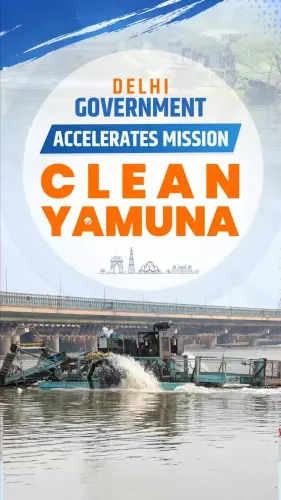
Delhi CM Rekha Gupta has announced 43 water and sewerage projects worth ₹8,941.22 crore to restore the Yamuna by intercepting untreated sewage, expanding treatment capacity, and building accessible riverfront spaces — the capital's largest such push in recent memory.
Key Takeaways
43 major water and sewerage projects are under execution by the Delhi Government to clean and restore the Yamuna.
Total outlay stands at ₹8,941.22 crore , placing this among the largest Yamuna-focused capital programmes in Delhi's history.
The three-track strategy targets sewage interception, treatment plant capacity , and public riverfront development simultaneously.
The Yamuna Action Plan dates to 1993 ; multiple earlier schemes failed to deliver sustained water quality improvement.
Oversight by the NGT and CPCB , alongside Delhi Jal Board data, will be the key measure of actual progress.
CM Rekha Gupta described the Yamuna as 'the lifeline of Delhi, a witness to our history and a promise to our future.'
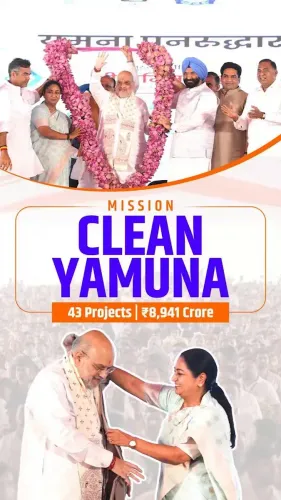
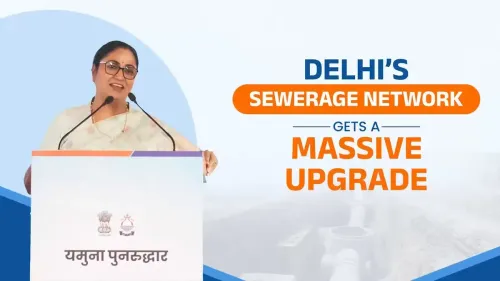
A river that has sustained Delhi for millennia is now at the centre of the capital's most ambitious infrastructure drive in years. Delhi Chief Minister Rekha Gupta announced on Friday, 23 October 2026 that the Delhi Government is executing 43 major water and sewerage projects worth ₹8,941.22 crore to restore the Yamuna — stopping untreated sewage at its source, expanding treatment capacity, and opening up the riverfront for ordinary Delhiites.
₹8,941 crore and 43 projects — what is actually being built
The CM framed the Yamuna not as a routine civic asset but as 'the lifeline of Delhi, a witness to our history and a promise to our future' — a conscious elevation of the river's status to galvanise public and administrative will. The three-pronged agenda is specific: intercept sewage before it reaches the river, strengthen sewage treatment plant (STP) infrastructure, and develop cleaner, accessible riverfront public spaces. The ₹8,941.22 crore price tag places this among the largest single-government capital outlays ever directed at the Yamuna in Delhi's history.
The core challenge is well-documented. Delhi's rapid urbanisation has for decades outpaced its sewage treatment capacity, with a significant share of the city's daily wastewater flowing untreated into the Yamuna. Every monsoon season, the river's condition deteriorates visibly — toxic foam, collapsed dissolved-oxygen levels, and fish kills have made the Yamuna a flashpoint for public outrage and judicial intervention alike.
Decades of plans, and why this one needs to be different
India's attempt to clean the Yamuna is not new. The Yamuna Action Plan Phase I was launched as far back as 1993 under the National River Conservation Plan, followed by Phase II and multiple STP augmentation schemes announced by successive Delhi governments between 2010 and 2023. Each round added capacity on paper; the river's water quality rarely reflected it. The National Green Tribunal (NGT) and the Central Pollution Control Board (CPCB) have repeatedly flagged non-compliance, turning the Yamuna into a symbol not just of ecological stress but of implementation failure.
What distinguishes the current announcement is the simultaneity of three tracks — interception, treatment, and public riverfront — rather than treating sewage infrastructure in isolation. Riverfront development, as seen in other Indian cities, has proven effective in building civic ownership of a cleaned waterway, making it harder for encroachments and illegal outflows to return once removed.
What Delhiites and watchdogs should track next
The credibility of this push will be tested quickly. The Delhi Jal Board and CPCB are the two bodies whose quarterly water quality data will tell the real story — not announcements, but dissolved-oxygen readings and biochemical oxygen demand figures at key monitoring points along the river inside Delhi. Environmental groups have long argued that project announcements must be tied to public, time-bound completion milestones for each of the 43 schemes.
CM Gupta closed with a direct appeal to the city: 'Together, let us return to Maa Yamuna the purity, respect and care she deserves.' The sentiment is widely shared across Delhi's political spectrum. Whether the infrastructure follows the intent is the only question that matters now.
Point of View
The CM is setting a measurable benchmark that courts, environmental regulators, and voters can hold her to. The riverfront-development component borrows from the Sabarmati and Gomti playbook, using public amenity as a force-multiplier for pollution abatement. The real test will come in the quarterly CPCB data: if dissolved-oxygen levels at Okhla do not improve within two monsoon cycles, the announcement risks joining a long list of well-funded Yamuna plans that dissolved into the river's own troubled history.
NationPress
23 Oct 2026
Frequently Asked Questions
What is Delhi's new Yamuna clean-up plan in 2026?
Delhi CM Rekha Gupta has announced 43 major water and sewerage projects worth ₹8,941.22 crore aimed at stopping untreated sewage from entering the Yamuna, expanding treatment infrastructure, and creating cleaner riverfront public spaces for Delhi residents.
How much money is the Delhi Government spending on Yamuna cleaning?
The Delhi Government is spending ₹8,941.22 crore across 43 water and sewerage projects focused on Yamuna restoration, making it one of the largest such outlays the capital has directed at the river.
Why is the Yamuna so polluted in Delhi?
Delhi's rapid urbanisation has long outpaced its sewage treatment capacity, causing a large share of the city's daily wastewater to enter the Yamuna untreated. This has caused toxic foam, low oxygen levels, and recurring fish kills, particularly during and after monsoon season.
What is the Yamuna Action Plan and has it worked?
The Yamuna Action Plan was launched in 1993 under India's National River Conservation Plan to intercept and treat sewage in Delhi. Multiple phases and additional schemes followed, but sustained improvement in the river's water quality has remained elusive, with the NGT and CPCB repeatedly flagging non-compliance.
Who monitors Yamuna water quality in Delhi?
The Central Pollution Control Board (CPCB) and the Delhi Jal Board are the primary bodies that monitor Yamuna water quality. Their quarterly dissolved-oxygen and biochemical oxygen demand readings at key points are the most reliable indicators of whether clean-up efforts are working.