CM Rekha Gupta Hails 500 KW Solar Plant at Dwarka Enclave

Synopsis
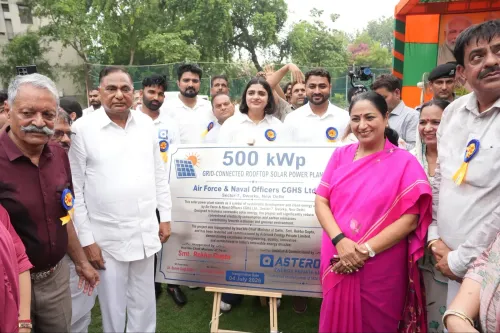
Delhi Chief Minister Rekha Gupta on 5 July 2026 hailed the inauguration of a 500 KW solar plant at the Air Force and Naval Officers Enclave in Dwarka, framing it as a milestone in building a greener, self-reliant Viksit Delhi under India's broader renewable energy push.
Key Takeaways
Delhi CM Rekha Gupta publicly welcomed the inauguration of a 500 KW solar plant at the Air Force and Naval Officers Enclave, Dwarka on 5 July 2026 .
The plant is located in Dwarka , a planned sub-city in southwest Delhi with high residential and institutional density.
The initiative aligns with Delhi's Solar Policy of 2016 , which offers subsidies and net-metering incentives for rooftop installations.
India's national target of 500 GW of non-fossil energy capacity by 2030 underpins state-level distributed solar efforts like this one.
CM Gupta linked the project to the Viksit Delhi vision, Delhi's adaptation of the national Viksit Bharat 2047 development goal.
Future focus areas include state budget allocations for solar subsidies and potential Delhi Assembly action on solar-ready building bye-laws.
Delhi Chief Minister Rekha Gupta on Sunday, 5 July 2026, welcomed the inauguration of a 500 KW solar plant at the Air Force and Naval Officers Enclave in Dwarka, calling it a sign of residential communities embracing clean energy as part of everyday life. The Chief Minister framed the installation as a step toward a greener, more self-reliant, and Viksit Delhi — Delhi's adaptation of the national Viksit Bharat vision for a developed India by 2047.
Context
In her post, CM Gupta described the development as 'encouraging,' saying the inauguration 'reflects the growing resolve to build a greener, more self-reliant and Viksit Delhi.' The Air Force and Naval Officers Enclave in Dwarka is a residential colony housing defence personnel in southwest Delhi — a planned sub-city known for its institutional and residential density. A solar plant of this scale at a defence residential enclave signals a shift in how large housing societies in the capital are approaching energy self-sufficiency.
Policy Backdrop
India's push for decentralised solar has deep policy roots. The Jawaharlal Nehru National Solar Mission, launched in 2010, set the framework for grid-connected and off-grid solar expansion across the country. Delhi followed with its own Solar Policy in 2016, which introduced subsidies and net-metering incentives specifically for residential and institutional rooftop installations.
These efforts feed into India's broader Panchamrit climate commitments made at COP26, which include reaching 500 GW of non-fossil energy capacity by 2030. Distributed solar projects in housing societies and government premises — like the one at Dwarka — are part of a decentralised strategy designed to reduce peak demand on the grid and cut transmission losses in dense urban areas.
Stakeholders and Impact
The primary beneficiaries are the defence personnel and their families residing at the enclave, who stand to see reduced electricity costs through net-metering arrangements. More broadly, Delhi's residential communities — from cooperative housing societies to large gated enclaves — are being positioned as active participants in the city's renewable energy transition, not merely consumers of centrally generated power.
The project also carries symbolic weight: defence establishments adopting rooftop solar sends a signal to private housing societies across the capital. If large, well-organised residential communities demonstrate the viability of such installations, it could accelerate uptake in sectors where adoption has been slower.
What's Next
Attention will now turn to Delhi's state budget allocations for solar subsidies in the coming fiscal year, as well as any legislative movement in the Delhi Assembly on amending building bye-laws to mandate solar-ready rooftop infrastructure for new constructions. CM Gupta's public endorsement of community-level solar projects suggests the administration may look to scale such installations across more residential and institutional campuses in the capital, keeping Viksit Delhi as the overarching policy anchor.
Point of View
The move carries both policy and optics value: it signals institutional credibility while nudging private housing societies toward adoption. The gesture fits a broader pattern of state governments using high-visibility, small-scale solar inaugurations to demonstrate green intent ahead of budget cycles. Whether this translates into structural policy shifts — such as mandatory solar-ready rooftops in building bye-laws — will be the real test of the administration's commitment beyond symbolism.
NationPress
4 Oct 2026
Frequently Asked Questions
What is the 500 KW solar plant inaugurated in Dwarka, Delhi?
It is a rooftop or campus-scale solar power installation at the Air Force and Naval Officers Enclave in Dwarka, southwest Delhi, welcomed by Chief Minister Rekha Gupta on 5 July 2026 as part of Delhi's green energy push.
What is Viksit Delhi that CM Rekha Gupta mentioned?
Viksit Delhi is Delhi's state-level adaptation of the national Viksit Bharat vision, which aims for a developed, self-reliant India by 2047, with sustainability and green infrastructure as key pillars.
What is Delhi's Solar Policy and how does it help residents?
Delhi notified its Solar Policy in 2016, offering subsidies and net-metering incentives that allow residential and institutional rooftop solar users to feed surplus electricity back to the grid and reduce their bills.
How does this Dwarka solar plant fit India's national renewable energy targets?
India has committed to achieving 500 GW of non-fossil energy capacity by 2030 under its Panchamrit climate goals. Distributed solar projects in urban residential and institutional complexes contribute to this decentralised national push.
Who benefits from the solar plant at the Air Force and Naval Officers Enclave?
Defence personnel and their families residing in the enclave are the direct beneficiaries, with potential savings on electricity costs through net-metering, while the broader Delhi public gains from reduced peak grid demand.