CM Rekha Gupta Boosts Delhi Environment Budget to ₹822 Cr

Synopsis
Delhi Chief Minister Rekha Gupta has announced a hike in the capital's environment budget from ₹505 crore to ₹822 crore and a target to plant over 35 lakh native-species trees over four years, framing the drive as essential to public health and the future of Delhi's residents.
Key Takeaways
Delhi's environment budget has been raised from ₹505 crore to ₹822 crore , an increase of roughly ₹317 crore .
More than 35 lakh native-species trees will be planted over the next four years .
Chief Minister Rekha Gupta linked the initiative directly to public health and intergenerational wellbeing.
The drive aligns with India's Green India Mission framework for urban native-species afforestation.
Sapling survival rates and ward-wise targets will be critical indicators of on-ground impact.
The announcement continues a decade-long pattern of green-cover expansion efforts by Delhi governments to counter chronic air pollution.
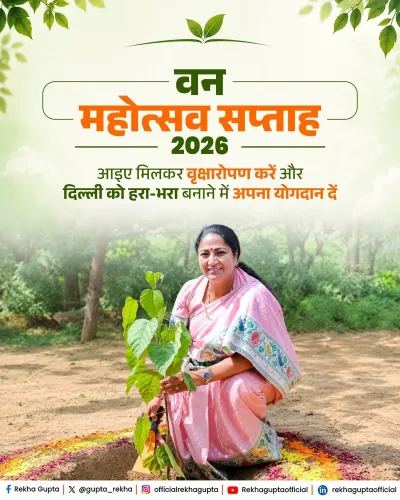
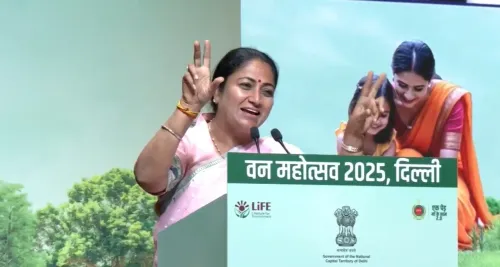
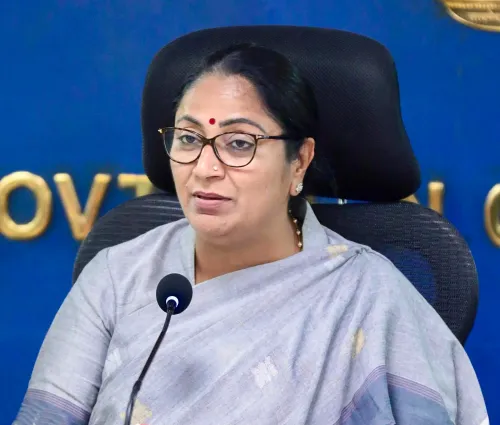
Delhi Chief Minister Rekha Gupta announced on Friday, 29 May 2026 that the Delhi government has raised its environment budget from ₹505 crore to ₹822 crore, with a pledge to plant more than 35 lakh native-species trees over the next four years as part of a sustained green-cover drive for the capital.
Context
Posting under the hashtag #GreenDelhi, the Chief Minister wrote: 'हरियाली केवल पर्यावरण नहीं, बल्कि दिल्लीवासियों के बेहतर स्वास्थ्य और आने वाली पीढ़ियों के सुरक्षित भविष्य का आधार है' — 'Greenery is not merely the environment, but the foundation of better health for Delhi's residents and a secure future for coming generations.' The post frames the budget hike and plantation target as a long-term public-health commitment rather than a routine administrative measure.
The announcement reflects a wider concern about Delhi's chronic air-quality and urban heat-island challenges, which have made green-cover expansion a recurring priority for successive city administrations. The Chief Minister added that 'our campaign for more greenery, more green spaces and a clean, healthy Delhi continues without pause.'
Policy Backdrop
Delhi governments have run annual tree-plantation drives and incremental environment budget allocations for over a decade, responding to the capital's position as one of the world's most polluted megacities. The shift to planting native species specifically aligns with scientific consensus that indigenous trees survive better in local soil and climate conditions and provide superior ecological services compared with exotic varieties.
At the national level, India's Green India Mission, launched in 2014, has channelled funds toward native-species afforestation in urban areas including Delhi, providing a complementary policy framework. The current administration's decision to nearly double the environment budget — a jump of roughly ₹317 crore — signals an intent to accelerate implementation beyond what earlier annual drives achieved.
Stakeholders and Impact
The primary beneficiaries are Delhi's estimated 3.3 crore residents, who face elevated risks from particulate-matter pollution and summer heat spikes. Urban environmental groups have long advocated for higher green-cover targets and the use of native species, making this announcement broadly aligned with civil-society demands.
The 35 lakh-plus tree target, spread over four years, would also generate sustained employment in nursery management, plantation logistics, and post-planting maintenance. Survival rates of saplings — a persistent weak point in large-scale urban plantation drives across Indian cities — will be a key metric for evaluating actual impact.
What's Next
Attention will now turn to implementation: whether the Delhi government releases a detailed plantation calendar, species list, and ward-wise targets. Urban forestry experts and civil-society groups are likely to track sapling survival data and green-cover satellite imagery as independent benchmarks.
Any mid-term revision to the ₹822 crore environment allocation in upcoming Delhi Assembly sessions will be watched closely, as budget announcements in the past have sometimes been subject to reappropriation. The initiative's success could also inform similar green-budget scaling efforts in other Indian state capitals grappling with comparable air-quality pressures.
Point of View
Chief Minister Rekha Gupta is making green infrastructure a flagship governance signal for the BJP's first full term running Delhi's administration. The explicit focus on native species and a four-year plantation timeline suggests the government is trying to move beyond the optics of one-off drives toward a measurable, multi-year commitment. Framing the initiative in public-health terms — rather than purely environmental ones — broadens its political appeal to urban voters increasingly anxious about air quality. The real test, as with every large-scale urban plantation programme in India, will be whether sapling survival data backs up the headline numbers when scrutinised mid-term.
NationPress
20 Sept 2026
Frequently Asked Questions
What is Delhi's new environment budget for 2026?
Delhi Chief Minister Rekha Gupta announced that the environment budget has been raised to ₹822 crore , up from the previous ₹505 crore .
How many trees will Delhi plant under the new green initiative?
The Delhi government has set a target of planting more than 35 lakh native-species trees over the next four years under the #GreenDelhi campaign.
Why is Delhi focusing on native species for tree plantation?
Native or indigenous tree species are better adapted to local soil and climate, have higher survival rates, and provide stronger ecological benefits — including air purification and shade — compared with exotic varieties.
What is the Green India Mission and how does it relate to Delhi's drive?
India's Green India Mission , launched in 2014 , funds native-species afforestation in urban areas including Delhi, complementing state-level initiatives like the one announced by Chief Minister Rekha Gupta.
How will the success of Delhi's tree plantation drive be measured?
Key indicators will include sapling survival rates, ward-wise planting progress, satellite-based green-cover data, and any mid-term budget revisions in upcoming Delhi Assembly sessions.