CM Rekha Gupta: Modi's tri-force has pushed Naxalism to last breaths

Synopsis
Delhi Chief Minister Rekha Gupta on 24 June 2026 credited PM Narendra Modi with a decisive blow against Naxalism, citing a tri-force of security, development and public trust under the SAMADHAN doctrine that has steadily reduced Maoist-affected districts across India.
Key Takeaways
Delhi CM Rekha Gupta posted on 24 June 2026 crediting PM Modi with pushing Naxalism to its 'last breaths' in India.
She described a tri-force of security, development and public trust as the decisive instrument against Left Wing Extremism.
The NDA government formalised this three-pillar approach after 2014 under the SAMADHAN doctrine , replacing the earlier Operation Green Hunt framework.
Chhattisgarh remains the state with the highest historical concentration of Maoist-affected districts and the primary theatre of operations.
Official data show a steady reduction in most-affected districts over the past decade, though specific post-2023 operational statistics remain unverified.
The Ministry of Home Affairs annual internal security report and any updated list of LWE-free districts will serve as the next key benchmarks.
Delhi Chief Minister Rekha Gupta on Wednesday, 24 June 2026 credited Prime Minister Narendra Modi with delivering what she called a decisive blow against Naxalism, arguing that a combination of security, development and public trust has brought Left Wing Extremism to its final stage in India.
Context
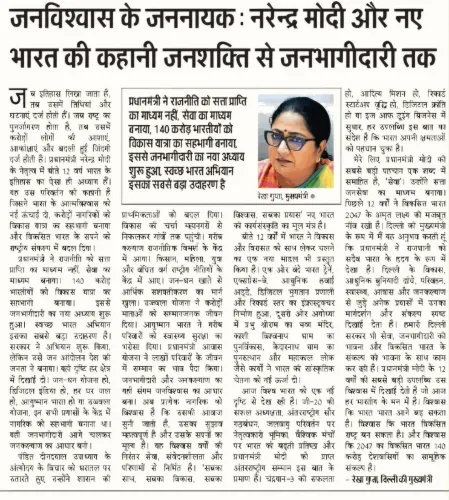
Posting in Hindi on X, CM Gupta wrote that PM Modi had struck at Naxalism with a 'त्रिशक्ति' (tri-force) of security, development and public trust. She described the moment as the victory of an idea: 'where there was once terror, talent will get opportunity; where there was once fear, the future will smile; and where there was once the shadow of violence, new dreams will take shape.' The post was accompanied by a video.
The remarks reflect a broader BJP narrative that the Modi government's integrated approach since 2014 has fundamentally altered the trajectory of Left Wing Extremism — a challenge that has persisted in India's forested hinterland for more than five decades.
Policy Backdrop
Successive Indian governments have treated Left Wing Extremism as both a security and a developmental challenge. The UPA government launched Operation Green Hunt in 2009, a coordinated security offensive spanning multiple Naxal-affected states. After 2014, the NDA government reoriented the approach around three pillars — security operations, infrastructure investment and community outreach — later formalised under the SAMADHAN doctrine.
The doctrine couples area-domination operations by central paramilitary forces with road-building, school construction and mobile-tower projects in remote forested districts. Chhattisgarh, which has historically recorded the highest concentration of Maoist-affected districts, has been the principal theatre for both security operations and development schemes. Official data have shown a steady reduction in the number of most-affected districts over the past decade, though the pace and depth of that reduction remain subjects of policy debate.
The same integrated template has been applied in other internal conflict zones, including Jammu and Kashmir and the Northeast, signalling a consistent doctrine across India's internal security landscape.
Stakeholders and Impact
Tribal communities in Naxal-affected districts stand at the centre of this policy contest — historically caught between Maoist coercion and state authority, they are the primary intended beneficiaries of development outreach. Central paramilitary forces, including the CRPF and specialised units, bear the operational burden on the security side.
State governments in Chhattisgarh, Jharkhand, Odisha, Telangana and Maharashtra coordinate with the Ministry of Home Affairs on both counter-insurgency operations and district-level development spending. The political dimension is equally significant: framing Naxalism's decline as a governance achievement allows the ruling party to point to tangible internal-security progress ahead of state and national electoral cycles.
What's Next
The Ministry of Home Affairs annual report on internal security is expected to provide updated data on violence incidents and the number of districts still classified as Left Wing Extremism-affected. Any fresh list of districts formally declared free of Naxal influence in the coming parliamentary session will be closely watched as a benchmark for the government's claims.
If the trend of shrinking Maoist geography continues, pressure will grow on the administration to accelerate the 'post-conflict' development phase — ensuring that reclaimed areas receive sustained investment so that the conditions that historically fed recruitment into Naxal ranks do not re-emerge.
Point of View
She echoes the SAMADHAN doctrine's language, signalling coordinated messaging rather than spontaneous commentary. The timing, well ahead of any scheduled state election in the major Naxal-belt states, suggests the party is building an advance record on internal security. The rhetorical pivot from 'terror to talent' and 'fear to future' also mirrors the template used in BJP communication around Jammu and Kashmir, indicating a transferable political playbook for conflict-resolution narratives.
NationPress
23 Sept 2026
Frequently Asked Questions
What did Delhi CM Rekha Gupta say about Naxalism?
On 24 June 2026, Delhi CM Rekha Gupta posted on X saying that PM Narendra Modi has used a tri-force of security, development and public trust to deliver a decisive blow against Naxalism, and that the movement is now in its 'last breaths' in India.
What is the SAMADHAN doctrine against Naxalism?
SAMADHAN is the NDA government's formalised counter-Naxal framework introduced after 2014, combining area-domination security operations, infrastructure development such as roads and schools, and community outreach to build public trust in Maoist-affected districts.
Which state has the most Naxal-affected districts in India?
Chhattisgarh has historically recorded the highest concentration of Maoist-affected districts and has been the principal theatre for both security operations and development schemes under the central government's anti-Naxal policy.
What was Operation Green Hunt?
Operation Green Hunt was a coordinated security offensive launched in 2009 by the UPA government across multiple Naxal-affected states; the NDA government later replaced this approach with the broader SAMADHAN doctrine after 2014.
How has the number of Naxal-affected districts changed in India?
Official data show a steady reduction in the number of most-affected districts over the past decade, though specific post-2023 operational statistics have not been independently verified; the Ministry of Home Affairs annual report is the key source for updated figures.